
解读信号调节蛋白α在实体瘤免疫治疗中的作用。
Deciphering the role of signal regulatory protein α in immunotherapy for solid tumors.
作者信息
Zhou Yulong, Tang Xiyang, Du Weiguang, Shu Chen, Yan Xiaolong, Ma Nan, Zhao Jinbo
机构信息
Department of Thoracic Surgery, Tangdu Hospital, The Fourth Military Medical University, Xi'an, Shaanxi, China.
Department of Cardiothoracic Surgery, The 902nd Hospital of the Chinese People's Liberation Army Joint Logistic Support Force, Bengbu, Anhui, China.
出版信息
Front Immunol. 2025 Jun 16;16:1612234. doi: 10.3389/fimmu.2025.1612234. eCollection 2025.
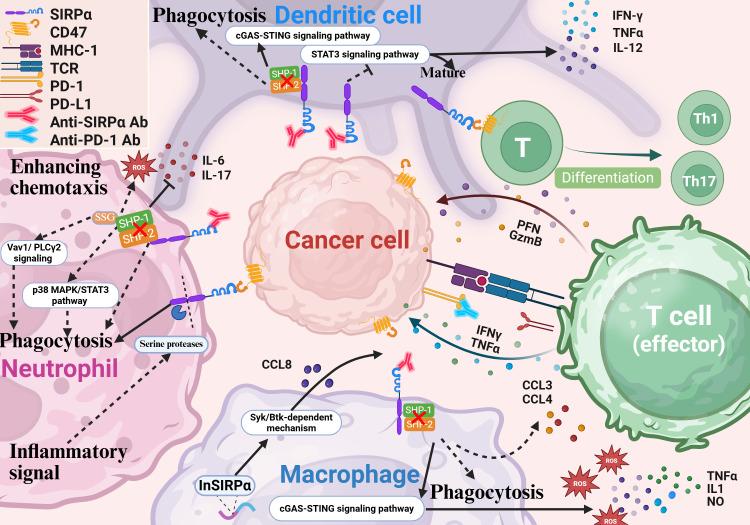
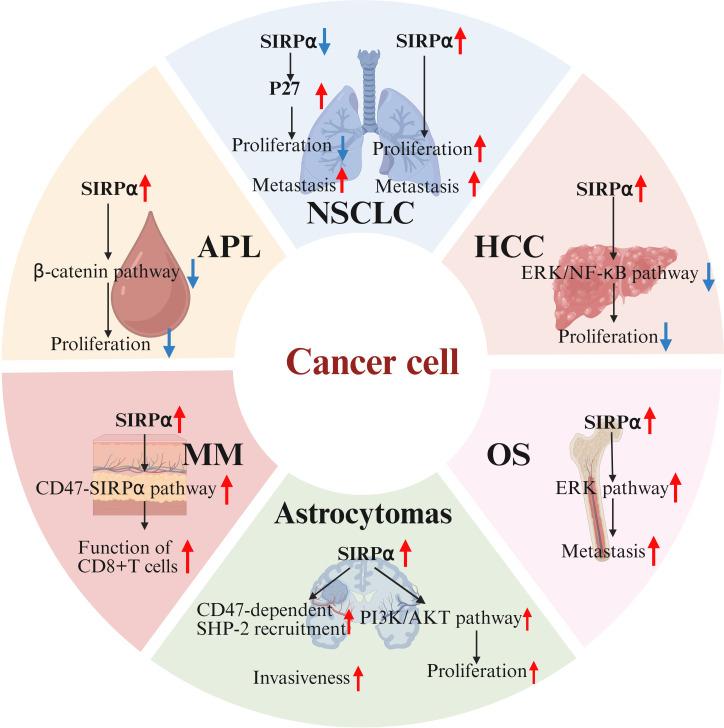
Therapies targeting immune checkpoints like programmed death receptor-1 and programmed death ligand-1 have demonstrated remarkable effectiveness in combating cancer. However, a subset of patients fails to respond to these therapies, underscoring the complexity of tumor immune evasion mechanisms. Exploring innovative immune regulatory targets represents a crucial research priority in this field. Signal regulatory protein α (SIRPα) is an immunosuppressive receptor expressed on myeloid cells that inhibits innate immunity through its interaction with the ligand integrin-associated protein (CD47). Blocking the SIRPα-CD47 axis can enhance myeloid cell-mediated anti-tumor responses and stimulate adaptive immunity, thereby synergizing with therapeutic antibodies and T-cell checkpoint inhibitors. Additionally, tumor-intrinsic SIRPα may facilitate tumor growth and immune evasion. This paper aims to elucidate the mechanisms of SIRPα activity in various cell types, review the advancements in SIRPα-targeted tumor therapies, and highlight the potential research value of tumor-expressed endogenous SIRPα.
针对程序性死亡受体-1和程序性死亡配体-1等免疫检查点的疗法在对抗癌症方面已显示出显著效果。然而,一部分患者对这些疗法没有反应,这凸显了肿瘤免疫逃逸机制的复杂性。探索创新的免疫调节靶点是该领域至关重要的研究重点。信号调节蛋白α(SIRPα)是一种在髓样细胞上表达的免疫抑制受体,它通过与配体整合素相关蛋白(CD47)相互作用来抑制先天免疫。阻断SIRPα-CD47轴可增强髓样细胞介导的抗肿瘤反应并刺激适应性免疫,从而与治疗性抗体和T细胞检查点抑制剂协同作用。此外,肿瘤内在的SIRPα可能促进肿瘤生长和免疫逃逸。本文旨在阐明SIRPα在各种细胞类型中的活性机制,综述靶向SIRPα的肿瘤治疗进展,并强调肿瘤表达的内源性SIRPα的潜在研究价值。


 Zotero 插件