
2016 - 2018年南非1岁以下因呼吸道和非呼吸道疾病住院婴儿中流感、呼吸道合胞病毒及其他呼吸道病原体的病因分数
Aetiological Fraction of Influenza, Respiratory Syncytial Virus and Other Respiratory Pathogens in Infants Aged < 1 Year Hospitalised With Respiratory and Non-Respiratory Medical Illness in South Africa, 2016-2018.
作者信息
Wolter Nicole, Cohen Cheryl, von Gottberg Anne, Tempia Stefano, Moyes Jocelyn, von Mollendorf Claire, Treurnicht Florette K, Hellferscee Orienka, Subramoney Kathleen, Moleleki Malefu, Reddy Cayla, Maake Lorens, Makhasi Mvuyo, Baute Neydis, Walaza Sibongile
机构信息
Centre for Respiratory Diseases and Meningitis, National Institute for Communicable Diseases of the National Health Laboratory Service, Johannesburg, South Africa.
School of Pathology, Faculty of Health Sciences, University of the Witwatersrand, Johannesburg, South Africa.
出版信息
Influenza Other Respir Viruses. 2025 Jul;19(7):e70135. doi: 10.1111/irv.70135.
BACKGROUND
Understanding the contribution of pathogens to respiratory illness in infants is important to guide interventions. We assessed the aetiology of respiratory pathogens among infants hospitalised with respiratory and non-respiratory illness.
METHODS
We conducted an unmatched case-control study among infants aged < 1 year. Cases were admitted with acute respiratory and non-respiratory illness in November 2016-October 2018. Controls were infants presenting for immunisation with no reported illness. Nasopharyngeal aspirates and blood were tested using multi-pathogen real-time PCR. Aetiological fraction (AF) was calculated using logistic regression, adjusting for HIV, age, season and pathogens with higher prevalence in cases than controls. Factors associated with respiratory illness hospitalisation were assessed using logistic regression.
RESULTS
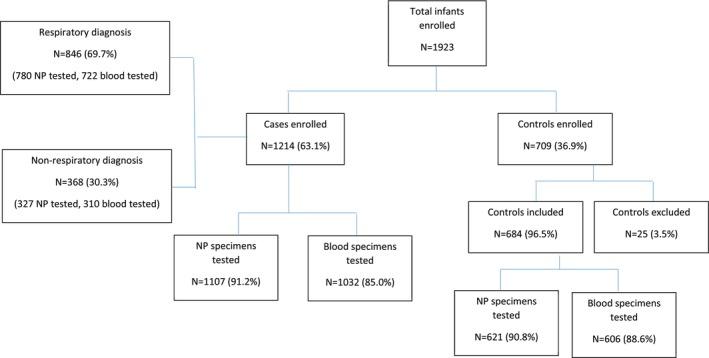
Overall, 1214 cases (846 respiratory, 368 non-respiratory) and 684 controls were included. Respiratory syncytial virus (RSV) (AF 94.0%), influenza (AF 72.6%) and human metapneumovirus (HMPV) (AF 74.9%) were significantly attributable to respiratory illness hospitalisation. Klebsiella pneumoniae had significant AF in both respiratory (AF 48.0%) and non-respiratory (AF 60.7%) hospitalisation. HIV exposure (adjusted odds ratio [aOR] 1.5, 95% confidence interval [CI] 1.1-2.0) and living with HIV (aOR 6.6, 95%CI 2.1-20.5), underlying illness (aOR 4.8, 95%CI 1.3-17.6), malnutrition (aOR 6.0, 95%CI 4.0-8.9), infection with RSV (aOR 19.7, 95%CI 11.4-34.1), influenza (aOR 5.7, 95%CI 2.3-14.1) or HMPV (aOR 4.1, 95%CI 2.0-8.6) were associated with respiratory illness hospitalisation.
CONCLUSIONS
Maternal immunisation to prevent severe RSV and influenza illness in infants should be prioritised. In addition, improved infant nutrition and the prevention of HIV-infection and HIV-exposure could reduce the high burden of severe respiratory illness.
背景
了解病原体对婴儿呼吸道疾病的影响对于指导干预措施很重要。我们评估了因呼吸道疾病和非呼吸道疾病住院的婴儿中呼吸道病原体的病因。
方法
我们在1岁以下婴儿中进行了一项非匹配病例对照研究。病例为2016年11月至2018年10月因急性呼吸道疾病和非呼吸道疾病入院的婴儿。对照为前来接种疫苗且无疾病报告的婴儿。使用多病原体实时PCR检测鼻咽抽吸物和血液。使用逻辑回归计算病因分数(AF),并对HIV、年龄、季节以及病例中患病率高于对照的病原体进行调整。使用逻辑回归评估与呼吸道疾病住院相关的因素。
结果
共纳入1214例病例(846例呼吸道疾病,368例非呼吸道疾病)和684例对照。呼吸道合胞病毒(RSV)(AF 94.0%)、流感(AF 72.6%)和人偏肺病毒(HMPV)(AF 7

 Zotero 插件