
生酮饮食、限时进食或隔日禁食对肥胖成年人减肥的影响:一项随机临床试验。
Effect of a ketogenic diet, time-restricted eating, or alternate-day fasting on weight loss in adults with obesity: a randomized clinical trial.
作者信息
Martínez-Montoro José Ignacio, Bandera Borja, Gutiérrez-Bedmar Mario, Gómez-Pérez Ana María, Macías-González Manuel, Moreno-Indias Isabel, Tinahones Francisco J
机构信息
Department of Endocrinology and Nutrition, Virgen de la Victoria University Hospital, Málaga, Spain.
Instituto de Investigación Biomédica de Málaga y Plataforma en Nanomedicina-IBIMA Plataforma BIONAND, Málaga, Spain.
出版信息
BMC Med. 2025 Jul 1;23(1):368. doi: 10.1186/s12916-025-04182-z.
BACKGROUND
Studies evaluating the effects of novel, alternative dietary approaches for weight loss compared with the Mediterranean diet (MedDiet) are lacking. We aimed to evaluate the effects of diets with varying ketogenic potential, i.e., a very-low carbohydrate diet (ketogenic diet, KD), time-restricted eating (TRE), and modified alternate-day fasting (mADF) on weight loss in obesity, compared with a MedDiet.
METHODS
Three-month, parallel-arm, randomized clinical trial including 160 adults with obesity. Participants were randomized to 1 of 5 groups: control (MedDiet), KD, early TRE (eTRE), late TRE (lTRE), or mADF. All diets were calorie-restricted. The primary outcome was differences in weight loss from baseline to 3 months between a calorie-restricted MedDiet and each of the four remaining calorie-restricted dietary interventions. Secondary outcomes included change in body mass index, body composition, and cardiometabolic risk factors.
RESULTS
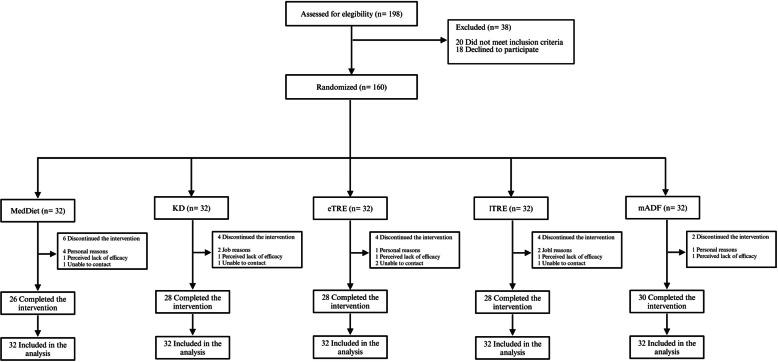
The mean age was 45.7 years (SD 10.7), and 70.6% were women. One hundred forty participants completed the study. Significant differences in weight loss from baseline to 3 months were found between KD and the control group [- 3.78 kg (- 5.65 to - 1.91 kg)], between mADF and the control group [- 3.14 kg (- 4.98 to - 1.30 kg)], and between lTRE and the control group [- 2.27 kg (- 4.13 to - 0.40 kg)], but not between eTRE and the control group [- 1.22 kg (- 3.07 to 0.64 kg)].
CONCLUSIONS
These results suggest that a calorie-restricted KD, mADF, or lTRE may be more effective for weight loss than a calorie-restricted MedDiet in obesity. Further research is needed to evaluate the long-term feasibility and efficacy of these dietary interventions compared with the MedDiet.
TRIAL REGISTRATION
ClinicalTrials.gov (NCT04453150).
背景
缺乏与地中海饮食(MedDiet)相比,评估新型替代饮食方法对减肥效果的研究。我们旨在评估与MedDiet相比,具有不同生酮潜力的饮食,即极低碳水化合物饮食(生酮饮食,KD)、限时进食(TRE)和改良隔日禁食(mADF)对肥胖者体重减轻的影响。
方法
一项为期三个月的平行组随机临床试验,纳入160名肥胖成年人。参与者被随机分为5组中的1组:对照组(MedDiet)、KD组、早期TRE组(eTRE)、晚期TRE组(lTRE)或mADF组。所有饮食均限制热量摄入。主要结局是限制热量的MedDiet与其余四种限制热量的饮食干预措施中每种措施相比,从基线到3个月体重减轻的差异。次要结局包括体重指数、身体成分和心血管代谢危险因素的变化。
结果
平均年龄为45.7岁(标准差10.7),70.6%为女性。140名参与者完成了研究。发现KD组与对照组之间从基线到3个月体重减轻有显著差异[-3.78千克(-5.65至-1.91千克)],mADF组与对照组之间[-3.14千克(-4.98至-1.30千克)],以及lTRE组与对照组之间[-2.27千克(-4.13至-0.40千克)],但eTRE组与对照组之间无显著差异[-1.22千克(-3.07至0.64千克)]。
结论
这些结果表明,在肥胖人群中,限制热量的KD、mADF或lTRE在减肥方面可能比限制热量的MedDiet更有效。需要进一步研究以评估这些饮食干预措施与MedDiet相比的长期可行性和疗效。
试验注册
ClinicalTrials.gov(NCT04453150)。

 Zotero 插件