
雷公藤甲素利用纳米技术的全面概述及其在前列腺疾病中的潜在应用。
A comprehensive overview of triptolide utilizing nanotechnology and its potential applications in prostate diseases.
作者信息
Yan Tongyin, Wang Yiao, Hou Zhiyan, Song Pan, Wang Puze, Li Jinze, Zheng Jing, Lv Dong
机构信息
Department of Pharmacy, the First Affiliated Hospital of Zhengzhou University, Zhengzhou, China.
College of Pharmacy, Zhengzhou University, Zhengzhou, China.
出版信息
Front Pharmacol. 2025 Jun 17;16:1592066. doi: 10.3389/fphar.2025.1592066. eCollection 2025.
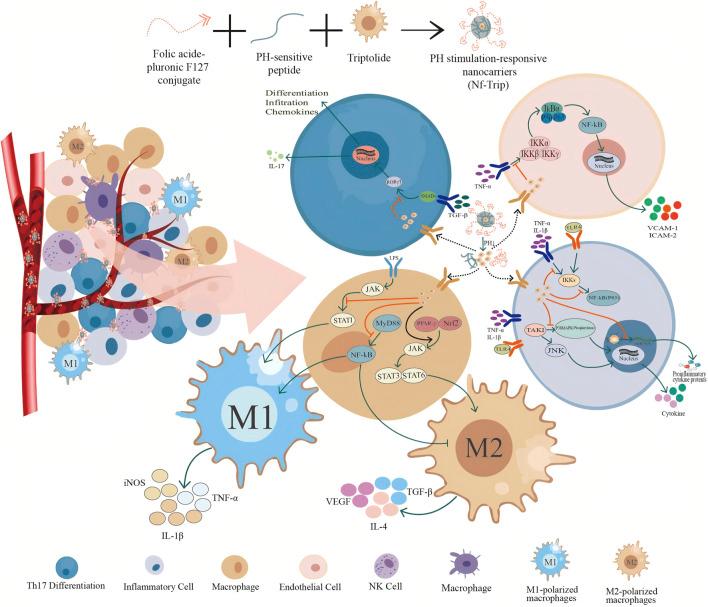
Triptolide (TPL) demonstrates a broad spectrum of biological and pharmacological activities, with its primary effects encompassing anti-inflammatory and anti-tumor properties, thereby rendering it applicable in the treatment of various diseases. However, the toxicity associated with TPL has considerably limited its clinical application. In recent years, the advancement of functional nanotechnology has created new opportunities for the application of TPL. TPL has been formulated using nanotechnology, resulting in a stable and tightly bound preparation. Regarding nanoparticle release, TPL can rapidly release the drug in acidic environments, such as tumor tissues, through pH-sensitive nanoparticles, while releasing the drug slowly under normal pH conditions. Furthermore, the surface characteristics and particle size of the carrier can be adjusted to control the drug release rate, thereby enhancing efficacy and reducing side effects. In terms of nanotargeting, active targeting achieved through surface modification can increase the concentration of the drug at the lesion site. Nanotechnology enhances the effectiveness of TPL, underscores its clinical advantages and potential, improves its disease-related performance, and offers novel strategies for disease treatment. This strategy is essential for improving therapeutic efficacy while minimizing side effects and enhancing bioavailability. Nano-TPL exhibits considerable potential for clinical application, owing to its effective targeted anti-inflammatory and anti-tumor properties, as well as its minimal toxic side effects. In this review, we present a succinct summary of the pharmacological activities and adverse effects of TPL, modifications made to its delivery system nanotechnology, and its clinical application prospect is exemplified by prostate disease.
雷公藤甲素(TPL)具有广泛的生物学和药理活性,其主要作用包括抗炎和抗肿瘤特性,因此可用于治疗多种疾病。然而,TPL的毒性在很大程度上限制了其临床应用。近年来,功能性纳米技术的进步为TPL的应用创造了新机会。TPL已通过纳米技术进行制剂开发,形成了一种稳定且结合紧密的制剂。关于纳米颗粒的释放,TPL可通过pH敏感的纳米颗粒在酸性环境(如肿瘤组织)中快速释放药物,而在正常pH条件下缓慢释放药物。此外,可调节载体的表面特性和粒径以控制药物释放速率,从而提高疗效并减少副作用。在纳米靶向方面,通过表面修饰实现的主动靶向可增加病变部位的药物浓度。纳米技术增强了TPL的有效性,凸显了其临床优势和潜力,改善了其与疾病相关的性能,并为疾病治疗提供了新策略。该策略对于提高治疗效果、最小化副作用和提高生物利用度至关重要。纳米雷公藤甲素(Nano-TPL)由于其有效的靶向抗炎和抗肿瘤特性以及最小的毒副作用,在临床应用中具有相当大的潜力。在本综述中,我们简要总结了TPL的药理活性和不良反应、其递送系统(纳米技术)的改进,以及以前列腺疾病为例的临床应用前景。

 Zotero 插件