
中年和老年代谢综合征患者的饮食炎症指数与死亡率
Dietary inflammatory index and mortality in middle-aged and elderly patients with metabolic syndrome.
作者信息
Li Xiangmei, Liu Lei, Li Xing, Yang Long, Men Li
机构信息
Department of Health Care Center, First Affiliated Hospital of Xinjiang Medical University, Ürümqi, China.
Department of Pharmacy, Xinjiang Uygur Autonomous Region Infectious Disease Hospital, Ürümqi, China.
出版信息
Diabetol Metab Syndr. 2025 Jul 2;17(1):245. doi: 10.1186/s13098-025-01818-1.
BACKGROUND
Metabolic Syndrome (MetS) significantly increases the risk of cardiovascular diseases and mortality, particularly in middle-aged and elderly populations. The Dietary Inflammation Index (DII) is a validated tool for assessing the inflammatory potential of an individual's diet, with higher scores indicating a dietary pattern that is more favorable to inflammation. The MetS population is inherently characterized by chronic low-grade inflammation, and previous studies have demonstrated an association between the DII and a wide range of chronic diseases in the general population, but little is known about the relationship between dietary inflammation and risk of death in the MetS population. This study aimed to investigate the association between DII and all-cause and cardiovascular mortality among middle-aged and elderly MetS patients.
METHODS
This retrospective cohort study was based on publicly available data from the National Health and Nutrition Examination Survey (NHANES) from 2005 to 2016. A total of 7,143 participants aged 40 years and older who were diagnosed with MetS were included. The MetS is based on the Joint Interim Statement criteria developed by the International Diabetes Federation (IDF) in 2009, which defines the MetS as the presence of any three or more of the following five items: central obesity, elevated triglycerides, lowered high-density lipoprotein (HDL) cholesterol, elevated blood pressure, and impaired glucose metabolism. Nutrient intake data were obtained from 24-hour dietary recalls. DII calculations were based on 28 food nutrient parameters, including energy, macronutrients, vitamins, minerals, and selected bioactive ingredients. Kaplan-Meier (KM) survival curves were used to analyze survival outcomes. Cox proportional hazards regression models were employed to assess the relationship between DII and mortality, with adjustments made for potential confounding factors. Restricted cubic spline (RCS) plots were used to explore the dose-response relationship.
RESULTS
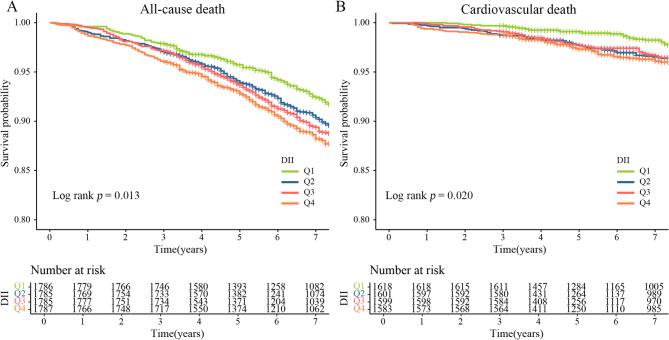
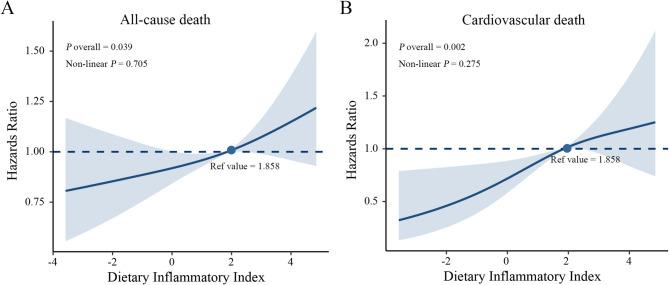
During a median follow-up period of 98 months, 1,026 participants (14.36%) died, including 284 (4.43%) from cardiovascular diseases. KM survival curves showed that higher DII quartiles were associated with lower survival rates (Log-rank P < 0.05). Cox regression results indicated that each unit increase in DII was associated with a higher risk of all-cause mortality (HR = 1.052, 95% CI: 1.006-1.100, P = 0.026) and cardiovascular mortality (HR = 1.157, 95% CI: 1.076-1.244, P < 0.001). Compared to the lowest quartile, participants in the highest DII quartile had significantly higher risks of all-cause mortality (HR = 1.289, 95% CI: 1.020-1.628, P = 0.033) and cardiovascular mortality (HR = 1.817, 95% CI: 1.194-2.764, P = 0.005). RCS analysis revealed a linear relationship between DII and both all-cause mortality (nonlinearity, P = 0.705) and cardiovascular mortality (nonlinearity, P = 0.275).
CONCLUSION
Higher DII scores were independently associated with increased all-cause and cardiovascular mortality among middle-aged and elderly MetS patients. Promoting an anti-inflammatory dietary pattern may be a cost-effective, non-pharmacologic approach to reducing the risk of cardiometabolic mortality in an aging population with a high cardiometabolic burden.
背景
代谢综合征(MetS)显著增加心血管疾病风险和死亡率,尤其在中老年人群中。饮食炎症指数(DII)是一种经过验证的评估个体饮食炎症潜力的工具,得分越高表明饮食模式越有利于炎症。代谢综合征人群具有慢性低度炎症的内在特征,先前研究已证实一般人群中DII与多种慢性疾病之间存在关联,但关于代谢综合征人群中饮食炎症与死亡风险之间的关系知之甚少。本研究旨在调查中老年代谢综合征患者中DII与全因死亡率和心血管死亡率之间的关联。
方法
这项回顾性队列研究基于2005年至2016年美国国家健康和营养检查调查(NHANES)的公开数据。共纳入7143名年龄在40岁及以上且被诊断为代谢综合征的参与者。代谢综合征基于国际糖尿病联盟(IDF)2009年制定的联合临时声明标准,该标准将代谢综合征定义为存在以下五项中的任意三项或更多项:中心性肥胖、甘油三酯升高、高密度脂蛋白(HDL)胆固醇降低、血压升高和葡萄糖代谢受损。营养摄入数据通过24小时饮食回忆获得。DII计算基于28种食物营养参数,包括能量、宏量营养素、维生素、矿物质和选定的生物活性成分。采用Kaplan-Meier(KM)生存曲线分析生存结果。采用Cox比例风险回归模型评估DII与死亡率之间的关系,并对潜在混杂因素进行调整。使用限制立方样条(RCS)图探索剂量反应关系。
结果
在中位随访期98个月内,1026名参与者(14.36%)死亡,其中284名(4.43%)死于心血管疾病。KM生存曲线显示,DII四分位数越高,生存率越低(对数秩检验P<0.05)。Cox回归结果表明,DII每增加一个单位,全因死亡率风险更高(HR = 1.052,95%CI:1.006 - 1.100,P = 0.026),心血管死亡率风险更高(HR = 1.157,95%CI:1.076 - 1.244,P<0.001)。与最低四分位数相比,DII最高四分位数的参与者全因死亡率风险显著更高(HR = 1.289,95%CI:1.020 - 1.628,P = 0.033),心血管死亡率风险更高(HR = 1.817,95%CI:1.194 - 2.764,P = 0.005)。RCS分析显示DII与全因死亡率(非线性,P = 0.705)和心血管死亡率(非线性,P = 0.275)之间均呈线性关系。
结论
较高的DII得分与中老年代谢综合征患者全因死亡率和心血管死亡率增加独立相关。推广抗炎饮食模式可能是一种经济有效的非药物方法,可降低心血管代谢负担高的老年人群中心血管代谢性死亡风险。


 Zotero 插件