
真皮成纤维细胞衰老与皮肤老化的最新进展:揭示机制与开拓治疗策略
Recent advances in dermal fibroblast senescence and skin aging: unraveling mechanisms and pioneering therapeutic strategies.
作者信息
Nan Li, Guo Pengchao, Hui Wang, Xia Fang, Yi Chenggang
机构信息
Department of Plastic Surgery, The Second Affiliated Hospital of Zhejiang University School of Medicine, Hangzhou, China.
Emergency Department, The Second Affiliated Hospital of Zhejiang University School of Medicine, Hangzhou, China.
出版信息
Front Pharmacol. 2025 Jun 18;16:1592596. doi: 10.3389/fphar.2025.1592596. eCollection 2025.
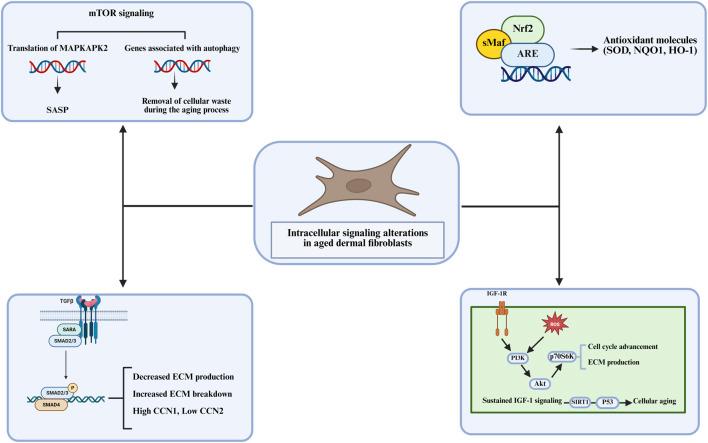
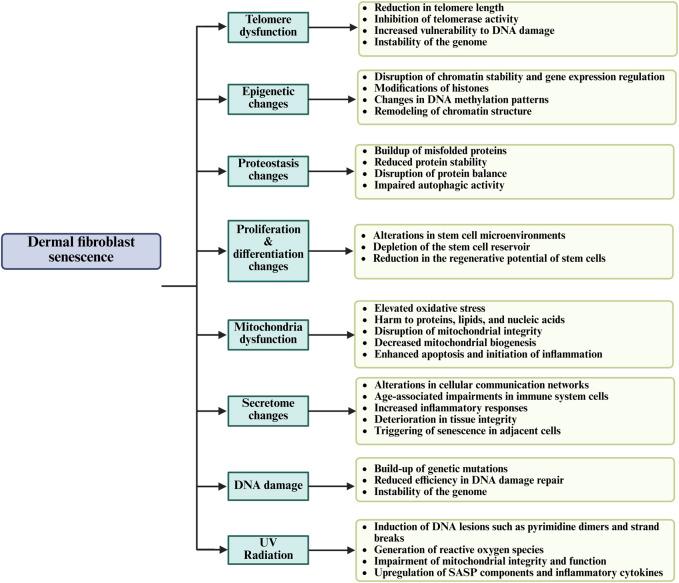
Aging is a multifactorial process that affects skin integrity through the progressive decline of dermal fibroblast function. Dermal fibroblasts are key regulators of extracellular matrix (ECM) composition, wound healing, and tissue homeostasis. However, their dysfunction contributes to structural deterioration, chronic inflammation, and impaired regenerative capacity. Cellular senescence, a fundamental characteristic of aging, results in the buildup of senescent fibroblasts that release growth factors, matrix-degrading enzymes, and pro-inflammatory cytokines, known as the senescence-associated secretory phenotype (SASP). This study examines the impact of fibroblast senescence on dermal aging, highlighting mechanisms such as DNA damage, mitochondrial dysfunction, oxidative stress, and telomere attrition. The role of SASP-driven ECM degradation, matrix metalloproteinases (MMPs) activation, and fibroblast-keratinocyte communication breakdown are explored, demonstrating their collective contribution to skin aging. Additionally, key signaling pathways, including p16INK4a/RB, p53, NF-κB, mTOR, and TGF-β, are implicated in fibroblast senescence and chronic inflammation. Recent advancements in therapeutic strategies targeting fibroblast aging, such as senolytics, extracellular vesicle-based interventions, and metabolic reprogramming, offer promising avenues for skin rejuvenation. This review delves into the molecular and cellular dynamics of dermal fibroblast aging, emphasizing their relevance for developing novel anti-aging interventions.
衰老是一个多因素过程,通过真皮成纤维细胞功能的逐渐衰退影响皮肤完整性。真皮成纤维细胞是细胞外基质(ECM)组成、伤口愈合和组织稳态的关键调节因子。然而,它们的功能障碍会导致结构恶化、慢性炎症和再生能力受损。细胞衰老作为衰老的一个基本特征,会导致衰老成纤维细胞的积累,这些细胞会释放生长因子、基质降解酶和促炎细胞因子,即所谓的衰老相关分泌表型(SASP)。本研究探讨了成纤维细胞衰老对皮肤衰老的影响,重点关注DNA损伤、线粒体功能障碍、氧化应激和端粒磨损等机制。研究了SASP驱动的ECM降解、基质金属蛋白酶(MMPs)激活和成纤维细胞-角质形成细胞通讯中断的作用,证明了它们对皮肤衰老的共同作用。此外,关键信号通路,包括p16INK4a/RB、p53、NF-κB、mTOR和TGF-β,与成纤维细胞衰老和慢性炎症有关。针对成纤维细胞衰老的治疗策略的最新进展,如衰老细胞溶解剂、基于细胞外囊泡的干预措施和代谢重编程,为皮肤年轻化提供了有前景的途径。这篇综述深入探讨了真皮成纤维细胞衰老的分子和细胞动力学,强调了它们在开发新型抗衰老干预措施方面的相关性。

 Zotero 插件