
一项全基因组shRNA筛选发现了一种用于自然杀伤细胞激活受体的新型潜在配体。
A genome-wide shRNA screen uncovers a novel potential ligand for NK cell activating receptors.
作者信息
Romania Paolo, Cifaldi Loredana, Gragera Paula, D'Alicandro Valerio, Caforio Matteo, Folgiero Valentina, Lucarini Valeria, Melaiu Ombretta, Bei Roberto, Locatelli Franco, Fruci Doriana
机构信息
Bambino Gesù Children's Hospital, Istituto di Ricovero e Cura a Carattere Scientifico (IRCCS), Rome, Italy.
Department of Clinical Sciences and Translational Medicine, University of Rome "Tor Vergata", Rome, Italy.
出版信息
Front Immunol. 2025 Jun 18;16:1537876. doi: 10.3389/fimmu.2025.1537876. eCollection 2025.
INTRODUCTION
Natural Killer (NK) cells play a key role in both innate and adaptive immune responses against viruses and tumor cells. Their function relies on the dynamic balance between activating and inhibitory signals, which are mediated by receptors that bind ligands expressed on target cells. While much is known about the function and expression patterns of NK cell activating receptors (NKARs), many of their ligands remain unidentified.
METHODS
K562 cells were transduced with a shRNA library targeting 15,000 genes and co-cultured with NK cells from healthy donors. Surviving clones were tested in cytotoxicity and degranulation assays. PLAC1 was cloned from JEG3 cells in a lentiviral vector and transfected in K562 cells. PLAC1-related gene expression and survival data were obtained from the TCGA database and analyzed using R. PLAC1 and DSG2 expression in healthy tissues and NK cells was obtained from the HPA database and a GEO dataset.
RESULTS
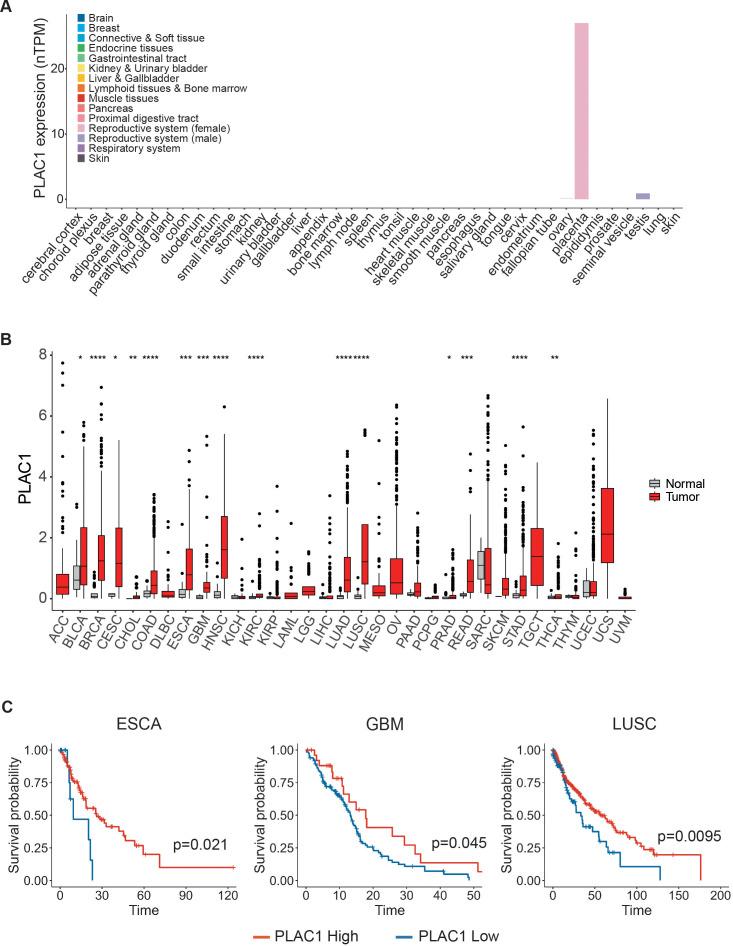
We identified ten candidate genes whose downregulation in K562 cells decreased NK cell-mediated cytotoxicity to levels comparable to silencing the MICA gene. The most promising candidates were functionally validated through single-target gene silencing and overexpression. Among them, the placenta-specific 1 () gene stood out, as its inhibition conferred the greatest protection to target cells from NK cell lysis, while overexpression of PLAC1 significantly increased NK cell degranulation. Importantly, PLAC1 was found to interact with NKAR fusion proteins, including NKG2D, DNAM1 NKp44 and NKp30, suggesting its potential involvement in NK cell function. PLAC1 is typically silent in normal tissues, with the exception of placental trophoblasts and testicular germ cells, but is markedly overexpressed in a wide range of tumors. Notably, its prognostic significance appears to be tumor-type specific, associating with either favorable or poor outcomes depending on the cancer context.
DISCUSSION
Our study identifies PLAC1 as a novel potential ligand for NKARs, suggesting it could be a valuable target for pharmacological strategies aimed at enhancing NK cell recognition. This finding holds promise for improving the efficacy of NK cell-based immunotherapies and advancing their clinical application.
引言
自然杀伤(NK)细胞在针对病毒和肿瘤细胞的先天性和适应性免疫反应中发挥关键作用。它们的功能依赖于激活信号和抑制信号之间的动态平衡,这些信号由与靶细胞上表达的配体结合的受体介导。虽然对NK细胞激活受体(NKARs)的功能和表达模式了解很多,但其许多配体仍未明确。
方法
用靶向15000个基因的shRNA文库转导K562细胞,并与健康供体的NK细胞共培养。对存活的克隆进行细胞毒性和脱颗粒试验检测。从JEG3细胞中克隆PLAC1到慢病毒载体中,并转染到K562细胞中。从TCGA数据库获得PLAC1相关基因表达和生存数据,并用R进行分析。从HPA数据库和一个GEO数据集中获得健康组织和NK细胞中PLAC1和DSG2的表达情况。
结果
我们鉴定出10个候选基因,其在K562细胞中的下调使NK细胞介导的细胞毒性降低到与沉默MICA基因相当的水平。通过单靶点基因沉默和过表达对最有前景的候选基因进行了功能验证。其中,胎盘特异性1(PLAC1)基因脱颖而出,因为其抑制作用赋予靶细胞对NK细胞裂解最大的保护,而PLAC1的过表达显著增加NK细胞脱颗粒。重要的是,发现PLAC1与NKAR融合蛋白相互作用,包括NKG2D、DNAM1、NKp44和NKp30,表明其可能参与NK细胞功能。PLAC1在正常组织中通常沉默,胎盘滋养层细胞和睾丸生殖细胞除外,但在多种肿瘤中明显过表达。值得注意的是,其预后意义似乎具有肿瘤类型特异性,根据癌症背景与良好或不良预后相关。
讨论
我们的研究将PLAC1鉴定为NKARs的一种新型潜在配体,表明它可能是旨在增强NK细胞识别的药理学策略的有价值靶点。这一发现有望提高基于NK细胞的免疫疗法的疗效并推进其临床应用。


 Zotero 插件