
鞭毛驱动的运动性通过改变细胞方向增强生物膜形成。
Flagellum-driven motility enhances biofilm formation by altering cell orientation.
作者信息
Wei Guanju, Palalay Jessica-Jae S, Sanfilippo Joseph E, Yang Judy Q
机构信息
Saint Anthony Falls Laboratory, University of Minnesota, Minneapolis, Minnesota, USA.
Department of Civil, Environmental, and Geo-Engineering, University of Minnesota, Minneapolis, Minnesota, USA.
出版信息
Appl Environ Microbiol. 2025 Jul 23;91(7):e0082125. doi: 10.1128/aem.00821-25. Epub 2025 Jul 3.
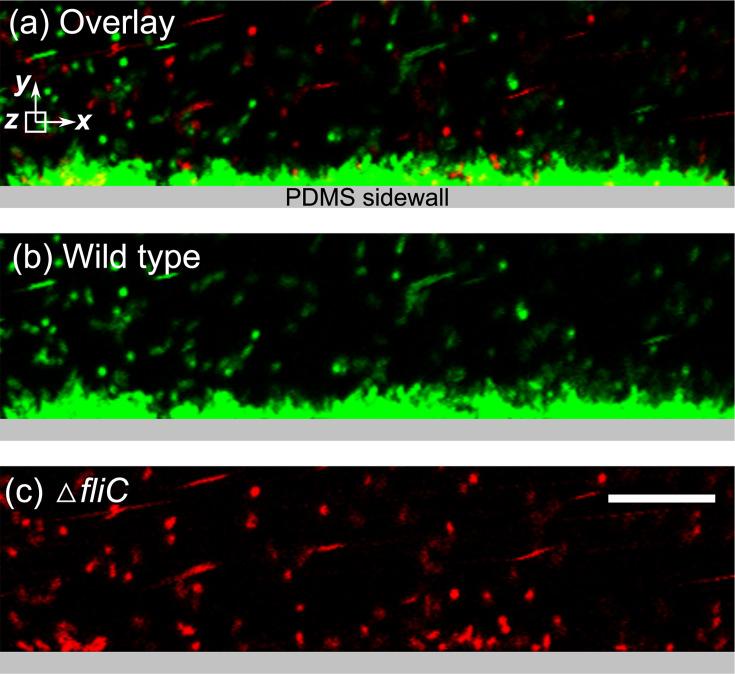
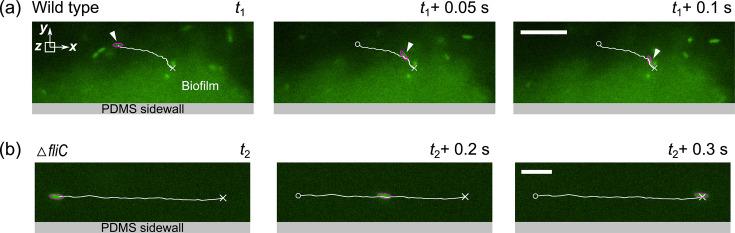
Bacterial motility plays a crucial role in biofilm development, yet the underlying mechanism remains not fully understood. Here, we demonstrate that the flagellum-driven motility of enhances biofilm formation by altering the orientation of bacterial cells, an effect controlled by shear stress rather than shear rate. By tracking wild-type and its non-motile mutants in a microfluidic channel, we demonstrate that while non-motile cells align with the flow, many motile cells can orient toward the channel sidewalls, enhancing cell surface attachment and increasing biofilm cell density by up to 10-fold. Experiments with varying fluid viscosities further demonstrate that bacterial swimming speed decreases with increasing fluid viscosity, and the cell orientation scales with the shear stress rather than shear rate. Our results provide a quantitative framework to predict the role of motility in the orientation and biofilm development under different flow conditions and viscosities.IMPORTANCEBiofilms are ubiquitous in rivers, water pipes, and medical devices, impacting the environment and human health. While bacterial motility plays a crucial role in biofilm development, a mechanistic understanding remains limited, hindering our ability to predict and control biofilms. Here, we reveal how the motility of , a common pathogen, influences biofilm formation through systematically controlled microfluidic experiments with confocal and high-speed microscopy. We demonstrate that the orientation of bacterial cells is controlled by shear stress. While non-motile cells primarily align with the flow, many motile cells overcome the fluid shear forces and reorient toward the channel sidewalls, increasing biofilm cell density by up to 10-fold. Our findings provide insights into how bacterial transition from free-swimming to surface-attached states under varying flow conditions, emphasizing the role of cell orientation in biofilm establishment. These results enhance our understanding of bacterial behavior in flow environments, informing strategies for biofilm management and control.
细菌运动性在生物膜形成过程中起着关键作用,但其潜在机制仍未完全明晰。在此,我们证明了[细菌名称]由鞭毛驱动的运动性通过改变细菌细胞的方向来增强生物膜形成,这一效应由剪切应力而非剪切速率控制。通过在微流控通道中追踪野生型[细菌名称]及其非运动性突变体,我们发现非运动性细胞会顺着流动方向排列,而许多运动性细胞能够朝向通道侧壁定向排列,从而增强细胞表面附着,并使生物膜细胞密度增加高达10倍。不同流体粘度的实验进一步表明,细菌游动速度随流体粘度增加而降低,且细胞定向与剪切应力而非剪切速率成比例。我们的研究结果提供了一个定量框架,以预测在不同流动条件和粘度下运动性在细胞定向和生物膜形成中的作用。
重要性
生物膜在河流、水管和医疗设备中普遍存在,影响着环境和人类健康。虽然细菌运动性在生物膜形成中起着关键作用,但对其机制的理解仍然有限,这阻碍了我们预测和控制生物膜的能力。在此,我们通过使用共聚焦显微镜和高速显微镜进行系统控制的微流控实验,揭示了一种常见病原体[细菌名称]的运动性如何影响生物膜形成。我们证明细菌细胞的定向由剪切应力控制。非运动性细胞主要顺着流动方向排列,而许多运动性细胞克服流体剪切力并重新定向朝向通道侧壁,使生物膜细胞密度增加高达10倍。我们的研究结果深入了解了细菌在不同流动条件下从自由游动状态转变为表面附着状态的过程,强调了细胞定向在生物膜形成中的作用。这些结果增进了我们对细菌在流动环境中行为的理解,为生物膜管理和控制策略提供了依据。



 Zotero 插件