Liu Jiayu, Xu Aoxi, Zhao Zhifeng, Ren Bin, Gao Zhao, Fang Dandong, Hei Bo, Sun Junzhao, Bao Xiangyang, Ma Lin, Zheng Xiaoque, Wang Yuxin, Ren Hecheng, Wang Guan, Zhu Li, Zhang Jianning
Department of Neurosurgery, the First Medical Centre, Chinese PLA General Hospital, Beijing, China.
Department of General Surgery, Beijing Tsinghua Changgung Hospital, School of Clinical Medicine, Tsinghua University, Beijing, 102218, China.
Commun Med (Lond). 2025 Jul 3;5(1):273. doi: 10.1038/s43856-025-00939-y.
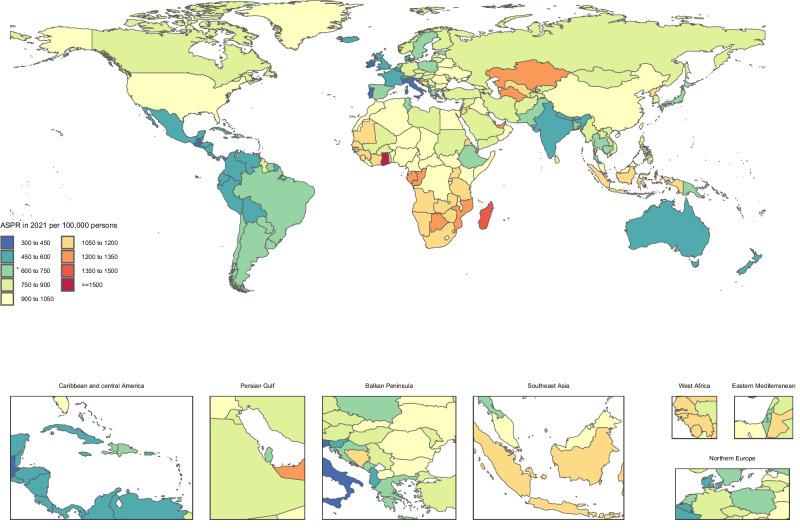
Visualizing the Global Burden of Diseases, Injuries, and Risk Factors Study (GBD) 2021 and predicting future disease burdens at global, regional, and national levels can help health policymakers develop evidence-based ischemic stroke (IS) prevention and cure strategies.
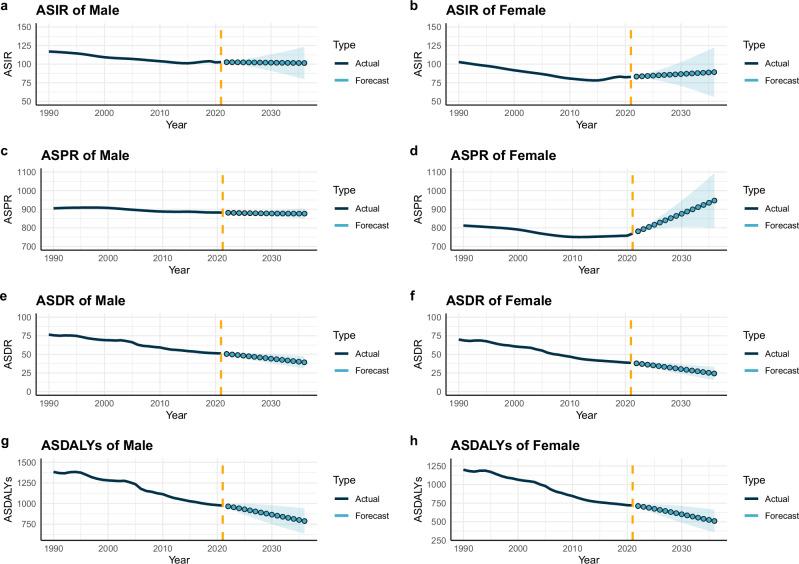
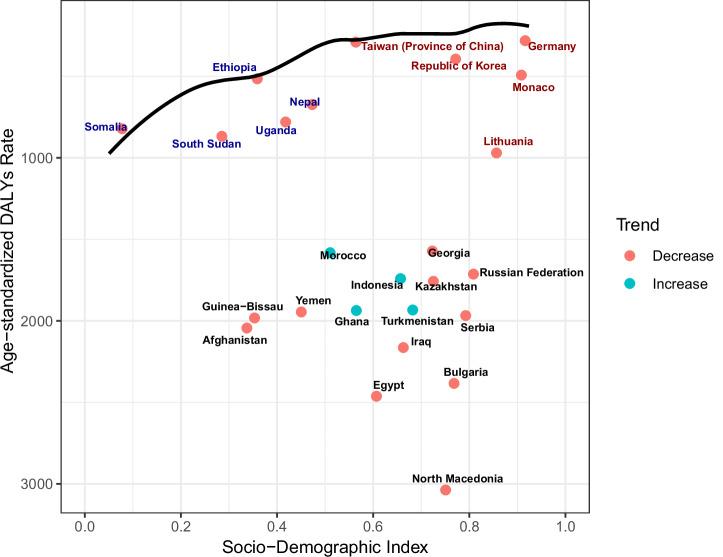
We stratify epidemiological parameters by sex, age, the World Bank's classification of economies, and sociodemographic index (SDI) levels. We use frontier analysis to assess whether the burden of ischemic stroke (IS) in each country aligns with its level of economic development. We apply the Autoregressive Integrated Moving Average (ARIMA) model and the Bayesian age-period-cohort (BAPC) model to predict the burden of IS over the next 15 years.
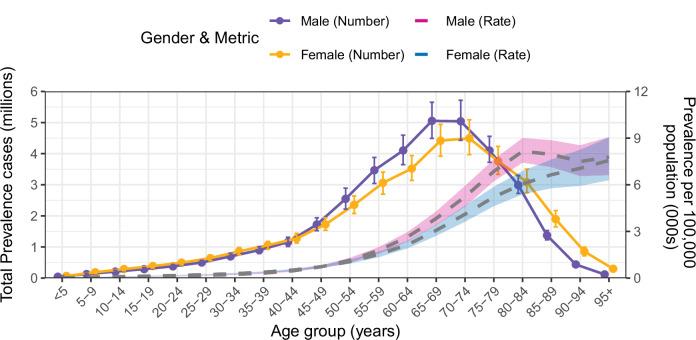
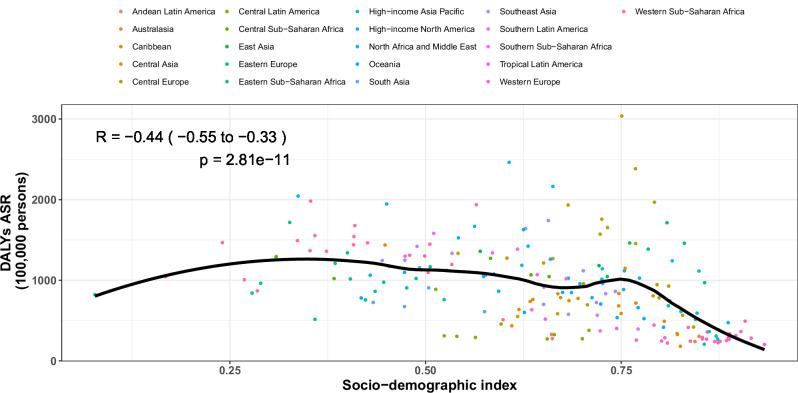
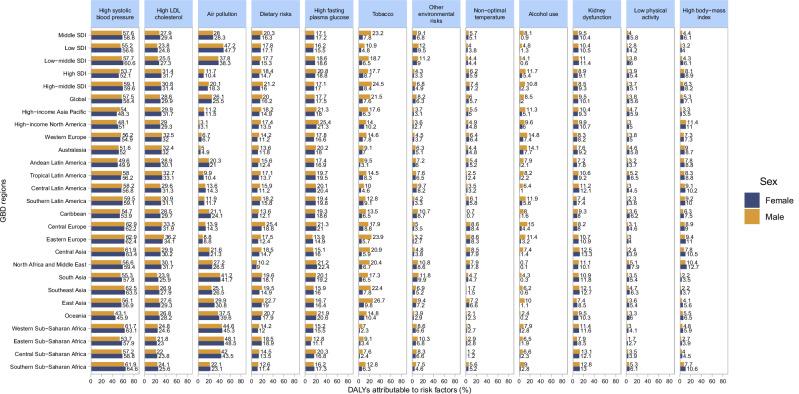
Here we show that IS accounts for 69.9 million prevalent cases, 7.8 million incident cases, 3.6 million deaths, and 70.4 million DALYs in 2021. In men, the global DALY rate of IS increases up to age 90-94 years and then decreases; however, for women, the rate increases up to the oldest age group (≥95 years). Regionally, we find that the association between the SDI and the age-standardized DALY rate of IS starts relatively flat, with a small peak up to a sociodemographic index of about 0.7, and then declines rapidly. Factors contributing most to the DALY rates for IS are high systolic blood pressure, high LDL cholesterol, and air pollution.
The disease burden of IS in medium-high SDI countries is still high, which means we could not meet the Sustainable Development Goal targets by 2030. Countries should formulate prevention and control measures suitable for their national conditions based on risk factors.
了解《2021年全球疾病、伤害和危险因素负担研究》(GBD 2021)并预测全球、区域和国家层面未来的疾病负担,有助于卫生政策制定者制定基于证据的缺血性中风(IS)防治策略。
我们按性别、年龄、世界银行的经济体分类以及社会人口指数(SDI)水平对流行病学参数进行分层。我们使用前沿分析来评估每个国家的缺血性中风(IS)负担是否与其经济发展水平相符。我们应用自回归积分移动平均(ARIMA)模型和贝叶斯年龄-时期-队列(BAPC)模型来预测未来15年的IS负担。
我们在此表明,2021年IS的患病例数为6990万例,新发病例数为780万例,死亡病例数为360万例,伤残调整生命年(DALY)数为7040万。在男性中,IS的全球DALY率在90 - 94岁之前上升,之后下降;然而,对于女性,该率在最高年龄组(≥95岁)之前一直上升。在区域层面,我们发现SDI与IS的年龄标准化DALY率之间的关联起初相对平缓,在社会人口指数约为0.7时出现一个小峰值,然后迅速下降。对IS的DALY率贡献最大的因素是收缩压升高、低密度脂蛋白胆固醇升高和空气污染。
中高SDI国家的IS疾病负担仍然很高,这意味着我们无法在2030年前实现可持续发展目标。各国应根据危险因素制定适合本国国情的防控措施。

 Zotero 插件