
复发性流产患者接受非整倍体植入前基因检测与传统体外受精/卵胞浆内单精子注射的累积活产率比较分析:一项回顾性研究
Comparative analysis of cumulative live birth rates in patients with recurrent pregnancy loss undergoing preimplantation genetic testing for aneuploidy versus conventional in vitro fertilisation/intracytoplasmic sperm injection: a retrospective study.
作者信息
Xin Li Pei, Han Jing Yi, Zheng Wei, Shen Ran, Meng Nan, Ren Bing Nan, Yan Yi Xuan, Yang Yue, Hu Man Yu, Guan Yi Chun
机构信息
Center for Reproductive Medicine, the Third Affiliated Hospital of Zhengzhou University, No.7 Kangfuqian Street, Erqi, Zhengzhou, 450052, People's Republic of China.
出版信息
J Ovarian Res. 2025 Jul 3;18(1):141. doi: 10.1186/s13048-025-01721-3.
BACKGROUND
Recurrent pregnancy loss (RPL) affects 1-2% of women worldwide and poses diagnostic and therapeutic challenges due to its multifactorial causes. Preimplantation genetic testing for aneuploidy (PGT-A) aims to improve outcomes by selecting euploid embryos, but its benefits in RPL patients remain uncertain. This study compared the effectiveness of PGT-A versus conventional in vitro fertilisation/intracytoplasmic sperm injection (IVF/ICSI) in improving cumulative live birth rates (CLBRs) and explored the effects of maternal age and miscarriage frequency on treatment efficacy.
METHODS
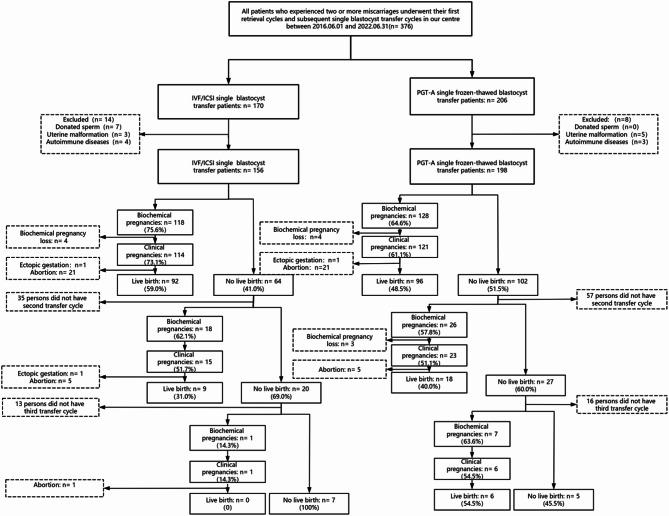
This study included RPL patients who underwent their first oocyte retrieval and at least one single-blastocyst transfer between June 2016 and June 2022. Patients were divided into an IVF/ICSI group (n = 156) and a PGT-A group (n = 198). Primary outcomes included the CLBR, live birth rate, miscarriage rate, time to live birth, and perinatal outcomes.
RESULTS
After three single-blastocyst transfer cycles, no significant difference was observed in the conservative CLBR between the PGT-A and IVF/ICSI groups (Cycle 1: adjusted odds ratio [aOR] = 0.78, 95% confidence interval [CI]: 0.49-1.23; Cycle 2: aOR = 0.81, 95% CI: 0.51-1.29; Cycle 3: aOR = 0.96, 95% CI: 0.60-1.53; all P > 0.05). Similarly, the optimal CLBR after three transfer cycles showed no significant difference between the two groups (P > 0.05). However, the time to live birth was significantly longer in the PGT-A group than in the IVF/ICSI group (adjusted hazard ratio = 0.56, 95% CI: 0.42-0.75, P < 0.05). Other outcomes were comparable between the two groups.
CONCLUSION
PGT-A did not significantly improve the CLBR or shorten the time to live birth in RPL patients. Further research is needed to elucidate its role and identify potential subgroups within the RPL population that may benefit from PGT-A.
背景
复发性流产(RPL)影响着全球1%-2%的女性,因其多因素病因带来了诊断和治疗方面的挑战。植入前非整倍体基因检测(PGT-A)旨在通过选择整倍体胚胎来改善妊娠结局,但其对RPL患者的益处仍不明确。本研究比较了PGT-A与传统体外受精/卵胞浆内单精子注射(IVF/ICSI)在提高累积活产率(CLBR)方面的有效性,并探讨了产妇年龄和流产次数对治疗效果的影响。
方法
本研究纳入了2016年6月至2022年6月期间首次进行卵母细胞采集且至少进行过一次单囊胚移植的RPL患者。患者被分为IVF/ICSI组(n = 156)和PGT-A组(n = 198)。主要结局包括CLBR、活产率、流产率、活产时间和围产期结局。
结果
经过三个单囊胚移植周期后,PGT-A组和IVF/ICSI组之间保守的CLBR无显著差异(第1周期:调整优势比[aOR]=0.78,95%置信区间[CI]:0.49-1.23;第2周期:aOR = 0.81,95% CI:0.51-1.29;第3周期:aOR = 0.96,95% CI:0.60-1.53;所有P>0.05)。同样,两个组在三个移植周期后的最佳CLBR也没有显著差异(P>0.05)。然而,PGT-A组的活产时间明显长于IVF/ICSI组(调整风险比=0.56,95% CI:0.42-0.75,P<0.05)。两组的其他结局相当。
结论
PGT-A在RPL患者中并未显著提高CLBR或缩短活产时间。需要进一步研究以阐明其作用,并确定RPL人群中可能从PGT-A中获益的潜在亚组。
 Zotero 插件