
当“老龄化”遇上“智能化”:中国西部农村老年人的智能健康认知与意愿
When "Aging" meets "Intelligence": smart health cognition and intentions of older adults in rural Western China.
作者信息
Li Xiao-Yu, Li Jun, Zhu Ning-Li, Luo Lei, Zhang Si-Yu, Cheng Wen-Wen, Li Jia-Xue, Yu Chen, Lu Song-He, Zhu Liang
机构信息
School of Preventive Medicine, The Fourth Military Medical University, Xi'an, Shaanxi, China.
The Shaanxi Provincial Key Laboratory of Environmental Health Hazard Assessment and Protection, Xi'an, Shaanxi, China.
出版信息
Front Psychiatry. 2025 Jun 19;15:1493376. doi: 10.3389/fpsyt.2024.1493376. eCollection 2024.
BACKGROUND
Population aging is occurring at an unprecedented pace, rendering "healthy aging" a critical issue of global importance. China is at the forefront of this demographic transformation and faces substantial challenges, especially in its western rural regions. In this context, smart health technology, propelled by advancements in medical care and information technology, emerges as a vital strategy to address the challenges associated with aging. Despite smart technologies' promising potential, the cognitive and behavioral intentions of older adults living in underdeveloped areas remain poorly understood.
METHODS
This study focuses on individuals aged 60 years and older residing in the rural regions of Western China. A total of 311 comprehensive datasets were collected using a questionnaire. These datasets encompass the fundamental cognitive understanding, usage requirements, and barriers faced by rural older adults regarding various aspects of their lives. The study aims to explore the attitudes, expectations, and personal perspectives of elderly rural residents towards smart health technology, as well as their views on its adoption. Finally, drawing on the literature, we constructed a structural equation model to analyze the primary factors influencing the cognitive and behavioral intentions of rural older adults toward smart health.
RESULTS
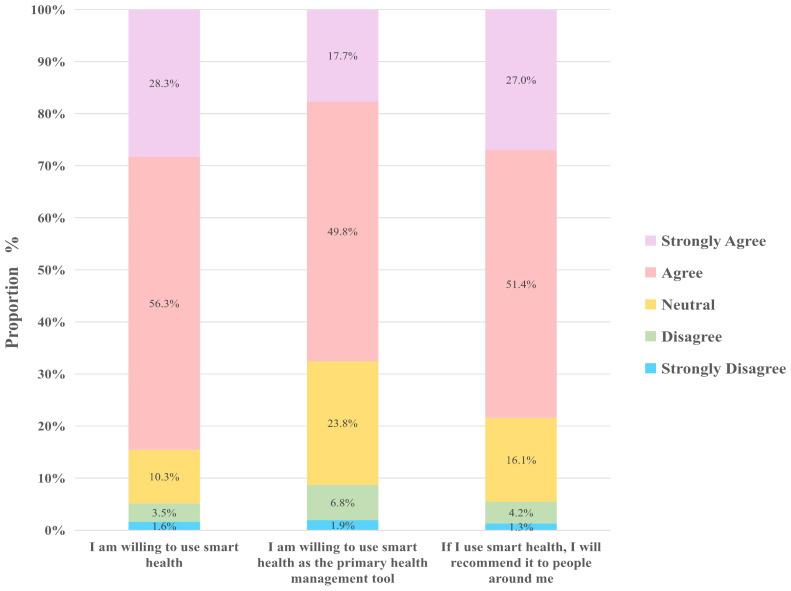
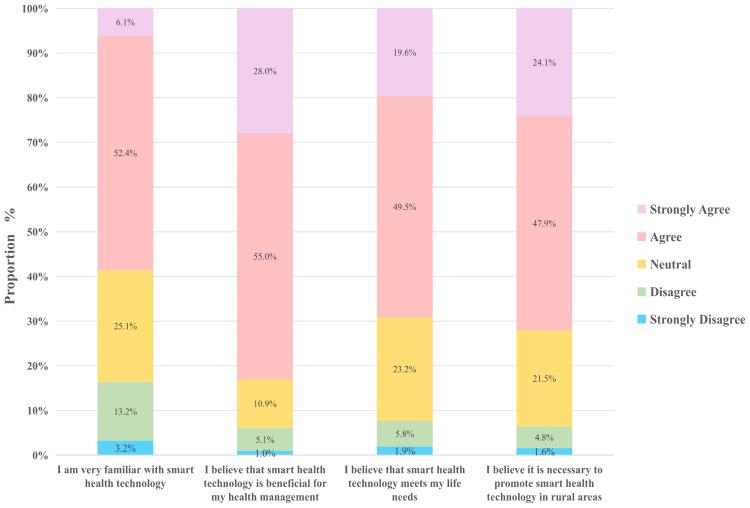
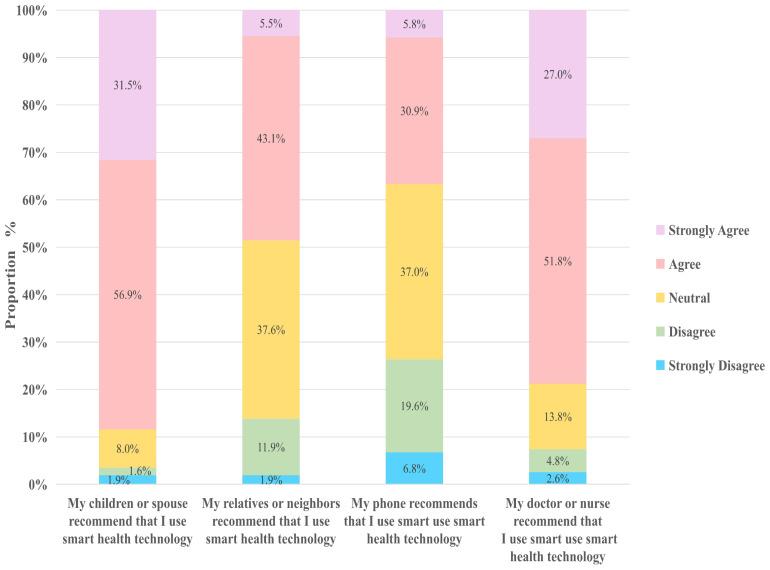
The survey results indicate significant progress in promoting smart health initiatives within the rural areas of western China. While the older adult population demonstrates a basic understanding of smart health, particularly concerning wearable devices such as blood pressure monitors and oximeters, this understanding also underscores the urgent need for improved health management and enhanced quality of life among rural older adults. As their comprehension of smart health deepens, a majority of older respondents recognize its potential to benefit personal health management, fulfill their daily needs, and highlight its importance for rural development. In terms of cognitive pathways toward adopting smart health, older individuals prefer recommendations from their children or spouses, as well as guidance from healthcare professionals such as doctors or nurses. Overall, older residents in rural western China exhibited a strong willingness to embrace smart health practices. After experiencing smart health technology, they were inclined to adopt it as their primary method of health management and recommend it to others, thereby presenting promising prospects for future smart health promotion in underdeveloped regions.
CONCLUSION
Smart health has immense potential to enhance the quality of life of older adults, driven by a genuine and pressing demand expressed by rural older adults and a strong behavioral intention toward adoption. Despite facing challenges, such as limited cognitive diversity in smart health, economic constraints, technical usability barriers, and lack of social and familial support, future initiatives must prioritize the actual needs of older adults in rural areas. This requires effective communication strategies and service models tailored to the specific conditions of underdeveloped regions in order to expand and deepen the use of smart health applications. Moreover, concerted efforts by governments, enterprises, and all sectors of society are essential to deliver more accessible and cost-effective health management and services to older adults. Ultimately, these efforts will contribute to enhancing the overall well-being and quality of life of older adults.
背景
人口老龄化正以前所未有的速度发生,使“健康老龄化”成为具有全球重要性的关键问题。中国处于这一人口结构转变的前沿,面临着巨大挑战,尤其是在其西部农村地区。在此背景下,由医疗保健和信息技术进步推动的智能健康技术,成为应对与老龄化相关挑战的重要战略。尽管智能技术具有广阔前景,但对生活在欠发达地区的老年人的认知和行为意图仍了解不足。
方法
本研究聚焦于居住在中国西部农村地区60岁及以上的人群。通过问卷调查收集了总共311个综合数据集。这些数据集涵盖了农村老年人在生活各个方面的基本认知理解、使用需求和面临的障碍。该研究旨在探索农村老年居民对智能健康技术的态度、期望和个人观点,以及他们对采用智能健康技术的看法。最后,借鉴文献,构建了一个结构方程模型,以分析影响农村老年人对智能健康的认知和行为意图的主要因素。
结果
调查结果表明,中国西部农村地区在推动智能健康倡议方面取得了显著进展。虽然老年人群体对智能健康有基本了解,特别是关于血压监测仪和血氧仪等可穿戴设备,但这种了解也凸显了农村老年人改善健康管理和提高生活质量的迫切需求。随着他们对智能健康的理解加深,大多数老年受访者认识到其对个人健康管理、满足日常需求的潜力,并强调其对农村发展的重要性。在采用智能健康的认知途径方面,老年人更喜欢子女或配偶的推荐,以及医生或护士等医疗专业人员的指导。总体而言,中国西部农村地区的老年居民表现出强烈的意愿接受智能健康实践。在体验智能健康技术后,他们倾向于将其作为主要的健康管理方法并推荐给他人,从而为未来欠发达地区的智能健康推广展现出广阔前景。
结论
受农村老年人表达的真实且迫切需求以及强烈的采用行为意图驱动,智能健康在提高老年人生活质量方面具有巨大潜力。尽管面临挑战,如智能健康方面认知多样性有限、经济限制、技术可用性障碍以及缺乏社会和家庭支持等,但未来的举措必须优先考虑农村地区老年人的实际需求。这需要针对欠发达地区的具体情况制定有效的沟通策略和服务模式,以扩大和深化智能健康应用的使用。此外,政府、企业和社会各界的共同努力对于为老年人提供更易获得且成本效益高的健康管理和服务至关重要。最终,这些努力将有助于提高老年人的整体幸福感和生活质量。



 Zotero 插件