
老年人肌肉减少症的风险因素及预测模型
Risk Factors and Predictive Models for Sarcopenia in Older Adults.
作者信息
Zhang Shiyuan, Yang Xue, An Nina, Lv Meng, Yang Lanyu, Liu Rui, Hu Song, Chen Weiguo, Feng Wenjing, Mao Yongjun
机构信息
Department of Geriatrics The Affiliated Hospital of Qingdao University Qingdao China.
Department of Abdominal Ultrasound The Affiliated Hospital of Qingdao University Qingdao China.
出版信息
Aging Med (Milton). 2025 Apr 18;8(3):192-199. doi: 10.1002/agm2.70012. eCollection 2025 Jun.
OBJECTIVES
Sarcopenia as an age-related syndrome is marked by a progressive loss of muscle strength and mass or reduced physical function. It is insidious in onset and presents a high prevalence. This study aimed to explore risk factors for sarcopenia in the elderly population and construct predictive models.
METHODS
Patients ( = 335) aged 60-93 years and received an examination by a dual-energy X-ray absorptiometry (DXA) or a body composition analyzer (InBody) between January 2020 and May 2024 were included. Clinical data and laboratory test results were collected from these subjects. LASSO and logistic regression models were constructed to identify and evaluate significant risk factors for sarcopenia. A nomogram and a decision tree model were established for the prediction of sarcopenia probability in the elderly. Random forest was employed to rank the importance of variables in predicting sarcopenia.
RESULTS
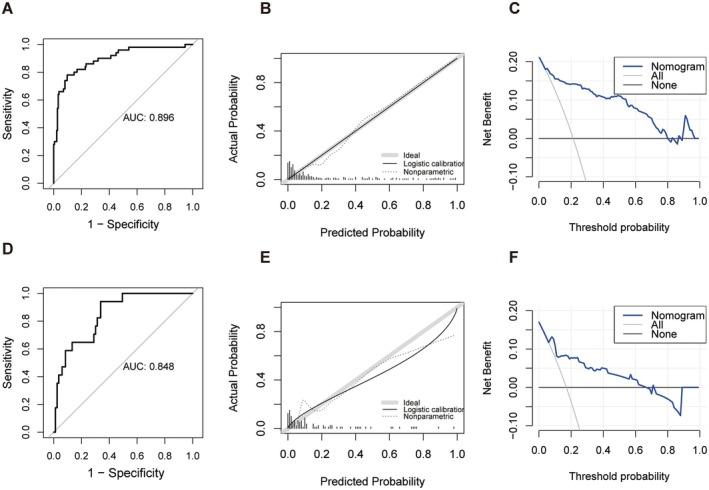
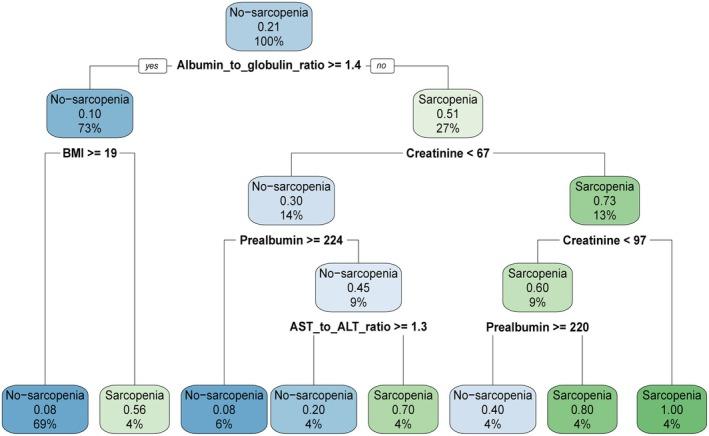
The potential risk factors for sarcopenia in this study were body mass index, prealbumin, albumin/globulin ratio, serum creatinine, and phosphorus. A nomogram and a decision tree model were constructed based on the factors, showing a high discriminative ability and a high classification accuracy, respectively. Both models were effective in predicting sarcopenia in the elderly, and the nomogram showed a notably reliable predictive performance.
CONCLUSIONS
This study identified risk factors and developed predictive models for sarcopenia in older adults, contributing to timely intervention and treatment of the disease. The nomogram provided an intuitive way to measure the probability of sarcopenia in the elderly population, and the decision tree model made the assessment of sarcopenia simple and rapid. Both models are helpful for clinical staff in early screening and identifying sarcopenia.
目的
肌肉减少症作为一种与年龄相关的综合征,其特征是肌肉力量和质量逐渐丧失或身体功能下降。它起病隐匿,患病率高。本研究旨在探讨老年人群肌肉减少症的危险因素并构建预测模型。
方法
纳入2020年1月至2024年5月期间年龄在60 - 93岁之间、接受过双能X线吸收法(DXA)或人体成分分析仪(InBody)检查的患者(n = 335)。收集这些受试者的临床资料和实验室检查结果。构建LASSO和逻辑回归模型以识别和评估肌肉减少症的重要危险因素。建立列线图和决策树模型用于预测老年人肌肉减少症的概率。采用随机森林对预测肌肉减少症的变量重要性进行排序。
结果
本研究中肌肉减少症的潜在危险因素为体重指数、前白蛋白、白蛋白/球蛋白比值、血清肌酐和磷。基于这些因素构建了列线图和决策树模型,分别显示出较高的判别能力和较高的分类准确率。两种模型均能有效预测老年人的肌肉减少症,且列线图显示出显著可靠的预测性能。
结论
本研究识别了老年人肌肉减少症的危险因素并建立了预测模型,有助于该疾病的及时干预和治疗。列线图为衡量老年人群肌肉减少症的概率提供了一种直观的方法,决策树模型使肌肉减少症的评估简单快速。两种模型均有助于临床工作人员早期筛查和识别肌肉减少症。


 Zotero 插件