
基于半抗原免疫亲和筛选技术鉴定三七总皂苷在脑出血小鼠脑组织中的蛋白质靶点AIF1
Identification of AIF1 as a protein target of notoginsenosides in brain tissue of mice with intracerebral hemorrhage based on hapten immunoaffinity fishing technique.
作者信息
Chen Feiyan, Qin Wei, Li Qianlin, Li Chu, Chen Cuihua, Chen Lin, Yao Qi, Zhu Zhu, Zhao Yunan
机构信息
Research and Experiment Center, College of Traditional Chinese Medicine, Nanjing University of Chinese Medicine, Nanjing, China.
Department of Pathology and Pathophysiology, School of Medicine, Nanjing University of Chinese Medicine, Nanjing, China.
出版信息
J Ginseng Res. 2025 Jul;49(4):451-459. doi: 10.1016/j.jgr.2025.04.001. Epub 2025 Apr 2.
BACKGROUND
Intracerebral hemorrhage (ICH) is a deadly stroke with high mortality or disability. Although recent research has demonstrated the efficacy of in ICH therapy, it is unclear which proteins may be targeted to achieve these advantages.
METHODS
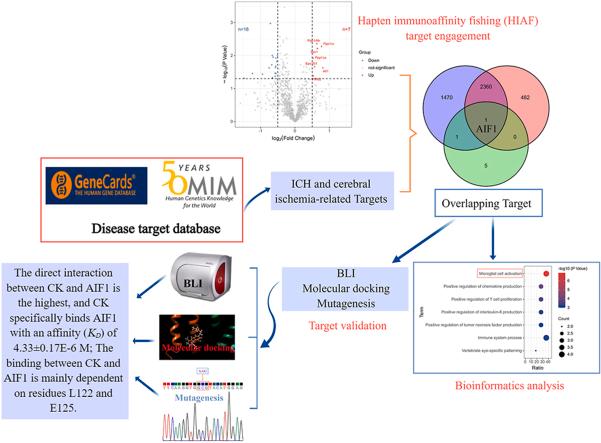
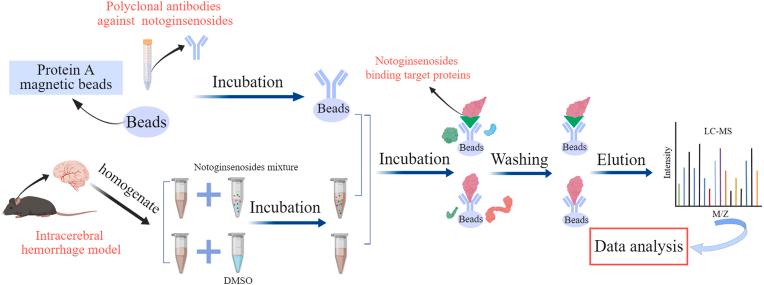
First, we generated polyclonal antibodies against notoginsenosides by immunizing rats with a ginsenoside Rh1-mcKLH conjugate. Second, the potential target proteins of notoginsenosides in brain tissue of ICH mice were identified using LC-MS-based hapten immunoaffinity fishing (HIAF). Third, the disease target databases and these proteins intersected. Fourth, biolayer interferometry (BLI), molecular docking, and site-directed mutagenesis were performed to validate allograft inflammatory factor 1 (AIF1) as a protein target of notoginsenosides. Last, bioinformatics analysis was performed to examine AIF1's biological characteristics.
RESULTS
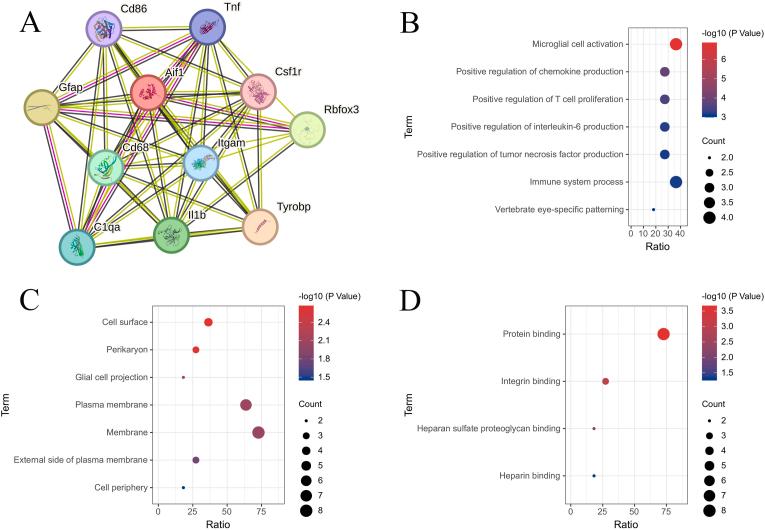
A potential protein target of notoginsenosides, AIF1, was found by intersecting the identified protein targets with the disease target databases via LC-MS-based HIAF. BLI analysis revealed that Compound K (CK) and AIF1 had the highest direct interaction, with an average shift value of 0.1091 nm. Subsequently, site-directed mutagenesis, molecular docking, and BLI kinetic analysis demonstrated that CK specifically bound to AIF1 with an affinity value of 4.33 ± 0.17E-6 M, with a significant reliance on residues L122 and E125. Bioinformatics analysis showed that AIF1 and its directly interacting proteins were associated with microglial activation.
CONCLUSION
Our study proposed a new technology for screening natural small molecule protein targets, and successfully identified AIF1 as a protein target of notoginsenosides, providing a chemical and biological basis for further research into targeting AIF1 to treat ICH.
背景
脑出血(ICH)是一种具有高死亡率或致残率的致命性中风。尽管最近的研究已经证明了[具体物质]在ICH治疗中的疗效,但尚不清楚哪些蛋白质可能是实现这些优势的靶点。
方法
首先,我们通过用人参皂苷Rh1 - mcKLH偶联物免疫大鼠来制备抗三七皂苷的多克隆抗体。其次,使用基于液相色谱 - 质谱的半抗原免疫亲和钓取法(HIAF)鉴定ICH小鼠脑组织中三七皂苷的潜在靶蛋白。第三,将疾病靶标数据库与这些蛋白质进行交叉分析。第四,进行生物层干涉术(BLI)、分子对接和定点诱变,以验证同种异体移植炎症因子1(AIF1)作为三七皂苷的蛋白质靶点。最后,进行生物信息学分析以研究AIF1的生物学特性。
结果
通过基于液相色谱 - 质谱的HIAF将鉴定出的蛋白质靶点与疾病靶标数据库交叉分析,发现了三七皂苷的一个潜在蛋白质靶点AIF1。BLI分析显示化合物K(CK)与AIF1的直接相互作用最强,平均位移值为0.1091纳米。随后,定点诱变、分子对接和BLI动力学分析表明,CK以亲和力值4.33±0.17E - 6 M特异性结合AIF1,且对残基L122和E125有显著依赖性。生物信息学分析表明,AIF1及其直接相互作用的蛋白质与小胶质细胞活化有关。
结论
我们的研究提出了一种筛选天然小分子蛋白质靶点的新技术,并成功鉴定出AIF1作为三七皂苷的蛋白质靶点,为进一步研究靶向AIF1治疗ICH提供了化学和生物学基础。



 Zotero 插件