
与肥胖倾向大鼠相比,肥胖抵抗大鼠的体能改善:不同饮食的影响及代谢分析。
Improved physical performance in obesity-resistant rats compared to obesity-prone rats: Effects of different diets and metabolic analysis.
作者信息
da Silva Daniel Sesana, Dos Santos Matheus Corteletti, Domingos Lucas Furtado, Cordeiro Jóctan Pimentel, Miranda Kiany, Siqueira Tavares Maria Gabriela, Santos Késsia Cristina Carvalho, Lima-Leopoldo Ana Paula, Soares Leopoldo André
机构信息
Postgraduate Program in Physiological Sciences, Center of Health Sciences, Federal University of Espírito Santo, Vitória, Espírito Santo, Brazil.
Postgraduate Program in Nutrition and Health, Center of Health Sciences, Federal University of Espírito Santo, Vitória, Espírito Santo, Brazil.
出版信息
PLoS One. 2025 Jul 7;20(7):e0327670. doi: 10.1371/journal.pone.0327670. eCollection 2025.
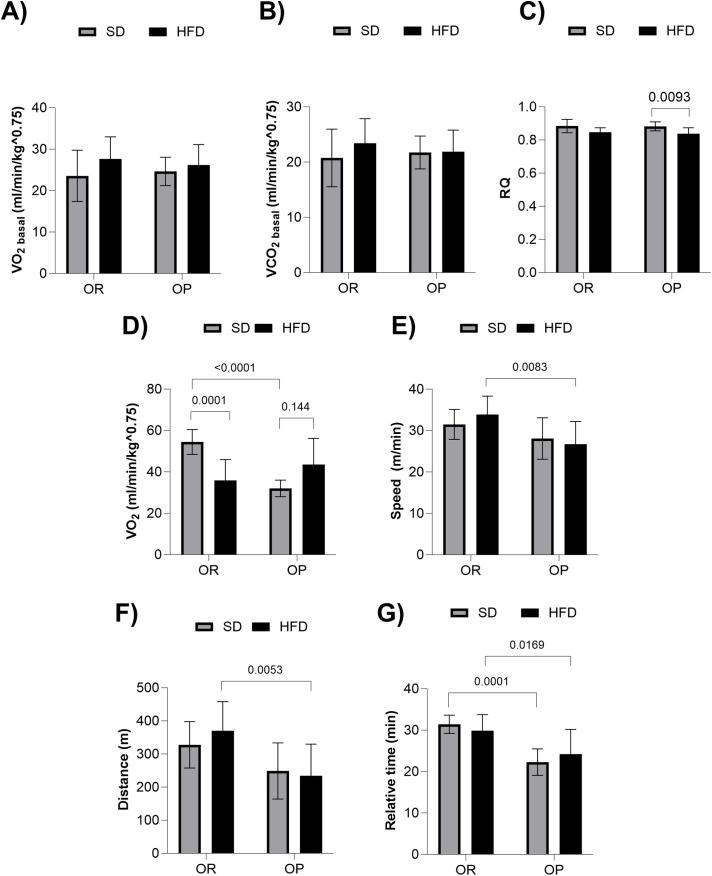
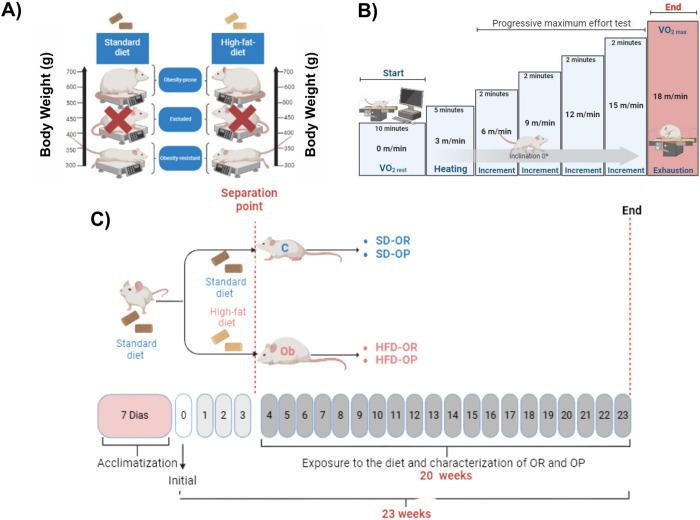
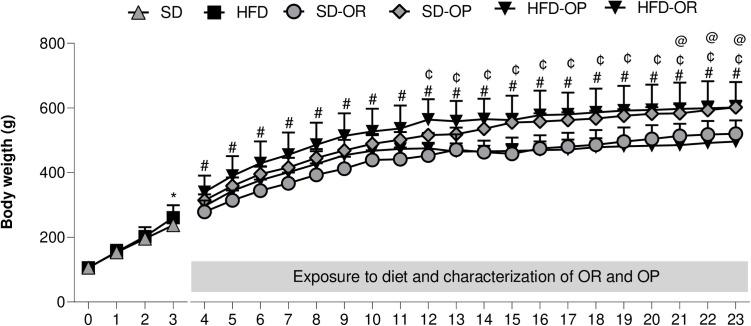
Animal models, such as high-fat diet-induced obese (DIO) rats, have been used to understand its pathophysiology. These models reveal differences between obesity-prone (OP) and obesity-resistant (OR) phenotypes. Thus, OR exhibit lower body mass gain and higher levels of physical activity, suggesting a more efficient energy metabolism. This study evaluated the metabolic adaptations and physical performance of OP and OR rats. Wistar rats (30 days old) were subjected to 23-week obesity exposure protocols. Initially, rats were randomized into two groups: a) SD: fed a standard diet (n = 39) and b) HFD: fed a high-fat diet (n = 39). Subsequently, animals were characterized as OP and OR on their respective diets: SD-OR (n = 13); SD-OP (n = 13); HFD-OP (n = 13); HFD-OR (n = 13). Nutritional, metabolic, and adiposity parameters were analyzed. Basal metabolism assessment was performed using indirect calorimetry. Physical performance and aerobic capacity were determined through treadmill exercise tests with gas analyzers for maximal oxygen consumption (VO2). OR animals had lower body mass compared to OP animals, despite consuming the same caloric intake under both diets. HFD-OP rats gained 30.5% more weight than HFD-OR rats, while SD-OP rats gained 19.5% more than SD-OR rats. SD-OR rats gained 20.5% more weight than HFD-OR. No significant differences in adiposity indices were observed among groups. HFD-OR rats showed 15.6% higher VO₂max than HFD-OP rats; SD-OR rats had 12.8% higher VO₂max and 20.3% longer time to exhaustion compared to SD-OP rats. Indirect calorimetry revealed higher energy expenditure in OR animals during the dark cycle. OP animals exhibited elevated insulin and HOMA-IR levels, while OR animals had higher leptin and glucagon levels. In conclusion, OR rats showed improved physical performance and aerobic capacity compared to OP rats, even on a high-fat diet, suggesting that OR rats have adaptive mechanisms that enhance energy metabolism and endurance.
动物模型,如高脂饮食诱导的肥胖(DIO)大鼠,已被用于了解其病理生理学。这些模型揭示了肥胖倾向(OP)和肥胖抵抗(OR)表型之间的差异。因此,OR表现出较低的体重增加和较高的身体活动水平,表明能量代谢更有效。本研究评估了OP和OR大鼠的代谢适应性和身体性能。将30日龄的Wistar大鼠进行为期23周的肥胖暴露实验。最初,将大鼠随机分为两组:a)SD组:喂食标准饮食(n = 39);b)HFD组:喂食高脂饮食(n = 39)。随后,根据各自的饮食将动物分为OP和OR:SD-OR(n = 13);SD-OP(n = 13);HFD-OP(n = 13);HFD-OR(n = 13)。分析营养、代谢和肥胖参数。使用间接量热法进行基础代谢评估。通过带气体分析仪的跑步机运动测试来测定身体性能和有氧能力,以测量最大耗氧量(VO2)。尽管在两种饮食下摄入相同的热量,但OR动物的体重低于OP动物。HFD-OP大鼠比HFD-OR大鼠体重增加30.5%,而SD-OP大鼠比SD-OR大鼠体重增加19.5%。SD-OR大鼠比HFD-OR大鼠体重增加20.5%。各组之间的肥胖指数没有显著差异。HFD-OR大鼠的VO₂max比HFD-OP大鼠高15.6%;与SD-OP大鼠相比,SD-OR大鼠的VO₂max高12.8%,力竭时间长20.3%。间接量热法显示,OR动物在黑暗周期中的能量消耗更高。OP动物的胰岛素和HOMA-IR水平升高,而OR动物的瘦素和胰高血糖素水平更高。总之,与OP大鼠相比,OR大鼠即使在高脂饮食下也表现出更好的身体性能和有氧能力,这表明OR大鼠具有增强能量代谢和耐力的适应性机制。


 Zotero 插件