
SIMPROV:用于模拟研究的溯源捕获
SIMPROV: Provenance capturing for simulation studies.
作者信息
Ruscheinski Andreas, Wolpers Anja, Henning Philipp, Wilsdorf Pia, Uhrmacher Adelinde M
机构信息
Institute for Visual and Analytic Computing, University of Rostock, Rostock, Germany.
出版信息
PLoS One. 2025 Jul 8;20(7):e0327607. doi: 10.1371/journal.pone.0327607. eCollection 2025.
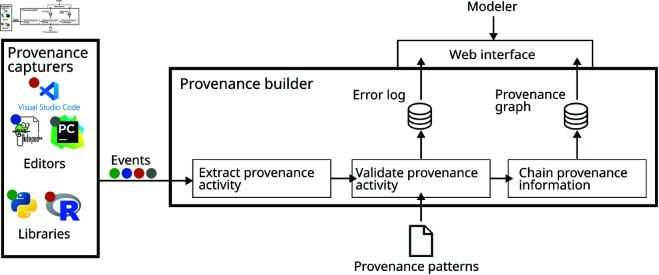
Improving interpretability and reusability has become paramount for modeling and simulation studies. Provenance, which encompasses information about the entities, activities, and agents involved in producing a model, experiment, or data, is pivotal in achieving this goal. However, capturing provenance in simulation studies presents a tremendous challenge due to the diverse software systems employed by modelers and the various entities and activities to be considered. Existing methods only automatically capture partial provenance from individual software systems, leaving gaps in the overall story of a simulation study. To address this limitation, we introduce a lightweight method that can record the provenance of complete simulation studies by monitoring the modeler in their familiar yet heterogeneous work environment, posing as few restrictions as possible. The approach emphasizes a clear separation of concerns between provenance capturers, which collect data from the diverse software systems used, and a provenance builder, which assembles this information into a coherent provenance graph. Furthermore, we provide a web interface that enables modelers to enhance and explore their provenance graphs. We showcase the practicality of SIMPROV through two cell biological case studies.
提高可解释性和可重用性已成为建模与仿真研究的首要任务。起源信息包含了有关生成模型、实验或数据所涉及的实体、活动和主体的信息,对于实现这一目标至关重要。然而,由于建模人员使用的软件系统多种多样,且要考虑的实体和活动各不相同,在仿真研究中捕获起源信息面临着巨大挑战。现有方法只能自动从单个软件系统中捕获部分起源信息,使得仿真研究的整体情况存在空白。为解决这一局限性,我们引入了一种轻量级方法,该方法可以通过在建模人员熟悉但异构的工作环境中对其进行监控,以尽可能少的限制来记录完整仿真研究的起源信息。该方法强调在起源信息捕获器(从所使用的各种软件系统收集数据)和起源信息构建器(将这些信息组装成连贯的起源图)之间进行明确的关注点分离。此外,我们提供了一个Web界面,使建模人员能够增强和探索他们的起源图。我们通过两个细胞生物学案例研究展示了SIMPROV的实用性。





 Zotero 插件