
影响口罩上细菌生存能力的因素及消毒方法的杀菌效果
Factors influencing bacterial viability on face masks and bactericidal effect of disinfection methods.
作者信息
Shimamura Yuko, Ozaki Mizuki, Shinya Misako, Oishi Rika, Komuro Misaki, Sasaki Kuniaki, Tanaka Hirofumi, Masuda Shuichi
机构信息
School of Food and Nutritional Sciences, University of Shizuoka, 52-1 Yada, Suruga-ku, Shizuoka, 422-8526, Japan.
Faculty of Science and Engineering, Iwate University, Ueda 3-18-8, Morioka, Iwate, 020-8550, Japan.
出版信息
Sci Rep. 2025 Jul 8;15(1):24357. doi: 10.1038/s41598-025-09204-7.
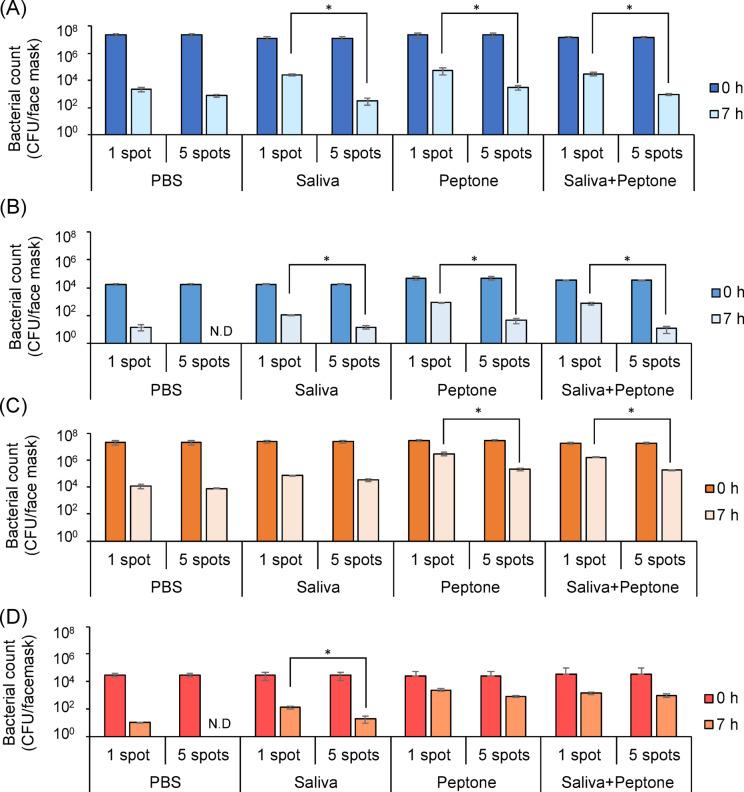
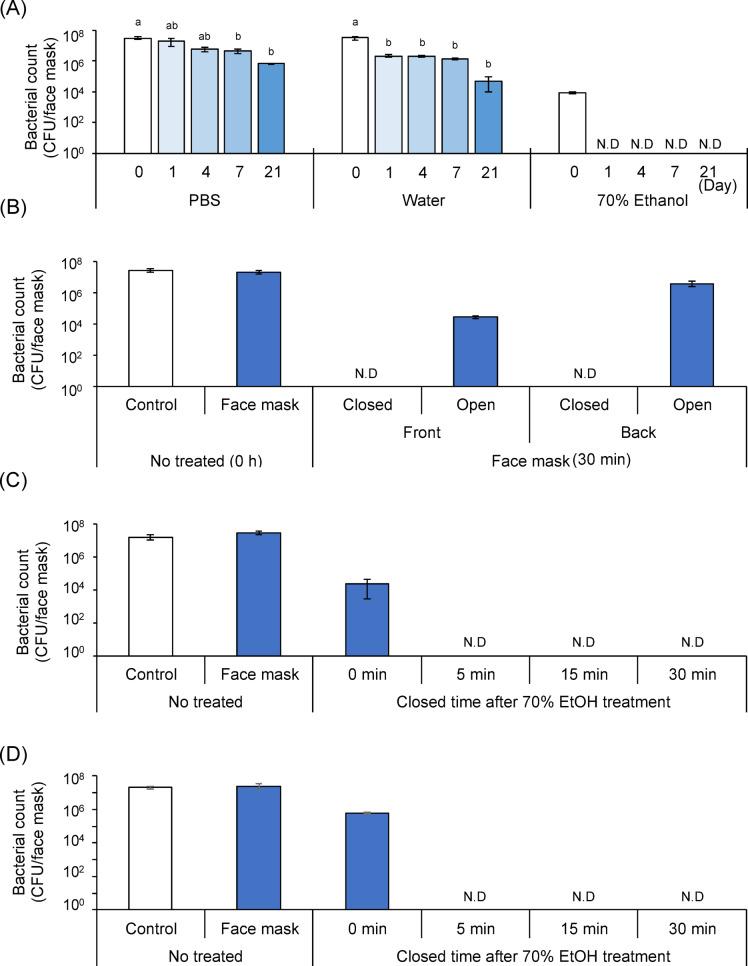
Face masks are contaminated with bacteria during daily use and storage. Several studies have already been conducted on face mask decontamination and bacterial survival during the pandemic. However, there are limited reports on methods of decontamination that can be implemented in daily life. In this study, we inoculated commercially available nonwoven face masks with Staphylococcus aureus and/or Staphylococcus epidermidis which are the main indigenous bacteria of human skin to obtain knowledge on the prevention of bacterial infection when wearing face masks in daily life, and investigated factors affecting bacterial viability on face masks and the bactericidal effect of different disinfection methods. Commercially available face masks were inoculated with two bacterial species and the effects of temperature, humidity, washing, contamination (sweat, sebum, saliva, protein, and cosmetics), and initial bacterial count and density on the viability of adherent bacteria were examined. After each bacterium was collected from the face mask, colonies were measured by the agar plate dilution method and the number of viable colonies. Various experiments were also performed to determine how to disinfect bacteria on face masks. Bacterial survival of face masks increased in the presence of artificial saliva and 1% peptone. By sealing the face mask after 70% ethanol spraying, the number of bacteria was reduced by 6 log order of magnitude and no colonies were detected. However, the presence of contaminants on the face mask weakened the bactericidal effect. Furthermore, direct exposure of the face masks to sunlight was suggested as a useful method for bacterial disinfection. Our findings revealed factors affecting bacterial viability on face masks, providing data that can be applied for the effective household disinfection of face masks.
口罩在日常使用和储存过程中会被细菌污染。在疫情期间,已经有几项关于口罩消毒和细菌存活情况的研究。然而,关于可在日常生活中实施的消毒方法的报道有限。在本研究中,我们将金黄色葡萄球菌和/或表皮葡萄球菌接种到市售的无纺布口罩上,这两种细菌是人类皮肤的主要固有细菌,目的是获取日常生活中佩戴口罩时预防细菌感染的相关知识,并研究影响口罩上细菌活力的因素以及不同消毒方法的杀菌效果。将市售口罩接种两种细菌,研究温度、湿度、洗涤、污染(汗液、皮脂、唾液、蛋白质和化妆品)以及初始细菌数量和密度对附着细菌活力的影响。从口罩上收集每种细菌后,通过琼脂平板稀释法测量菌落并计算活菌数量。还进行了各种实验以确定如何对口罩上的细菌进行消毒。在人工唾液和1%蛋白胨存在的情况下,口罩上细菌的存活率增加。在喷洒70%乙醇后密封口罩,细菌数量减少了6个对数级,未检测到菌落。然而,口罩上污染物的存在会削弱杀菌效果。此外,建议将口罩直接暴露在阳光下是一种有效的细菌消毒方法。我们的研究结果揭示了影响口罩上细菌活力的因素,提供了可应用于家庭有效消毒口罩的数据。




 Zotero 插件