
创伤性脊髓损伤AIS分级转换机制
Mechanisms of Traumatic Spinal Cord Injury AIS Grade Conversion.
作者信息
Stokum Jesse A, Serra Riccardo, Gorny Nicole, Wilhelmy Bradley, Chryssikos Timothy J, Schwartzbauer Gary, Aarabi Bizhan, Gerzanich Volodymyr, Simard J Marc
机构信息
Department of Neurosurgery, University of Maryland School of Medicine, Baltimore, Maryland, USA.
Department of Pathology, University of Maryland School of Medicine, Baltimore, Maryland, USA.
出版信息
Neurotrauma Rep. 2025 Jun 16;6(1):506-524. doi: 10.1089/neur.2025.0035. eCollection 2025.
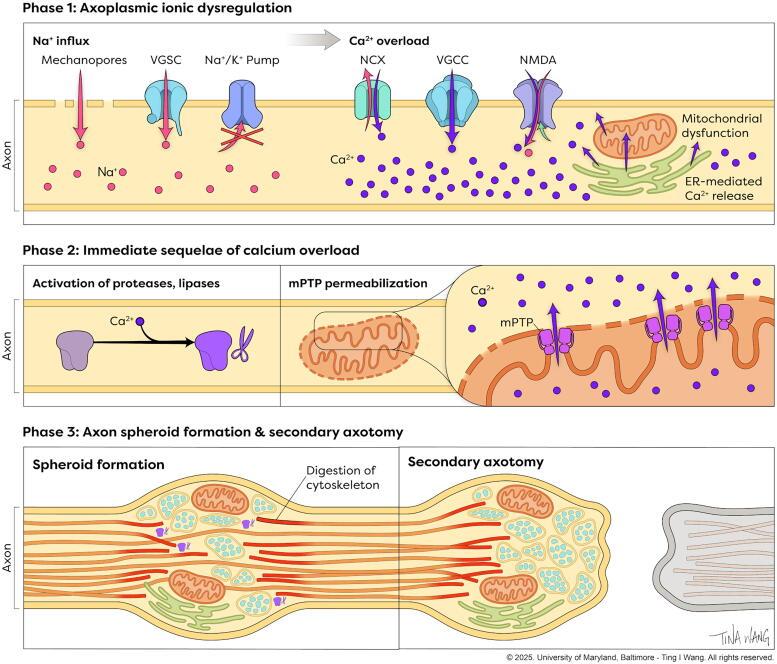
Spinal cord injury (SCI) remains a major unsolved problem that permanently impairs the lives of innumerable individuals worldwide. Although advances in the basic, pre-clinical and clinical sciences of SCI hold promise for patients, clinicians may lack a full insight into the relevant cellular and molecular events, and laboratory researchers may underappreciate how cellular and molecular phenomena translate into meaningful functional outcomes. To help bridge these perspectives, we first review the American Spinal Injury Association (ASIA) Impairment Scale (AIS) grade, which is the principal instrument used to gauge clinical outcomes in SCI, and the clinically important concept of AIS grade "conversion" (improvement), which occurs in some but not all patients. We then review underlying mechanisms that contribute to the AIS grade and its conversion, including mechanisms of transient neurological dysfunction (neuronal and axonal "stunning"), mechanisms of secondary cell loss (apoptosis, pyroptosis, and necroptosis), and mechanisms of axonal loss (primary axotomy and secondary axonal degeneration). Finally, we briefly review approaches to clinical management that may ameliorate identified mechanisms of secondary tissue loss and neurological dysfunction following SCI.
脊髓损伤(SCI)仍然是一个重大的未解决问题,它永久性地损害了全球无数人的生活。尽管脊髓损伤的基础、临床前和临床科学取得了进展,给患者带来了希望,但临床医生可能对相关的细胞和分子事件缺乏全面的了解,而实验室研究人员可能没有充分认识到细胞和分子现象是如何转化为有意义的功能结果的。为了帮助弥合这些观点,我们首先回顾美国脊髓损伤协会(ASIA)损伤量表(AIS)分级,这是用于评估脊髓损伤临床结果的主要工具,以及AIS分级“转换”(改善)这一重要的临床概念,这种情况在部分而非所有患者中会出现。然后,我们回顾导致AIS分级及其转换的潜在机制,包括短暂性神经功能障碍(神经元和轴突“休克”)机制、继发性细胞死亡(凋亡、焦亡和坏死性凋亡)机制以及轴突丢失(原发性轴突切断和继发性轴突退变)机制。最后,我们简要回顾临床管理方法,这些方法可能会改善已确定的脊髓损伤后继发性组织损失和神经功能障碍的机制。


 Zotero 插件