
分子诊断与肝细胞癌个性化治疗的新作用
Emerging role of molecular diagnosis and personalized therapy for hepatocellular carcinoma.
作者信息
Wang Ming-Da, Diao Yong-Kang, Yao Lan-Qing, Fan Zhong-Qi, Wang Ke-Chun, Wu Han, Gu Li-Hui, Xu Jia-Hao, Li Chao, Lv Guo-Yue, Yang Tian
机构信息
Department of Hepatobiliary Surgery, Eastern Hepatobiliary Surgery Hospital, Second Military Medical University (Navy Medical University), Shanghai 200438, China.
Department of Hepatobiliary and Pancreatic Surgery, General Surgery Center, First Hospital of Jilin University, Changchun 130021, China.
出版信息
ILIVER. 2024 Feb 9;3(1):100083. doi: 10.1016/j.iliver.2024.100083. eCollection 2024 Mar.
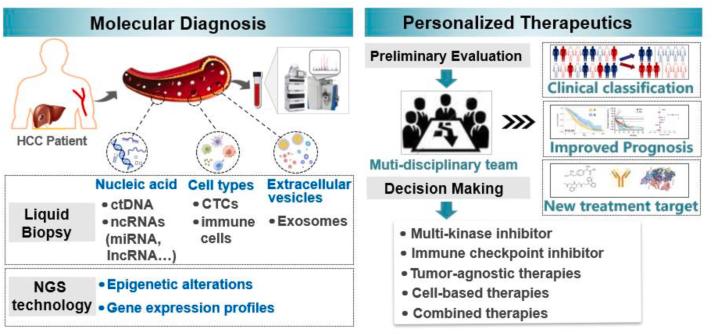
Hepatocellular carcinoma (HCC) is a prevalent malignancy worldwide, ranking as the sixth most common malignancy and the third leading cause of cancer-related mortality. Late diagnosis, limited management options, and its complex etiology contribute to the poor prognosis and high mortality rates. Recent advances in understanding the molecular mechanisms of HCC and innovations in high-throughput sequencing technologies have led to the development of molecular diagnostics and personalized therapies for this challenging malignancy. This review provides a comprehensive overview of research on the molecular diagnosis and individualized treatment for HCC. We highlight key advances and potential future directions and discuss the application of next-generation sequencing technologies to identify and characterize genetic and epigenetic alterations in HCC patients. These technologies may aid in the selection of targeted therapies, prediction of treatment response, and monitoring disease progression. Furthermore, we explore the role of liquid biopsy in HCC diagnosis, prognosis prediction, and treatment monitoring, focusing on circulating tumor cells, circulating tumor DNA, and extracellular vesicles. We also explore the evolving landscape of personalized therapy for HCC, including targeted therapies against key oncogenic signaling pathways, immune checkpoint inhibitors, tumor-agnostic therapies, and innovative cell-based therapies. We discuss the challenges and opportunities that lie ahead in the quest to improve HCC patient outcomes through the integration of molecular diagnostics and individualized precision therapies. We emphasize the need for multi-interdisciplinary collaboration, refinement of predictive and prognostic biomarkers, and the development of more effective combination strategies for HCC management in the new area of precision medicine.
肝细胞癌(HCC)是全球一种常见的恶性肿瘤,是第六大常见恶性肿瘤,也是癌症相关死亡的第三大主要原因。晚期诊断、有限的治疗选择及其复杂的病因导致了预后不良和高死亡率。近年来,在了解HCC分子机制方面的进展以及高通量测序技术的创新,促使了针对这种具有挑战性的恶性肿瘤的分子诊断和个性化治疗的发展。本综述全面概述了HCC分子诊断和个体化治疗的研究。我们重点介绍了关键进展和未来潜在方向,并讨论了应用下一代测序技术来识别和表征HCC患者的基因和表观遗传改变。这些技术可能有助于靶向治疗的选择、治疗反应的预测以及疾病进展的监测。此外,我们探讨了液体活检在HCC诊断、预后预测和治疗监测中的作用,重点关注循环肿瘤细胞、循环肿瘤DNA和细胞外囊泡。我们还探讨了HCC个性化治疗的发展态势,包括针对关键致癌信号通路的靶向治疗、免疫检查点抑制剂、肿瘤非特异性治疗以及创新的细胞治疗。我们讨论了通过整合分子诊断和个体化精准治疗来改善HCC患者预后所面临的挑战和机遇。我们强调在精准医学新领域中,多学科合作、完善预测和预后生物标志物以及开发更有效的HCC联合管理策略的必要性。
 Zotero 插件