
检测与从肝炎进展为肝硬化再到肝细胞癌相关的代谢特征。
Detection of metabolic signatures implicated in the progression from hepatitis to cirrhosis to hepatocellular carcinoma.
作者信息
Yu Simiao, Wang Sici, Li Jiahui, Zheng Haocheng, Li Ping, Rong Wenya, Jing Jing, He Tingting, Sun Yongqiang, Wang Liping, Zhu Zhenyu, Ding Xia, Wang Ruilin
机构信息
Department of Hepatology of Traditional Chinese Medicine, The Fifth Medical Center of PLA General Hospital, Beijing 100039, China.
College of Traditional Chinese Medicine, Beijing University of Chinese Medicine, Beijing 100029, China.
出版信息
ILIVER. 2024 Dec 20;4(1):100142. doi: 10.1016/j.iliver.2024.100142. eCollection 2025 Mar.
BACKGROUND AND AIMS
Hepatocellular carcinoma (HCC) is the third leading cause of cancer-related deaths worldwide. The mechanisms driving the transition from hepatitis to cirrhosis, and eventually, to HCC are unclear. This study aimed to clarify the metabolic changes that underly the progression of HCC and identify potential prognostic and therapeutic biomarkers.
METHODS
This prospective study collected serum samples from patients with chronic hepatitis, cirrhosis, or HCC, hospitalized at the Fifth Medical Center of the PLA General Hospital, from December 2022 to December 2023. The samples were analyzed using non-targeted, ultra-high-performance liquid chromatography and mass spectrometry. Partial least squares-discriminant analysis modeling and -tests were used to identify key differentially expressed metabolites associated with the progression from hepatitis to cirrhosis to HCC. Pathway enrichment analysis was conducted to determine the key metabolic pathways involved, while machine learning models were applied to identify the metabolite signatures.
RESULTS
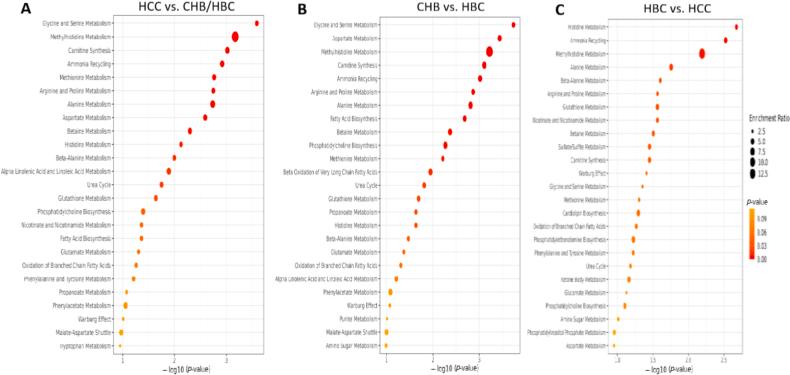
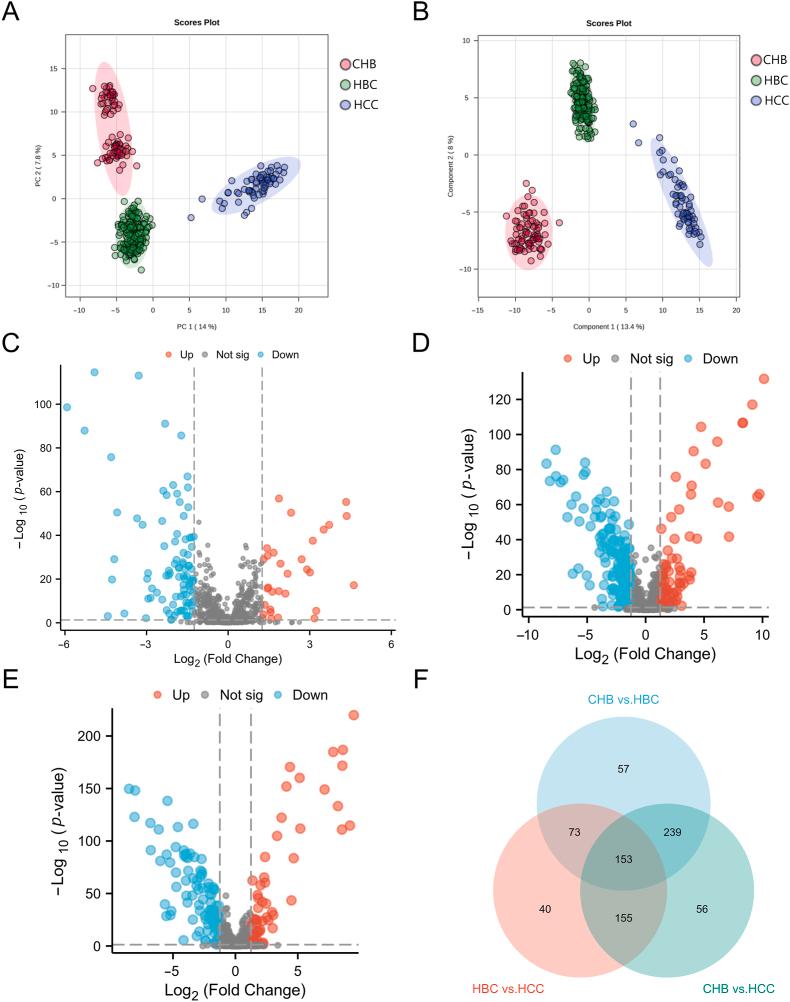
We identified 153 differentially expressed metabolites in the progression from hepatitis to cirrhosis to HCC, many of which were involved in ammonia cycling or the metabolism of methylhistidine, alanine, arginine, proline, or betaine. We also identified L-histidine and adenosine as the metabolites that demonstrated significant sensitivity and specificity for distinguishing among the hepatitis, cirrhosis, and HCC stages.
CONCLUSIONS
Our study comprehensively characterized the metabolic profiles of the different stages of the hepatitis-cirrhosis-HCC transition. We showed that serum metabolite detection is a viable diagnostic tool for identifying and monitoring high-risk individuals, which could potentially be used to halt the development of HCC.
背景与目的
肝细胞癌(HCC)是全球癌症相关死亡的第三大主要原因。从肝炎发展到肝硬化,最终发展为HCC的驱动机制尚不清楚。本研究旨在阐明HCC进展背后的代谢变化,并确定潜在的预后和治疗生物标志物。
方法
本前瞻性研究收集了2022年12月至2023年12月在中国人民解放军总医院第五医学中心住院的慢性肝炎、肝硬化或HCC患者的血清样本。使用非靶向超高效液相色谱和质谱对样本进行分析。采用偏最小二乘判别分析建模和检验来识别与从肝炎到肝硬化再到HCC进展相关的关键差异表达代谢物。进行通路富集分析以确定所涉及的关键代谢通路,同时应用机器学习模型来识别代谢物特征。
结果
我们在从肝炎到肝硬化再到HCC 的进展过程中鉴定出153种差异表达的代谢物,其中许多参与氨循环或甲基组氨酸、丙氨酸、精氨酸、脯氨酸或甜菜碱的代谢。我们还确定L-组氨酸和腺苷为在区分肝炎、肝硬化和HCC阶段时表现出显著敏感性和特异性的代谢物。
结论
我们的研究全面表征了肝炎-肝硬化-HCC转变不同阶段的代谢谱。我们表明,血清代谢物检测是识别和监测高危个体的可行诊断工具,有可能用于阻止HCC的发展。

 Zotero 插件