
1990 - 2021年50岁及以上成年人肌肉骨骼疾病的全球负担:风险因素和社会人口不平等
Global Burden of Musculoskeletal Disorders in Adults Aged 50 and Over, 1990-2021: Risk Factors and Sociodemographic Inequalities.
作者信息
Guan Shi-Yang, Zheng Jin-Xin, Zhang Shun-Xian, Xu Shengqian, Shuai Zongwen, Cai Hong-Yan, Pan Faming
机构信息
Department of Epidemiology and Biostatistics, School of Public Health, Anhui Medical University, Hefei, Anhui, China.
Inflammation and Immune Mediated Diseases Laboratory of Anhui Province, Hefei, Anhui, China.
出版信息
J Cachexia Sarcopenia Muscle. 2025 Aug;16(4):e70008. doi: 10.1002/jcsm.70008.
BACKGROUND
Adults aged 50 and over are particularly vulnerable to musculoskeletal (MSK) disorders, with their impact expected to intensify as the global population ages. This study aims to comprehensively assess the global burden of MSK disorders among adults aged 50 and over from 1990 to 2021, as well as temporal trends, risk factors and sociodemographic inequalities.
METHODS
Data were sourced from the Global Burden of Disease 2021 study. Temporal trends in age-standardized rates were evaluated by calculating average annual percent changes (AAPC). Absolute and relative inequalities were assessed using the slope index of inequality and concentration index, respectively.
RESULTS
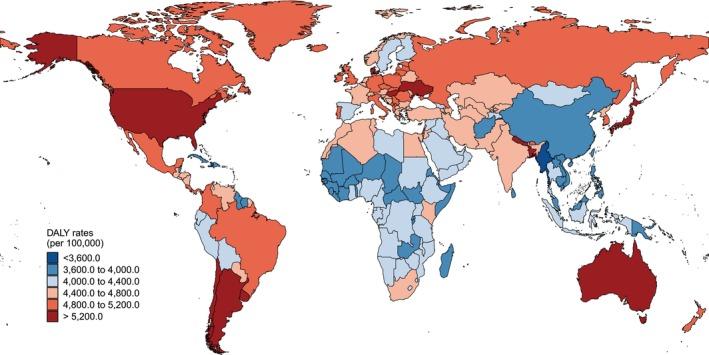
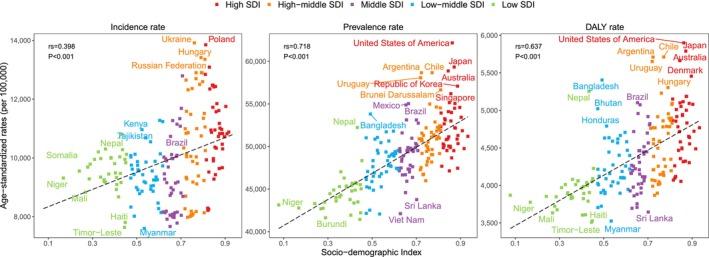
From 1990 to 2021, MSK disorders remained the largest contributor to total years lived with disability (YLDs) among adults aged 50 and over globally. The global age-standardized incidence rate significantly decreased (AAPC = -0.181, 95% CI: -0.190 to -0.172), whereas the global prevalence and disability-adjusted life-year (DALY) rates significantly increased (AAPC = 0.126, 95% CI: 0.118-0.134, and AAPC = 0.057, 95% CI: 0.042-0.072, respectively). High sociodemographic index (SDI) countries exhibited the highest age-standardized incidence, prevalence and DALY rates (11 236.6, 56 308.1 and 5277.1 per 100 000 population, respectively), whereas low-middle SDI countries showed the most rapid increases in prevalence and DALY rates (AAPC = 0.229, 95% CI: 0.218-0.240, and AAPC = 0.230, 95% CI: 0.204-0.256, respectively). Significantly positive associations were identified between SDI and age-standardized incidence, prevalence and DALY rates (all p < 0.001). High body mass index (BMI) was the largest contributor to global DALYs of MSK disorders, accounting for 10.3% of the total in this population, whereas occupational ergonomic factors, smoking and kidney dysfunction contributed 7.3%, 6.0% and 0.2%, respectively. Although the proportions of DALYs due to occupational ergonomic factors and smoking declined globally (from 9.2% to 7.3% and from 8.9% to 6.0%, respectively), those due to high BMI and kidney dysfunction increased (from 7.7% to 10.3% and from 0.19% to 0.22%, respectively). Both absolute and relative SDI-related inequalities persisted across 204 countries and territories, with no significant changes observed.
CONCLUSIONS
MSK disorders have remained the largest contributor to disability among adults aged 50 and over. Despite significant progress in reducing the incidence rate, both the prevalence and DALY rates have significantly increased. With the expanding global ageing population, there is an urgent need for improved prevention strategies to mitigate the long-term impacts of MSK disorders in this vulnerable population.
背景
50岁及以上的成年人特别容易患肌肉骨骼疾病,随着全球人口老龄化,预计其影响会加剧。本研究旨在全面评估1990年至2021年50岁及以上成年人中肌肉骨骼疾病的全球负担,以及时间趋势、风险因素和社会人口不平等情况。
方法
数据来源于《2021年全球疾病负担研究》。通过计算平均年度百分比变化(AAPC)来评估年龄标准化率的时间趋势。分别使用不平等斜率指数和集中指数评估绝对和相对不平等情况。
结果
1990年至2021年,肌肉骨骼疾病仍然是全球50岁及以上成年人残疾生存总年数(YLD)的最大贡献因素。全球年龄标准化发病率显著下降(AAPC = -0.181,95%CI:-0.190至-0.172),而全球患病率和残疾调整生命年(DALY)率显著上升(AAPC分别为0.126,95%CI:0.118 - 0.134;以及AAPC为0.057,95%CI:0.042 - 0.072)。社会人口指数(SDI)高的国家年龄标准化发病率、患病率和DALY率最高(分别为每10万人口11236.6、56308.1和5277.1),而中低SDI国家的患病率和DALY率增长最快(AAPC分别为0.229,95%CI:0.218 - 0.240;以及AAPC为0.230,95%CI:0.204 - 0.256)。SDI与年龄标准化发病率、患病率和DALY率之间存在显著正相关(所有p < 0.001)。高体重指数(BMI)是肌肉骨骼疾病全球DALY的最大贡献因素,占该人群总数的10.3%,而职业工效学因素、吸烟和肾功能不全分别占7.3%、6.0%和0.2%。尽管全球因职业工效学因素和吸烟导致的DALY比例下降(分别从9.2%降至7.3%和从8.9%降至6.0%),但因高BMI和肾功能不全导致的比例上升(分别从7.7%升至10.3%和从0.19%升至0.22%)。在204个国家和地区,与SDI相关的绝对和相对不平等情况持续存在,未观察到显著变化。
结论
肌肉骨骼疾病仍然是50岁及以上成年人残疾的最大贡献因素。尽管在降低发病率方面取得了显著进展,但患病率和DALY率均显著上升。随着全球老龄化人口的增加,迫切需要改进预防策略,以减轻肌肉骨骼疾病对这一弱势群体的长期影响。



 Zotero 插件