
在营养物质可利用的情况下,非生长底物乙烷会干扰专性甲烷氧化菌OB3b的核心甲烷营养作用。
Non-growth substrate ethane perturbs core methanotrophy in obligate methanotroph OB3b upon nutrient availability.
作者信息
Park Sunho, Shin Chungheon, Criddle Craig S, Myung Jaewook
机构信息
Department of Civil and Environmental Engineering, Korea Advanced Institute of Science and Technology (KAIST), Daejeon, Republic of Korea.
Department of Civil and Environmental Engineering, Stanford University, Stanford, California, USA.
出版信息
Appl Environ Microbiol. 2025 Aug 20;91(8):e0096925. doi: 10.1128/aem.00969-25. Epub 2025 Jul 10.
UNLABELLED
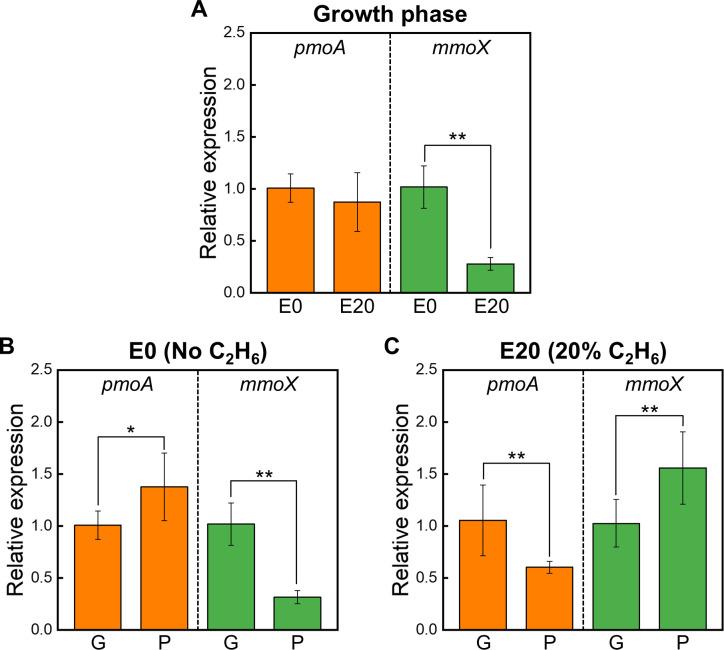
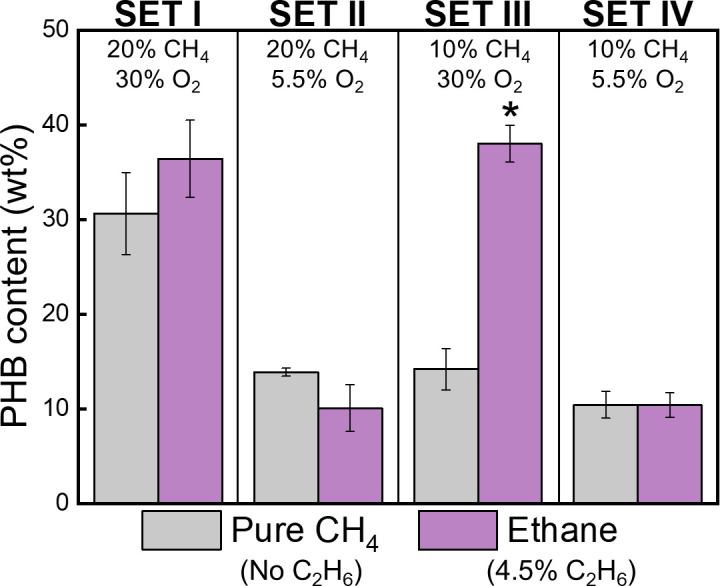
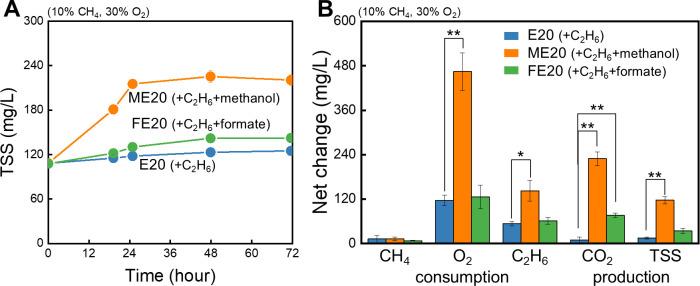
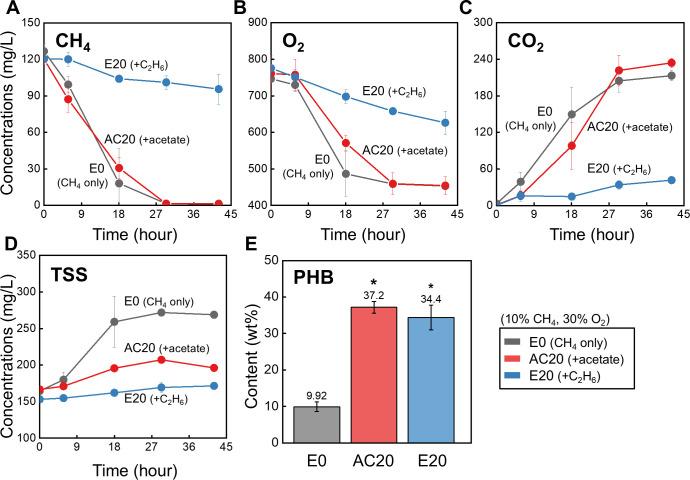
Obligate methanotrophs grow exclusively on C1 compounds; however, their widespread ecological distribution and ability to produce polyhydroxybutyrate (PHB) under nutrient stress suggest a greater-than-expected degree of metabolic flexibility. However, the metabolic responses of type II obligate methanotrophs to heterogeneous substrate conditions, common in natural and engineered environments, remain poorly understood. Here, we investigated how ethane (CH), a non-growth substrate and methane monooxygenase (MMO) co-substrate, affects the metabolism of OB3b under varying CH concentrations and nutrient availabilities (CH, O, and nitrogen). Exposure to CH impaired CH oxidation and cell growth while stimulating PHB synthesis, with these effects becoming more pronounced at higher CH levels. Externally supplemented reducing equivalents were preferentially directed toward CH uptake rather than CH oxidation under co-substrate conditions. Additionally, acetate derived from CH exerted divergent effects on carbon assimilation during growth and PHB accumulation phases, without directly interfering with CH oxidation. RT-qPCR unraveled that MMO gene expression responded to CH in a nutrient availability-dependent manner, with opposing patterns during growth and PHB accumulation phases. Interestingly, MMO transcript levels did not correlate with CH oxidation rates, suggesting that MMO mRNA abundance may not serve as a reliable proxy for actual methanotrophic activity under co-substrate conditions. These findings highlight the significant effects of heterogeneous substrate environments-containing co-metabolic substrates and microbial metabolites-on obligate methanotrophs, offering insights for revisiting methanotrophic activities in ecosystems and optimizing biotechnological applications.
IMPORTANCE
Type II methanotrophs present a dual advantage: mitigating methane emissions and producing bioproducts such as polyhydroxybutyrate (PHB). However, their full potential remains untapped, partly due to a limited understanding of how co-occurring gases influence their metabolism. Methane-rich emissions from both natural and anthropogenic sources are frequently accompanied by secondary gases, such as ethane, which create heterogeneous substrate conditions. This study reveals that ethane, a non-growth co-metabolic substrate, significantly modulates the metabolism of type II obligate methanotrophs, affecting microbial growth, methane oxidation, and PHB synthesis. These results advance our understanding of the metabolic plasticity of these organisms and also reveal new opportunities to leverage secondary substrates for selectively fine-tuning beneficial methanotrophic activities, such as biopolymer production.
未标记
专性甲烷营养菌仅以C1化合物为生长底物;然而,它们广泛的生态分布以及在营养胁迫下产生聚羟基丁酸酯(PHB)的能力表明其代谢灵活性程度高于预期。然而,II型专性甲烷营养菌对自然和工程环境中常见的异质底物条件的代谢反应仍知之甚少。在此,我们研究了乙烷(CH)这种非生长底物和甲烷单加氧酶(MMO)的共底物,在不同的CH浓度和营养可用性(CH、O和氮)下如何影响OB3b的代谢。暴露于CH会损害CH氧化和细胞生长,同时刺激PHB合成,在较高CH水平下这些影响会更加明显。在共底物条件下,外部补充的还原当量优先用于CH摄取而非CH氧化。此外,源自CH的乙酸盐在生长和PHB积累阶段对碳同化产生不同影响,而不会直接干扰CH氧化。RT-qPCR分析表明,MMO基因表达以营养可用性依赖的方式对CH作出反应,在生长和PHB积累阶段呈现相反模式。有趣的是,MMO转录水平与CH氧化速率不相关,这表明在共底物条件下,MMO mRNA丰度可能无法可靠地代表实际的甲烷营养活性。这些发现突出了包含共代谢底物和微生物代谢物的异质底物环境对专性甲烷营养菌的显著影响,为重新审视生态系统中的甲烷营养活性和优化生物技术应用提供了见解。
重要性
II型甲烷营养菌具有双重优势:减少甲烷排放和生产聚羟基丁酸酯(PHB)等生物产品。然而,它们的全部潜力尚未得到充分挖掘,部分原因是对共存气体如何影响其代谢的了解有限。自然和人为来源的富含甲烷的排放物通常伴随着乙烷等二次气体,这会产生异质底物条件。本研究表明,乙烷这种非生长共代谢底物会显著调节II型专性甲烷营养菌的代谢,影响微生物生长、甲烷氧化和PHB合成。这些结果增进了我们对这些生物体代谢可塑性的理解,也揭示了利用二次底物选择性微调有益甲烷营养活性(如生物聚合物生产)的新机会。



 Zotero 插件