
2016 - 2023年非洲恶性疟原虫分离株离体抗疟药物疗效评估:一项基因型 - 表型关联研究
Assessment of ex vivo antimalarial drug efficacy in African Plasmodium falciparum parasite isolates, 2016-2023: a genotype-phenotype association study.
作者信息
Rosado Jason, Fola Abebe A, Cojean Sandrine, Sarrasin Véronique, Coppée Romain, Bailly Justine, Zaffaroulah Rizwana, Bouzayene Azza, Cicéron Liliane, Houzé Ludivine, Crudale Rebecca, Musset Lise, Thellier Marc, Pradines Bruno, Clain Jérôme, Bailey Jeffrey A, Houzé Sandrine
机构信息
Université Paris Cité, IRD, Inserm, MERIT, Paris, F-75006, France.
Department of Pathology and Laboratory Medicine, Brown University, RI, 02906, USA; Center for Computational Molecular Biology, Brown University, RI, 02906, USA.
出版信息
EBioMedicine. 2025 Jul 9;118:105835. doi: 10.1016/j.ebiom.2025.105835.
BACKGROUND
Given the altered responses to both artemisinins and lumefantrine in Eastern Africa, monitoring antimalarial drug resistance in all African countries is paramount.
METHODS
We measured the susceptibility to six antimalarials using ex vivo growth inhibition assays (IC) for a total of 805 Plasmodium falciparum isolates obtained from travellers returning to France (2016-2023), mainly from West and Central Africa. Isolates were sequenced using molecular inversion probes (MIPs) targeting forty-three genes across the parasite genome, of which nineteen are drug resistance genes.
FINDINGS
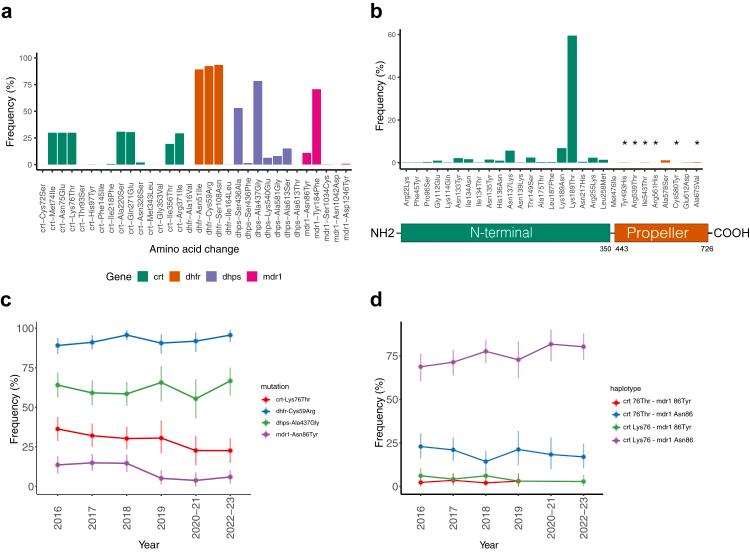
Ex vivo susceptibility of all assessed antimalarial compounds was consistent with their potent activity. The median IC values for the six drugs were 1.1 nM [IQR: 0.8-1.7] for DHA, 16.7 nM [9.9-27.4] for LMF, 29.5 nM [19.1-45.5] for MFQ, 23.4 nM [17.1-39.0] for MDAQ, 26.7 nM [18.0-41.2] for CQ, and 18.5 nM [15.1-24.3] for PPQ. Only four isolates carried a validated pfkelch13 mutation. Multiple mutations in pfcrt and one in pfmdr1 (Asn86Tyr) were significantly associated with altered susceptibility to multiple drugs, and their frequencies decreased over time. Pfcrt and pfmdr1 mutations altered susceptibility to lumefantrine and mefloquine in an additive manner, with the wild-type haplotype (pfcrt K76-pfmdr1 N86) exhibiting the lowest susceptibility.
INTERPRETATION
Our study on P. falciparum isolates from West and Central Africa indicates a low frequency of molecular markers associated with artemisinin resistance and a modest but significant decrease (1.6-2.3X) in the frequency of multidrug resistance markers. These genotypic changes likely mark parasite adaptation to sustained drug pressure and call for intensifying the monitoring of antimalarial drug resistance in Africa.
FUNDING
This work was supported by the French Ministry of Health (grant to the French National Malaria Reference Centre) and by the Agence Nationale de la Recherche (ANR-17-CE15-0013-03 to JC). JAB was supported by NIH R01AI139520. JR postdoctoral fellowship was funded by Institut de Recherche pour le Développement.
背景
鉴于青蒿素和本芴醇在东非的反应发生了变化,监测所有非洲国家的抗疟药物耐药性至关重要。
方法
我们使用体外生长抑制试验(IC)测量了805株恶性疟原虫分离株对六种抗疟药物的敏感性,这些分离株主要来自西非和中非,是2016年至2023年返回法国的旅行者身上获取的。使用分子倒置探针(MIP)对分离株进行测序,该探针靶向寄生虫基因组中的43个基因,其中有19个是耐药基因。
研究结果
所有评估的抗疟化合物的体外敏感性与其强效活性一致。六种药物的IC中位数分别为:双氢青蒿素(DHA)1.1 nM[四分位距:0.8 - 1.7],本芴醇(LMF)16.7 nM[9.9 - 27.4],甲氟喹(MFQ)29.5 nM[19.1 - 45.5],哌喹(MDAQ)23.4 nM[17.1 - 39.0],氯喹(CQ)26.7 nM[18.0 - 41.2],以及咯萘啶(PPQ)18.5 nM[15.1 - 24.3]。只有四个分离株携带经过验证的pfkelch13突变。pfcrt中的多个突变和pfmdr1中的一个突变(Asn86Tyr)与对多种药物敏感性的改变显著相关,并且它们的频率随时间下降。pfcrt和pfmdr1突变以累加方式改变对本芴醇和甲氟喹的敏感性,野生型单倍型(pfcrt K76 - pfmdr1 N86)表现出最低的敏感性。
解读
我们对来自西非和中非的恶性疟原虫分离株的研究表明,与青蒿素耐药性相关的分子标记频率较低,多药耐药标记频率有适度但显著的下降(1.6 - 2.3倍)。这些基因型变化可能标志着寄生虫对持续药物压力的适应,因此需要加强对非洲抗疟药物耐药性的监测。
资金来源
这项工作得到了法国卫生部(授予法国国家疟疾参考中心的资助)和法国国家研究机构(给JC的ANR - 17 - CE15 - 0013 - 03)的支持。JAB得到了美国国立卫生研究院R01AI139520的支持。JR博士后奖学金由法国发展研究所资助。



 Zotero 插件