
间充质干细胞对表达嵌合抗原受体的T淋巴细胞和自然杀伤细胞功能的影响。
Effects of Mesenchymal Stem Cells on Functions of Chimeric Antigen Receptor-Expressing T Lymphocytes and Natural Killer Cells.
作者信息
Volarevic Vladislav, Harrell Carl Randall, Arsenijevic Aleksandar, Djonov Valentin, Volarevic Ana
机构信息
Departments of Genetics, Microbiology and Immunology, Center for Research on Harmful Effects of Biological and Chemical Hazards, Faculty of Medical Sciences, University of Kragujevac, 69 Svetozara Markovica Street, 34000 Kragujevac, Serbia.
Regenerative Processing Plant, LLC, 34176 US Highway 19 N, Palm Harbor, FL 34684, USA.
出版信息
Cells. 2025 Jun 25;14(13):978. doi: 10.3390/cells14130978.
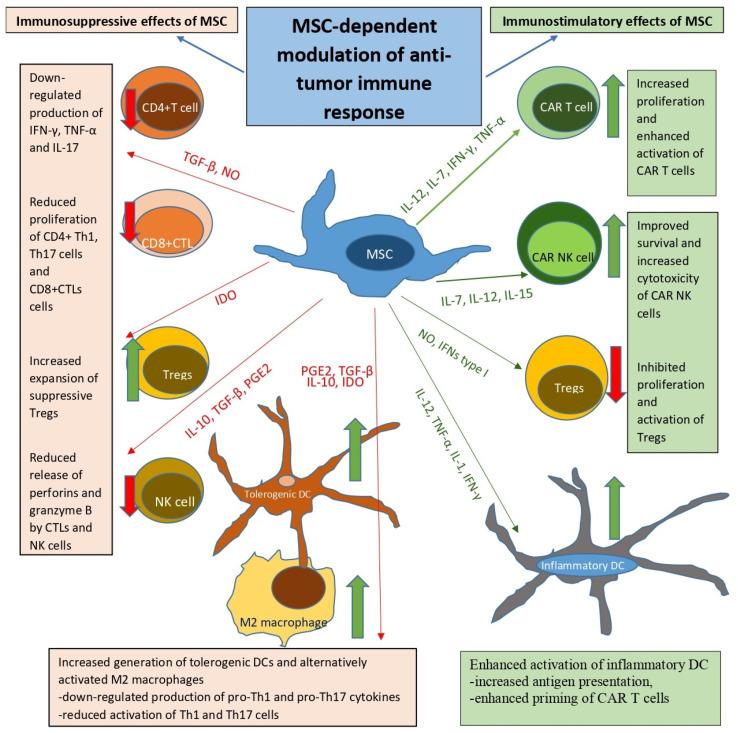
Chimeric antigen receptor (CAR)-engineered immune cells, particularly CAR T lymphocytes and CAR natural killer (NK) cells, have revolutionized cancer immunotherapy. However, their therapeutic efficacy and safety can be influenced by the tumor microenvironment, particularly the presence of mesenchymal stem cells (MSCs). MSCs are immunomodulatory cells which can alter the function of tumor-infiltrated immune cells in both supportive and suppressive ways. Results obtained in recently conducted experimental studies demonstrate that MSCs modulate proliferation, cytotoxicity, cytokine production and anti-tumor activity in CAR-expressing immune cells in both a juxtacrine and a paracrine manner. While MSCs can enhance CAR cell viability and persistence through trophic support, they may also impair cytotoxic function and promote an immunosuppressive phenotype under certain conditions. Understanding the dualistic nature of MSCs in CAR-based immunotherapy for malignant diseases is critical for optimizing clinical outcomes. Additionally, MSCs may serve as vehicles for targeted delivery of immunomodulatory agents, and should be considered as active components in the design of next-generation CAR-based immunotherapies. Accordingly, in this review article we emphasize molecular and cellular mechanisms involved in MSC-dependent modulation of CAR-expressing immune cells, paving the way for more efficient CAR-based immunotherapy for malignant diseases.
嵌合抗原受体(CAR)工程化免疫细胞,特别是CAR T淋巴细胞和CAR自然杀伤(NK)细胞,已经彻底改变了癌症免疫治疗。然而,它们的治疗效果和安全性可能会受到肿瘤微环境的影响,特别是间充质干细胞(MSC)的存在。MSC是免疫调节细胞,能够以支持和抑制的方式改变肿瘤浸润免疫细胞的功能。最近进行的实验研究结果表明,MSC以旁分泌和自分泌的方式调节表达CAR的免疫细胞的增殖、细胞毒性、细胞因子产生和抗肿瘤活性。虽然MSC可以通过营养支持提高CAR细胞的活力和持久性,但在某些情况下,它们也可能损害细胞毒性功能并促进免疫抑制表型。了解MSC在基于CAR的恶性疾病免疫治疗中的双重性质对于优化临床结果至关重要。此外,MSC可作为免疫调节药物靶向递送的载体,应被视为下一代基于CAR的免疫治疗设计中的活性成分。因此,在这篇综述文章中,我们强调了参与MSC依赖性调节表达CAR的免疫细胞的分子和细胞机制,为更有效的基于CAR的恶性疾病免疫治疗铺平了道路。
 Zotero 插件