
抗菌肽在伤口愈合和皮肤再生中的作用:在免疫和微生物防御中的双重角色
Antimicrobial Peptides in Wound Healing and Skin Regeneration: Dual Roles in Immunity and Microbial Defense.
作者信息
Adnan Siti Balqis, Maarof Manira, Fauzi Mh Busra, Md Fadilah Nur Izzah
机构信息
Department of Tissue Engineering and Regenerative Medicine (DTERM), Faculty of Medicine, Universiti Kebangsaan Malaysia, Cheras 56000, Kuala Lumpur, Malaysia.
Advance Bioactive Materials-Cells UKM Research Group, Universiti Kebangsaan Malaysia, Bangi 43600, Selangor, Malaysia.
出版信息
Int J Mol Sci. 2025 Jun 20;26(13):5920. doi: 10.3390/ijms26135920.
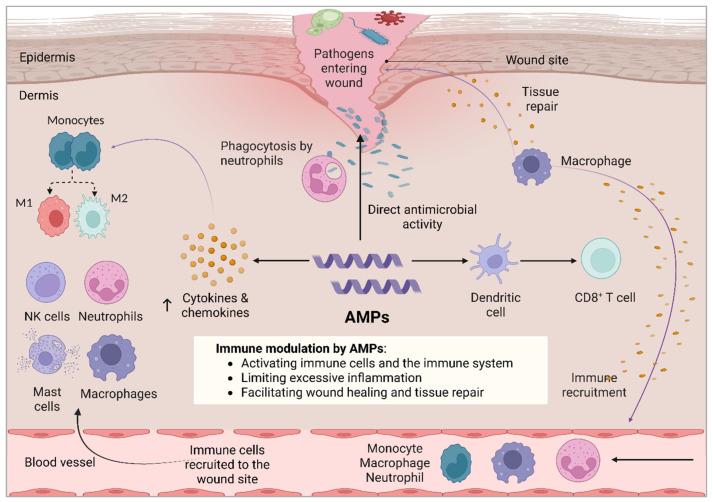
Although penicillin transformed antibiotic therapy, rising antimicrobial resistance (AMR) has limited its effectiveness, creating a need for new approaches in wound healing. Antimicrobial peptides (AMPs) are promising candidates due to their rapid membrane-disrupting action, immunomodulatory effects, and ability to target drug-resistant pathogens, though their specific roles in promoting wound healing are still not fully understood. This review aims to provide a comprehensive synthesis of the current evidence on the dual role of AMPs as both antimicrobial and immunomodulatory agents in the context of wound healing. Recent studies published between 2020 and 2025 were comprehensively reviewed, focusing on the mechanisms by which AMPs contribute to pathogen elimination, immune regulation, tissue repair, and inflammation resolution. AMPs not only exhibit rapid membrane-disruptive activities against a wide range of pathogens but also influence immune cell behavior, particularly by promoting macrophage polarization toward a reparative M2 phenotype, modulating cytokine and chemokine network, and maintaining T-cell homeostasis. Their ability to simultaneously control infection and regulate inflammation positions AMPs as promising candidates for advanced wound care strategies. The dual antimicrobial and immunomodulatory functions of AMPs represent a synergistic mechanism essential for effective wound recovery. Understanding and harnessing these properties can drive the development of innovative therapies, such as AMP-integrated smart biomaterials and targeted peptide delivery systems, offering new solutions for both acute and chronic wound management.
尽管青霉素改变了抗生素治疗方式,但不断上升的抗菌耐药性(AMR)限制了其有效性,这就需要在伤口愈合方面采用新方法。抗菌肽(AMPs)因其快速的膜破坏作用、免疫调节作用以及靶向耐药病原体的能力而成为有前景的候选物,不过它们在促进伤口愈合中的具体作用仍未完全明确。本综述旨在全面综合当前关于抗菌肽在伤口愈合背景下作为抗菌和免疫调节双重作用的证据。对2020年至2025年间发表的近期研究进行了全面综述,重点关注抗菌肽促进病原体清除、免疫调节、组织修复和炎症消退的机制。抗菌肽不仅对多种病原体表现出快速的膜破坏活性,还影响免疫细胞行为,特别是通过促进巨噬细胞向修复性M2表型极化、调节细胞因子和趋化因子网络以及维持T细胞稳态来实现。它们同时控制感染和调节炎症的能力使抗菌肽成为先进伤口护理策略的有前景候选物。抗菌肽的双重抗菌和免疫调节功能代表了有效伤口恢复所必需的协同机制。理解和利用这些特性可以推动创新疗法的发展,如整合抗菌肽的智能生物材料和靶向肽递送系统,为急性和慢性伤口管理提供新的解决方案。



 Zotero 插件