
选择通路分析以深入了解猫肥厚性心肌病发病机制的机理
Selected Pathway Analyses to Gain Mechanistic Insights into the Pathogenesis of Feline Hypertrophic Cardiomyopathy.
作者信息
Schurna Lea, Joshua Jessica, Monné Rodríguez Josep, Prisco Francesco, Baron Toaldo Marco, De Neck Simon, Baggio Francesca, Fonfara Sonja, Kipar Anja
机构信息
Institute of Veterinary Pathology, Vetsuisse Faculty, University of Zurich, 8057 Zurich, Switzerland.
Center for Clinical Studies, Vetsuisse Faculty, University of Zurich, 8057 Zurich, Switzerland.
出版信息
Int J Mol Sci. 2025 Jul 5;26(13):6497. doi: 10.3390/ijms26136497.
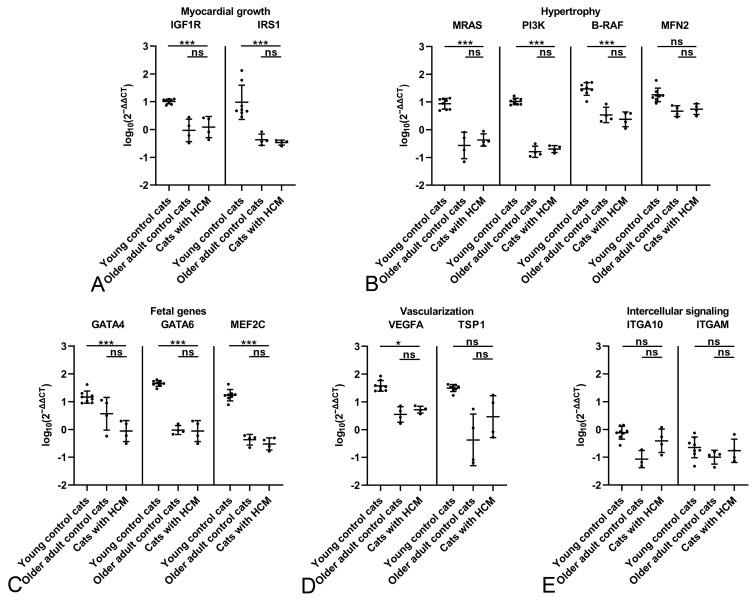
Hypertrophic cardiomyopathy (HCM) is the most prevalent acquired heart disease in cats and shares many clinical, phenotypical and pathological features with human HCM. Despite its relevance, knowledge on the pathomechanisms underlying the disease is limited. The present study aimed to characterize the molecular phenotypic changes in cardiomyocytes in feline HCM (fHCM) to better understand their contribution to the pathogenesis. To achieve this, the myocardium of the left ventricular free wall of 15 cats with confirmed fHCM and 30 control cats (two age groups: 16 cats 18-month-old, and 14 older adult cats without cardiac disease) were subjected to RT-qPCRs for markers representative of cardiomyocyte function. Overall, all markers were expressed at the highest level in young control cats, and increasing age correlated with decreased expression, regardless of sex. The comparison between the older adult control cats and those with HCM showed increased transcription levels for most markers associated with the disease, and higher expression of all markers in affected male cats compared to females. The constitutive transcription of all markers provides evidence of continuous myocardial adaptation throughout cats' life. The high transcription values in the myocardium of young healthy cats and male cats affected by HCM suggest a particularly high myocardial responsiveness early in life and with HCM and reveal sex as relevant factor in the disease process. These results support the relevance of age and sex in the cardiac response to HCM in feline hearts.
肥厚型心肌病(HCM)是猫最常见的后天性心脏病,与人类HCM有许多临床、表型和病理特征。尽管其具有相关性,但对该疾病潜在发病机制的了解有限。本研究旨在表征猫肥厚型心肌病(fHCM)心肌细胞的分子表型变化,以更好地理解它们在发病机制中的作用。为实现这一目标,对15只确诊为fHCM的猫和30只对照猫(两个年龄组:16只18个月大的猫和14只无心脏病的老年猫)左心室游离壁的心肌进行了逆转录定量聚合酶链反应(RT-qPCR),以检测代表心肌细胞功能的标志物。总体而言,所有标志物在年轻对照猫中表达水平最高,且无论性别,年龄增长与表达降低相关。老年对照猫与患有HCM的猫之间的比较显示,与该疾病相关的大多数标志物转录水平升高,且受影响的雄性猫中所有标志物的表达均高于雌性猫。所有标志物的组成型转录证明了猫一生中心肌的持续适应性。年轻健康猫和受HCM影响的雄性猫心肌中的高转录值表明,生命早期和患有HCM时心肌反应性特别高,并揭示性别是疾病过程中的一个相关因素。这些结果支持了年龄和性别在猫心脏对HCM的反应中的相关性。


 Zotero 插件