
尼日利亚12至23个月儿童全面免疫接种覆盖率的地区差异及孕产妇社会人口学决定因素:来自2018年尼日利亚人口与健康调查的见解
Regional Disparities and Maternal Sociodemographic Determinants of Full Immunization Coverage Among Children Aged 12-23 Months in Nigeria: Insights from NDHS 2018.
作者信息
Sani Jamilu, Halane Salad, Ahmed Mohamed Mustaf, Ahmed Abdiwali Mohamed, Hersi Mohamed Dahir
机构信息
Department of Demography and Social Statistics, Federal University, Birnin Kebbi, Kebbi State, Nigeria.
Department of Public Health, Ministry of Health, Galmudug, Somalia.
出版信息
Pediatric Health Med Ther. 2025 Jul 8;16:157-170. doi: 10.2147/PHMT.S520721. eCollection 2025.
BACKGROUND
Childhood immunization is crucial for reducing morbidity and mortality from vaccine-preventable diseases. Despite global efforts, Nigeria faces persistently low immunization uptake with significant regional and socioeconomic disparities. This study investigated the prevalence, regional disparities, and sociodemographic determinants of full immunization coverage among children aged 12-23 months in Nigeria.
METHODS
This secondary analysis utilized data from the 2018 Nigeria Demographic and Health Survey (NDHS), focusing on 2453 mothers with children aged 12-23 months. Full immunization coverage was defined per World Health Organization (WHO) guidelines. Descriptive statistics, bivariate analysis, and multivariable logistic regression identified predictors of coverage.
RESULTS
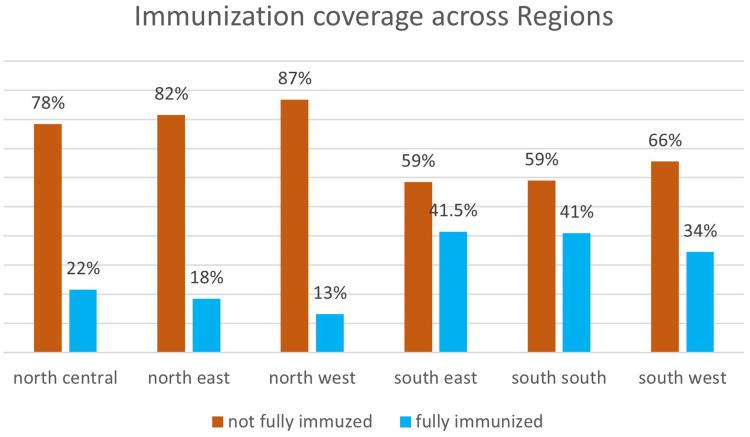
Only 26% of children were fully immunized nationwide. Marked regional disparities were observed, with the North West (13%) and North East (18%) exhibiting the lowest rates, while the South East (42%) and South South (41%) had the highest. Multivariable analysis revealed that maternal education, household wealth, and region of residence were significant predictors. Children of mothers with higher education were more likely to be fully immunized (AOR: 1.87, 95% CI: 1.10-3.18, p = 0.022), as were those from the richest households compared to the poorest (AOR: 3.20, 95% CI: 1.95-5.25, p < 0.001). Children in the South East (AOR: 2.00, 95% CI: 1.16-3.46, p = 0.013) and South South (AOR: 1.73, 95% CI: 0.99-3.02, p = 0.052) also showed significantly higher odds of full immunization compared to the North West.
CONCLUSION
Full immunization coverage in Nigeria remains critically low, driven by pronounced regional and socioeconomic inequities. Targeted interventions focusing on improving maternal education, expanding equitable healthcare access in underserved regions, and providing financial support to low-income families are essential. Policy efforts must prioritize these vulnerable groups to enhance child health outcomes and achieve universal immunization coverage in Nigeria.
背景
儿童免疫接种对于降低疫苗可预防疾病的发病率和死亡率至关重要。尽管全球都在努力,但尼日利亚的免疫接种率一直很低,存在显著的地区和社会经济差异。本研究调查了尼日利亚12至23个月大儿童的全程免疫覆盖率、地区差异以及社会人口学决定因素。
方法
这项二次分析利用了2018年尼日利亚人口与健康调查(NDHS)的数据,重点关注2453名有12至23个月大孩子的母亲。全程免疫覆盖率根据世界卫生组织(WHO)的指南定义。描述性统计、双变量分析和多变量逻辑回归确定了覆盖率的预测因素。
结果
全国只有26%的儿童实现了全程免疫。观察到明显的地区差异,西北部(13%)和东北部(18%)的免疫接种率最低,而东南部(42%)和南部(41%)的免疫接种率最高。多变量分析显示,母亲的教育程度、家庭财富和居住地区是显著的预测因素。母亲受教育程度较高的孩子更有可能实现全程免疫(调整后比值比:1.87,95%置信区间:1.10 - 3.18,p = 0.022),与最贫困家庭相比,最富裕家庭的孩子也是如此(调整后比值比:3.20,95%置信区间:1.95 - 5.25,p < 0.001)。与西北部相比,东南部(调整后比值比:2.00,95%置信区间:1.16 - 3.46,p = 0.013)和南部(调整后比值比:1.73,95%置信区间:0.99 - 3.02,p = 0.052)的儿童全程免疫的几率也显著更高。
结论
由于明显的地区和社会经济不平等,尼日利亚的全程免疫覆盖率仍然极低。针对性的干预措施,重点是提高母亲的教育程度、在服务不足地区扩大公平的医疗服务可及性以及为低收入家庭提供财政支持,至关重要。政策努力必须优先考虑这些弱势群体,以改善儿童健康状况并在尼日利亚实现普遍免疫覆盖。

 Zotero 插件