
用于铁离子检测的碳纳米点中双光子吸收诱导光致发光的高效猝灭
Efficient Quenching of Two-Photon Absorption Induced Photoluminescence in Carbon Nanodots for Fe Ion Detection.
作者信息
Siomra Agnieszka, Wawrzyńczyk Dominika, Cichy Bartłomiej, Wądrzyk Magdalena, Kasperkiewicz Paulina, Samoć Marek, Nyk Marcin
机构信息
Institute of Advanced Materials, Faculty of Chemistry, Wroclaw University of Science and Technology, Wybrzeze Wyspianskiego 27, 50-370 Wroclaw, Poland.
Polish Academy of Sciences, Institute of Low Temperature and Structure Research, Okolna 2, 50-422 Wroclaw, Poland.
出版信息
ACS Omega. 2025 Jun 26;10(26):28020-28031. doi: 10.1021/acsomega.5c01915. eCollection 2025 Jul 8.
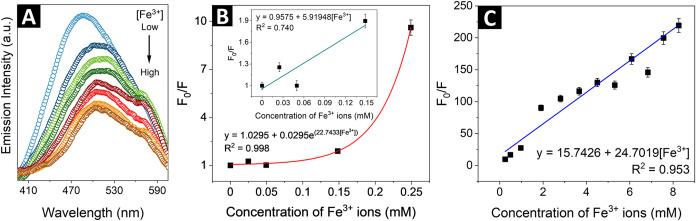
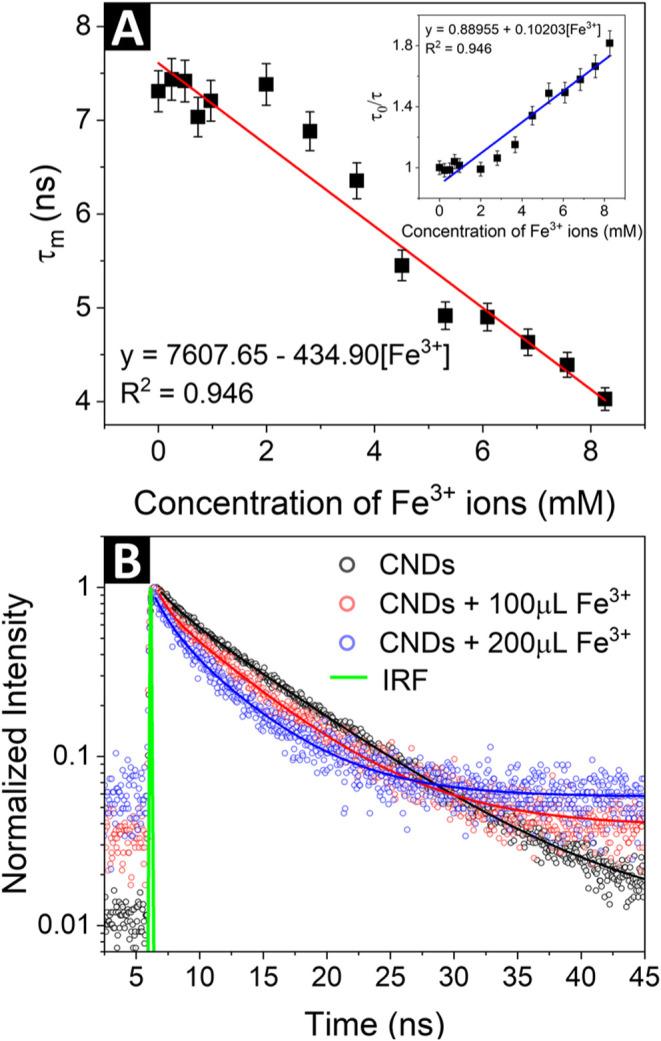
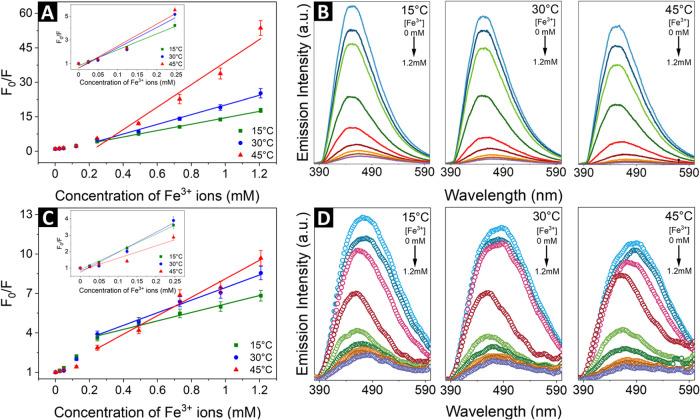
This study reports on the linear and nonlinear optical (NLO) properties of water-dispersed carbon nanodots (CNDs) fabricated via a rapid one-step hydrothermal microwave-assisted technique. The CNDs exhibit two-photon excited luminescence, which was characterized with spectrally tunable femtosecond laser pulses as involving the two-photon absorption (TPA) cross sections (σ) as large as 1.4 × 10 Goeppert-Mayer (GM) at the excitation wavelength of 720 nm and the quantum yield (QYs) of 28%. By analyzing the σ spectra, specific wavelength ranges optimal for excitation via the two-photon process were identified. In addition, the potential of the CNDs as sensors for the selective and sensitive detection of Fe ions through one- and two-photon induced fluorescence quenching was investigated. To gain deeper insights into the mechanism underlying the observed decrease in fluorescence intensity upon addition of Fe ions, potentially involving dynamic quenching, fluorescence quenching experiments across various temperatures were conducted, being the first such study in both one-photon and two-photon excitation regimes for this sensor. The possibility of energy transfer between CNDs and Fe ions was investigated by analyzing the luminescence kinetics using time-correlated single-photon counting (TCSPC) and streak camera techniques, in one- and two-photon regime, respectively. The pronounced nonlinear optical response of the CNDs highlights their potential as active optoelectronic materials for optical sensors operating in the near-infrared (NIR) region. Cytotoxicity studies of the water-dispersed CNDs revealed no observable toxicity, even at high concentrations, making them suitable for biorelated applications.
本研究报告了通过快速一步水热微波辅助技术制备的水分散碳纳米点(CND)的线性和非线性光学(NLO)特性。CND表现出双光子激发发光,用光谱可调谐飞秒激光脉冲进行表征,其在720nm激发波长下的双光子吸收(TPA)截面(σ)高达1.4×10戈培尔-迈耶(GM),量子产率(QYs)为28%。通过分析σ光谱,确定了双光子过程激发的最佳特定波长范围。此外,还研究了CND作为通过单光子和双光子诱导荧光猝灭选择性灵敏检测铁离子的传感器的潜力。为了更深入了解添加铁离子后观察到的荧光强度降低的潜在机制,可能涉及动态猝灭,进行了不同温度下的荧光猝灭实验,这是该传感器在单光子和双光子激发模式下的首次此类研究。分别在单光子和双光子模式下,通过使用时间相关单光子计数(TCSPC)和条纹相机技术分析发光动力学,研究了CND与铁离子之间能量转移的可能性。CND明显的非线性光学响应突出了它们作为在近红外(NIR)区域工作的光学传感器的有源光电子材料的潜力。水分散CND的细胞毒性研究表明,即使在高浓度下也没有明显毒性,使其适用于生物相关应用。



 Zotero 插件