
在约旦阿拉伯人群中研究突变与乳腺癌之间的联系。
Investigating the link between mutation and breast cancer in a Jordanian Arab population.
作者信息
Sharaf Baha, Bani Hani Hira, Zayed Anas, Barbar Maha, Khater Suhaib, Hushki Ahmad, Abdel-Razeq Rashid, Titi Mohammad, Al-Halalsheh Reem, Mahafdah Suleiman, Ashour Lin, Abdel-Razeq Hikmat
机构信息
Department of Internal Medicine, King Hussein Cancer Center, Amman, Jordan.
Department of Surgery, Royal Jordanian Medical Services, Amman, Jordan.
出版信息
Front Oncol. 2025 Jun 27;15:1557341. doi: 10.3389/fonc.2025.1557341. eCollection 2025.
INTRODUCTION
missense mutation, welldescribed in Ashkenazi Jewish, is commonly encountered among Jordanian patients with solid tumors. In this study, we investigated the potential association between the gene ( variant) and the risk of breast cancer among Jordanian Arab patients.
METHODS
All newly diagnosed patients with solid tumors were offered participation in a universal germline genetic screening study utilizing an investigational 84-gene panel. Patients were categorized based on whether they met or did not meet the criteria outlined in the National Comprehensive Cancer Network (NCCN) for genetic testing.
RESULTS
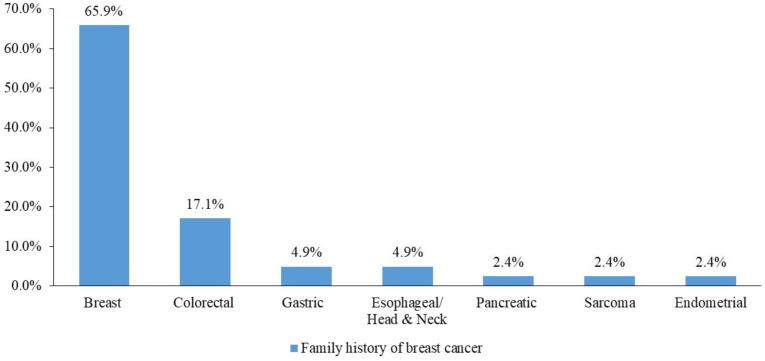
Among the screened cancer patients ( = 3,319), 136 (4.1%) had APCI1307K. Breast cancer was the most common primary tumor ( = 56, 41.2%). Among them, 41 (73.2%) had a screening colonoscopy, and 12 (29.3%) were found to have colorectal polyps, while 41.7% (5/12) had low-grade dysplasia. Of the 34 (25.0%) patients diagnosed with colorectal cancer, 23 (67.6%) exhibited tumors presenting as polyps, had concomitant polyps, or displayed background abnormalities with a polypoid nature.
DISCUSSION
These findings suggest that Arab individuals with the missense mutation are at higher risk of breast and familial colorectal cancers. The missense variant holds promise in informing screening and cancer prevention strategies. However, additional confirmation by larger studies is needed.
引言
错义突变在阿什肯纳兹犹太人中已有充分描述,在约旦实体瘤患者中也很常见。在本研究中,我们调查了该基因(变体)与约旦阿拉伯患者患乳腺癌风险之间的潜在关联。
方法
所有新诊断的实体瘤患者都被邀请参加一项使用84基因检测 panel 的通用种系基因筛查研究。患者根据是否符合美国国立综合癌症网络(NCCN)基因检测标准进行分类。
结果
在筛查的癌症患者(n = 3319)中,136 人(4.1%)携带 APC I1307K。乳腺癌是最常见的原发性肿瘤(n = 56,41.2%)。其中,41 人(73.2%)进行了结肠镜筛查,12 人(29.3%)被发现患有结直肠息肉,而 41.7%(5/12)有低度发育异常。在 34 名(25.0%)被诊断为结直肠癌的患者中,23 人(67.6%)的肿瘤表现为息肉、伴有息肉或显示有息肉样背景异常。
讨论
这些发现表明,携带该错义突变的阿拉伯个体患乳腺癌和家族性结直肠癌的风险更高。该错义变体有望为筛查和癌症预防策略提供依据。然而,需要更大规模的研究进行进一步证实。


 Zotero 插件