
将纳米传感器增强的可穿戴设备与机器学习相结合,用于精准健康管理,造福老年人群体。
Synergizing Nanosensor-Enhanced Wearable Devices with Machine Learning for Precision Health Management Benefiting Older Adult Populations.
作者信息
Li Zhihao, He Bangshun, Li Yiwei, Liu Bi-Feng, Zhang Guojun, Liu Songlin, Hu Tony Ye, Li Ying
机构信息
School of Laboratory Medicine, Engineering Research Center of TCM Protection Technology and New Product Development for the Elderly Brain Health, Ministry of Education, Hubei University of Chinese Medicine, 16 Huangjia Lake West Road, Wuhan 430065, China.
Hubei Shizhen Laboratory, 16 Huangjia Lake West Road, Wuhan 430065, China.
出版信息
ACS Nano. 2025 Jul 29;19(29):26273-26295. doi: 10.1021/acsnano.5c04337. Epub 2025 Jul 14.
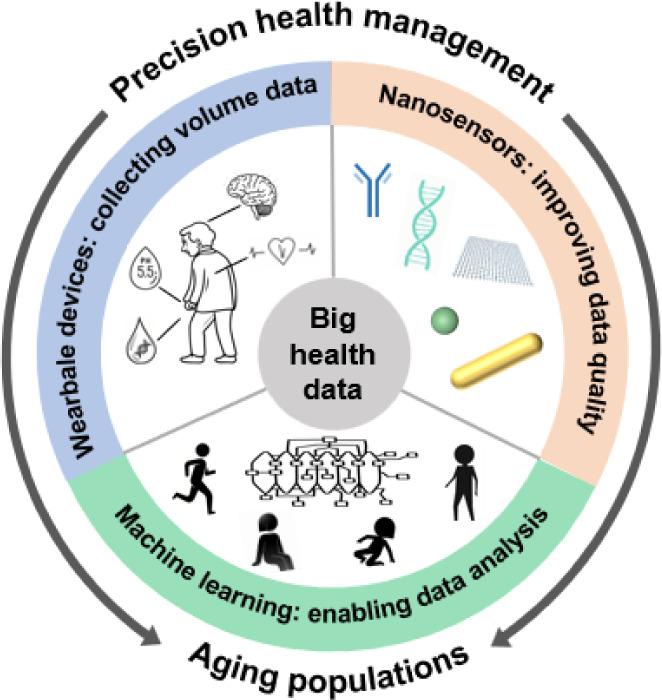
Population aging presents significant health challenges and socioeconomic burdens globally, driving an increased demand for precision health management. In the era of big data, the exponential growth of health information is accelerating advances in precision health strategies for older adults. For this population, effective strategies can be achieved by the integration of wearable devices, nanosensors, and machine learning. Wearable devices enable continuous monitoring of diverse, real-time health metrics, serving as vital tools for collecting comprehensive health data. Nanosensors can be loaded into wearable devices to enhance their performance by significantly improving detection sensitivity and specificity, thereby increasing the accuracy and reliability of the data collected. Meanwhile, machine learning provides powerful methods for rapid and efficient analysis of large-scale health data, driving the optimization of nanosensors as well as wearable devices. This review examines the synergistic roles of wearable devices, nanosensors, and machine learning in the precision health management field, focusing on the value of big health data (i.e., big data in health care). We begin by exploring wearable devices as critical tools for gathering extensive health information, followed by an in-depth discussion of how nanosensors enhance data quality. Subsequently, we highlight the contributions of machine learning algorithms to the precise analysis of big health data and propose several proactive health management strategies from the perspective of "diagnosis-analysis-prevention". Finally, we present perspectives on the future integration of these technologies to advance comprehensive health management, precision diagnostics, and personalized medicine for older individuals.
全球人口老龄化带来了重大的健康挑战和社会经济负担,推动了对精准健康管理的需求增长。在大数据时代,健康信息的指数级增长正在加速老年人精准健康策略的发展。对于这一人群,可通过整合可穿戴设备、纳米传感器和机器学习来实现有效的策略。可穿戴设备能够持续监测各种实时健康指标,是收集全面健康数据的重要工具。纳米传感器可被装入可穿戴设备,通过显著提高检测灵敏度和特异性来增强其性能,从而提高所收集数据的准确性和可靠性。同时,机器学习为大规模健康数据的快速高效分析提供了强大方法,推动了纳米传感器以及可穿戴设备的优化。本综述探讨了可穿戴设备、纳米传感器和机器学习在精准健康管理领域的协同作用,重点关注大健康数据(即医疗保健中的大数据)的价值。我们首先探讨可穿戴设备作为收集广泛健康信息的关键工具,接着深入讨论纳米传感器如何提高数据质量。随后,我们强调机器学习算法对大健康数据精确分析的贡献,并从“诊断 - 分析 - 预防”的角度提出几种积极的健康管理策略。最后,我们对这些技术未来的整合提出展望,以推进针对老年人的全面健康管理、精准诊断和个性化医疗。


 Zotero 插件