
GrimAge和GrimAge2年龄加速能有效预测死亡风险:一项回顾性队列研究。
GrimAge and GrimAge2 Age Acceleration effectively predict mortality risk: a retrospective cohort study.
作者信息
Zhu Tieshi, He Yong, Wang Yixi, Zhao Le
机构信息
Department of Medical Affairs, Agricultural Reclamation Central Hospital of Guangdong, Zhanjiang, Guangdong, China.
Department of Neurology, Zhanjiang Central Hospital, Guangdong Medical University, Zhanjiang, Guangdong, China.
出版信息
Epigenetics. 2025 Dec;20(1):2530618. doi: 10.1080/15592294.2025.2530618. Epub 2025 Jul 14.
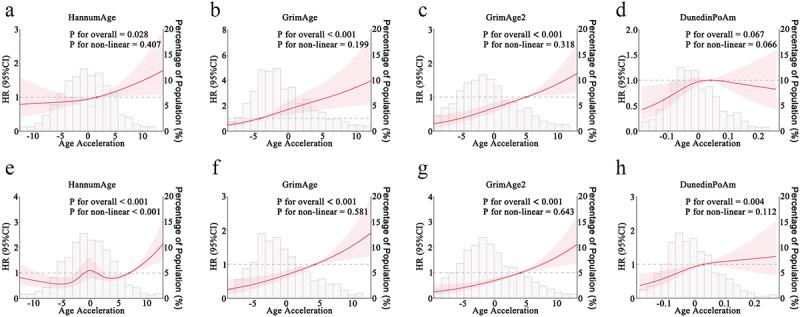
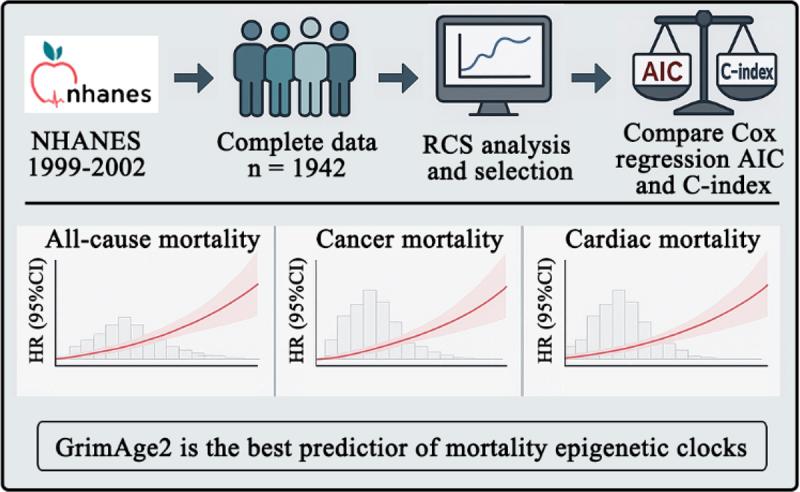
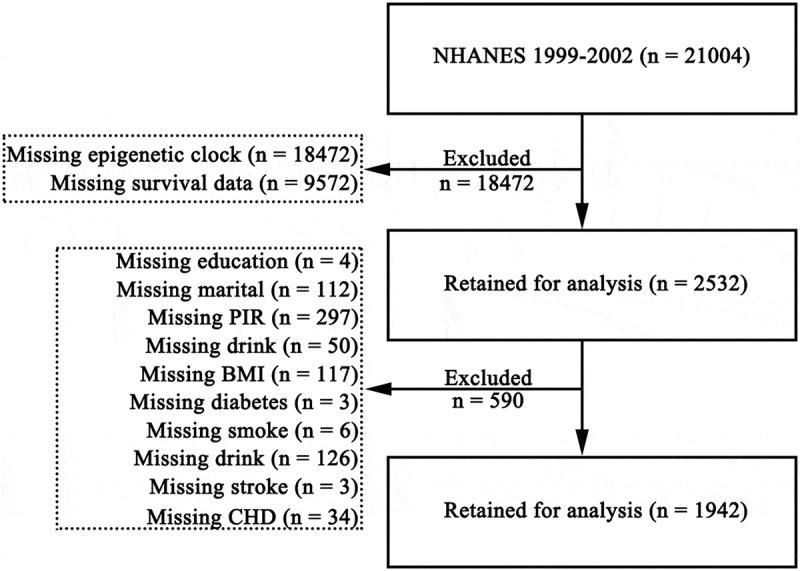
Epigenetic clocks have been widely applied to assess biological ageing, with Age Acceleration (AA) serving as a key metric linked to adverse health outcomes, including mortality. However, the comparative predictive value of AAs derived from different epigenetic clocks for mortality risk has not been systematically evaluated. In this retrospective cohort study based on 1,942 NHANES participants (median age 65 years; 944 women), we examined the associations between AAs from multiple epigenetic clocks and the risks of all-cause, cancer-specific, and cardiac mortality. Restricted cubic spline models were used to assess the shape of these associations, and Cox proportional hazards regression was employed to quantify risk estimates. Model performance was compared using the Akaike Information Criterion (AIC) and concordance index (C-index). Our findings revealed that only GrimAge AA and GrimAge2 AA demonstrated approximately linear and positive associations with all three mortality outcomes. Both were significantly associated with increased risks of death, and these associations were consistent across most subgroups. GrimAge and GrimAge2 AAs showed very similar performance in predicting all-cause, cancer and cardiac mortality, with only small differences in AIC values and C-index scores. These findings suggest that both GrimAge and GrimAge2 are effective epigenetic biomarkers for mortality risk prediction and may be valuable tools in future ageing-related research.
表观遗传时钟已被广泛应用于评估生物衰老,年龄加速(AA)作为与不良健康结局(包括死亡率)相关的关键指标。然而,来自不同表观遗传时钟的年龄加速对死亡风险的比较预测价值尚未得到系统评估。在这项基于1942名美国国家健康与营养检查调查(NHANES)参与者(年龄中位数65岁;944名女性)的回顾性队列研究中,我们研究了多个表观遗传时钟的年龄加速与全因、癌症特异性和心脏死亡率风险之间的关联。使用受限立方样条模型评估这些关联的形状,并采用Cox比例风险回归来量化风险估计值。使用赤池信息准则(AIC)和一致性指数(C指数)比较模型性能。我们的研究结果表明,只有GrimAge AA和GrimAge2 AA与所有三种死亡结局呈现出近似线性的正相关。两者均与死亡风险增加显著相关,且这些关联在大多数亚组中都是一致的。GrimAge和GrimAge2 AA在预测全因、癌症和心脏死亡率方面表现非常相似,AIC值和C指数得分仅有微小差异。这些研究结果表明,GrimAge和GrimAge2都是预测死亡风险的有效表观遗传生物标志物,可能是未来衰老相关研究中有价值的工具。

 Zotero 插件