
多模态深度学习提高膜性肾病病理诊断的准确性。
Multimodal deep learning improving the accuracy of pathological diagnoses for membranous nephropathy.
作者信息
Hu Xiuxiu, Yang Jinyue, Li Yiping, Gong Yuxiang, Ni Haifeng, Wei Qing, Yang Minyu, Zhang Yu, Huang Jing, Ma Cao, Wei Bizhen, Yu Kaijie, Xu Jiayun, Xia Siyu, Tang Taotao, Chen Pingsheng
机构信息
Department of Pathology, School of Medicine, Southeast University, Nanjing, China.
School of Automation, Southeast University, Nanjing, China.
出版信息
Ren Fail. 2025 Dec;47(1):2528106. doi: 10.1080/0886022X.2025.2528106. Epub 2025 Jul 14.
OBJECTIVES
Renal biopsy is the gold standard for the diagnosis of glomerular diseases including membranous nephropathy (MN), however, it faces challenges in accuracy, objectivity, and reproducibility of tissue evaluation. This study aims to develop a multimodal pathological diagnosis system to assist pathologists in diagnosing MN in morphology.
METHODS
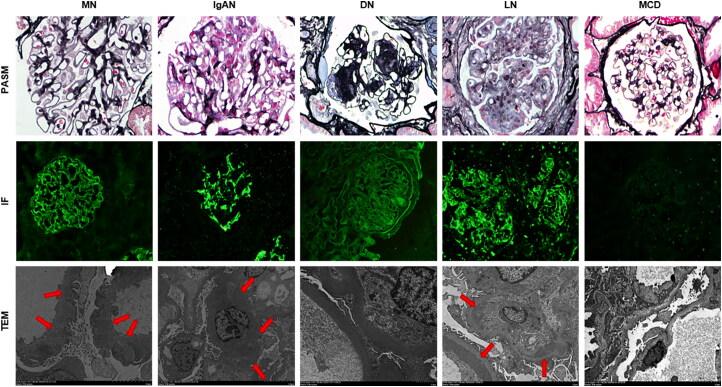
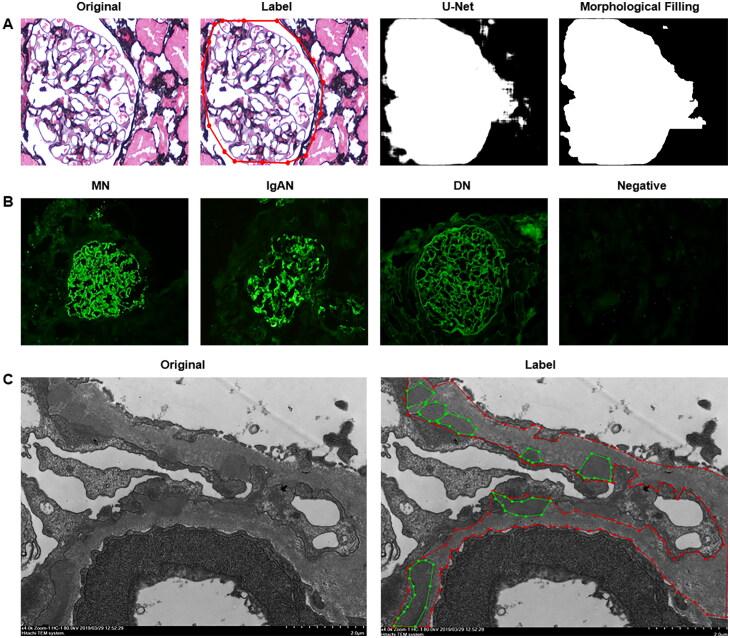
Using PASM-stained, immunofluorescence, and electron microscopy images from MN patients, we built three deep-learning models to detect lesions. The outputs of these models were combined to provide a comprehensive pathological diagnosis. Our system was compared with pathologists, validated on external test sets, and detected in 138 patients with various kidney diseases.
RESULTS
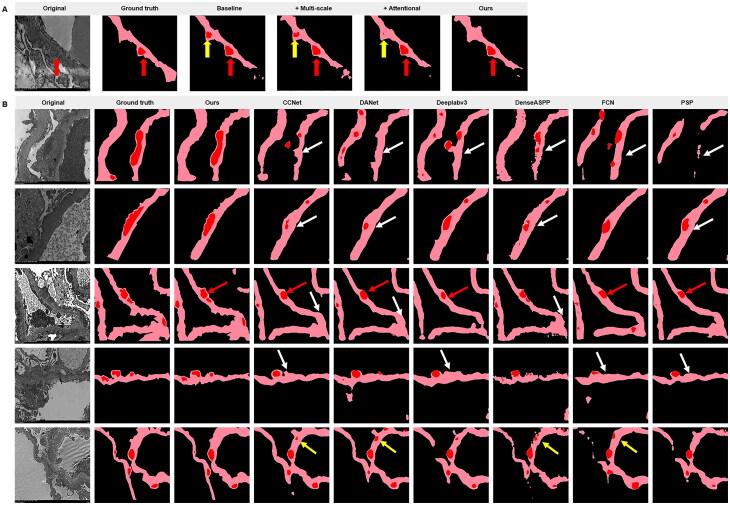
Considering PASM-stained images, our model had a classification accuracy of 91.74%, a recall of 81.97%, and an F1 score of 86.58% for spike identification. For immunofluorescence images, our model had an accuracy rate of 98.97%, a recall rate of 99.65%, and an F1 score of 99.31% for MN classification. Regarding the segmentation of electron-dense deposits, the segmentation model had a Dice coefficient of 85.66% and an IoU of 75.93%. Our model presented superior performance to that of pathologists in fluorescence image classification and segmentation of deposits, achieved high accuracy in spike identification and fluorescence image classification in external test sets, and could be targeted to diagnose MN in a wide range of glomerular diseases.
CONCLUSIONS
This multimodal pathological diagnosis system can not only assist pathologists in diagnosing MN rapidly and accurately but also lays the foundation to develop diagnostic models for other glomerular diseases.
目的
肾活检是诊断包括膜性肾病(MN)在内的肾小球疾病的金标准,然而,它在组织评估的准确性、客观性和可重复性方面面临挑战。本研究旨在开发一种多模态病理诊断系统,以协助病理学家对MN进行形态学诊断。
方法
我们使用MN患者的过碘酸六胺银(PASM)染色、免疫荧光和电子显微镜图像,构建了三个深度学习模型来检测病变。将这些模型的输出结果相结合,以提供全面的病理诊断。我们的系统与病理学家进行了比较,在外部测试集上进行了验证,并在138例患有各种肾脏疾病的患者中进行了检测。
结果
考虑PASM染色图像,我们的模型在钉突识别方面的分类准确率为91.74%,召回率为81.97%,F1分数为86.58%。对于免疫荧光图像,我们的模型在MN分类方面的准确率为98.97%,召回率为99.65%,F1分数为99.31%。关于电子致密沉积物的分割,分割模型的Dice系数为85.66%,交并比(IoU)为75.93%。我们的模型在荧光图像分类和沉积物分割方面表现优于病理学家,在外部测试集中的钉突识别和荧光图像分类方面达到了高精度,并且可以针对多种肾小球疾病诊断MN。
结论
这种多模态病理诊断系统不仅可以协助病理学家快速、准确地诊断MN,还为开发其他肾小球疾病的诊断模型奠定了基础。




 Zotero 插件