
髓系转换:特应性皮炎中的免疫驱动因素——在发病机制中的作用及新兴治疗靶点
The myeloid switch: immune drivers in atopic dermatitis - roles in pathogenesis and emerging therapeutic targeting.
作者信息
Kupschke Erik, Schenk Mirjam
机构信息
Christine Kühne - Center for Allergy Research and Education, Davos, Switzerland.
Graduate School for Cellular and Biomedical Sciences, University of Bern, Bern, Switzerland.
出版信息
Front Immunol. 2025 Jun 30;16:1608338. doi: 10.3389/fimmu.2025.1608338. eCollection 2025.
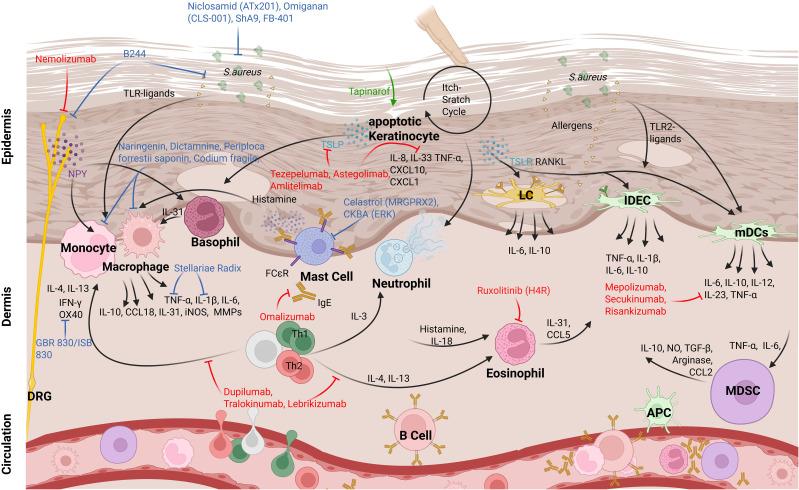
Atopic dermatitis (AD) is one of the most common chronic inflammatory skin diseases worldwide, significantly impairing patients' quality of life. It is characterized by recurrent eczematous lesions, intense pruritus, and disruption of the epidermal barrier. The pathogenesis of AD is multifactorial and involves complex interactions between genetic predisposition, environmental triggers, skin barrier defects, microbial dysbiosis, and immune dysregulation. While much of the research in recent decades has focused on the type 2 helper T cell (Th2)-driven adaptive immune responses that dominate the acute phase of the disease, the role of innate immunity-particularly that of myeloid cells-has emerged as a crucial and underrated component in disease pathogenesis and progression. This review highlights recent findings on the role of myeloid cells in the initiation, maintenance, and amplification of inflammation in AD. Myeloid cells respond to a wide range of environmental and tissue-derived triggers, including cytokines, alarmins, and microbial products. Upon activation, they contribute to the inflammatory milieu by producing chemokines and cytokines, presenting antigens, and recruiting other immune cells to the skin. Importantly, myeloid cells not only shape the local immune landscape but also engage in crosstalk with keratinocytes and adaptive immune cells, thereby reinforcing chronic inflammation. In addition, the review outlines emerging therapeutic strategies aimed at modulating myeloid cell function or selectively targeting pro-inflammatory subsets. These approaches offer promising avenues that complement existing Th2-centered therapies, addressing disease mechanisms beyond the adaptive immune response. A deeper understanding of the diverse and dynamic roles of myeloid cells in AD may thus support the development of more comprehensive and personalized treatment strategies for long-term disease control.
特应性皮炎(AD)是全球最常见的慢性炎症性皮肤病之一,严重损害患者的生活质量。其特征为反复发作的湿疹样皮损、剧烈瘙痒以及表皮屏障破坏。AD的发病机制是多因素的,涉及遗传易感性、环境触发因素、皮肤屏障缺陷、微生物群落失调和免疫失调之间的复杂相互作用。尽管近几十年来的许多研究都集中在主导疾病急性期的2型辅助性T细胞(Th2)驱动的适应性免疫反应上,但固有免疫的作用——尤其是髓样细胞的作用——已成为疾病发病机制和进展中一个关键且被低估的组成部分。本综述重点介绍了髓样细胞在AD炎症的起始、维持和放大中的作用的最新研究发现。髓样细胞对多种环境和组织来源的触发因素作出反应,包括细胞因子、警报素和微生物产物。激活后,它们通过产生趋化因子和细胞因子、呈递抗原以及招募其他免疫细胞至皮肤,从而促成炎症环境。重要的是,髓样细胞不仅塑造局部免疫格局,还与角质形成细胞和适应性免疫细胞进行串扰,进而强化慢性炎症。此外,本综述概述了旨在调节髓样细胞功能或选择性靶向促炎亚群的新兴治疗策略。这些方法提供了有前景的途径,可补充现有的以Th2为中心的疗法,解决适应性免疫反应之外的疾病机制。因此,更深入地了解髓样细胞在AD中多样且动态的作用,可能有助于制定更全面、个性化的长期疾病控制治疗策略。

 Zotero 插件