
使用超高效液相色谱-高分辨率质谱法对用于结核病诊断的血浆生物标志物进行代谢组学和脂质组学研究。
Metabolomics and lipidomics of plasma biomarkers for tuberculosis diagnostics using UHPLC-HRMS.
作者信息
Sun Gaofeng, Wang Quan, Shan Xinjie, Kuerbanjiang Maierheba, Ma Ruiying, Zhou Wensi, Sun Lin, Li Qifeng
机构信息
Graduate of School, Xinjiang Medical University, Urumqi, China.
Department of Medical Laboratory, The Infectious Disease Hospital of Xinjiang Uygur Autonomous Region, Urumqi, China.
出版信息
Front Cell Infect Microbiol. 2025 Jun 30;15:1526740. doi: 10.3389/fcimb.2025.1526740. eCollection 2025.
INTRODUCTION
Determining metabolic profiles during host-pathogen interactions is crucial for developing novel diagnostic tests and exploring the mechanisms underlying infectious diseases. However, the characteristics of the circulating metabolites and their functions after infection have not been fully elucidated. Therefore, this study aimed to identify the differential metabolites in tuberculosis (TB) patients and explore the diagnostic value of these metabolites as potential biomarkers.
METHODS
Seventy-two TB patients and 78 healthy controls (HCs) were recruited as the training set, while 30 TB patients and 30 HCs were enrolled as the independent validation set. Metabolites in plasma samples were analyzed by high-resolution mass spectrometry. Differential metabolites were screened using principal component analysis and machine learning algorithms including LASSO, Random Forest, and XGBoost. The diagnostic accuracy of the core differential metabolites was evaluated. Pearson correlation analysis was performed.
RESULT
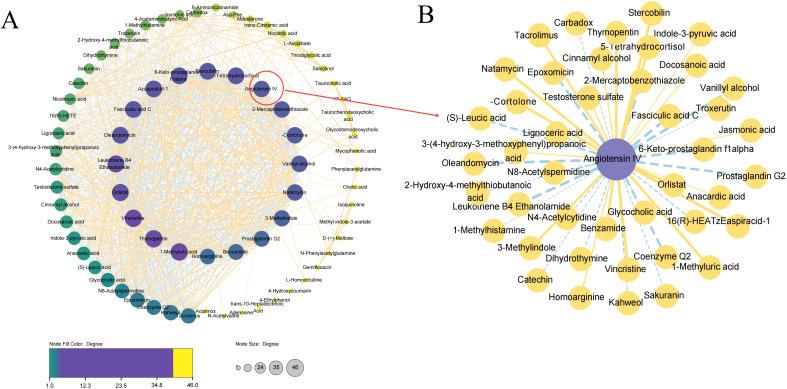
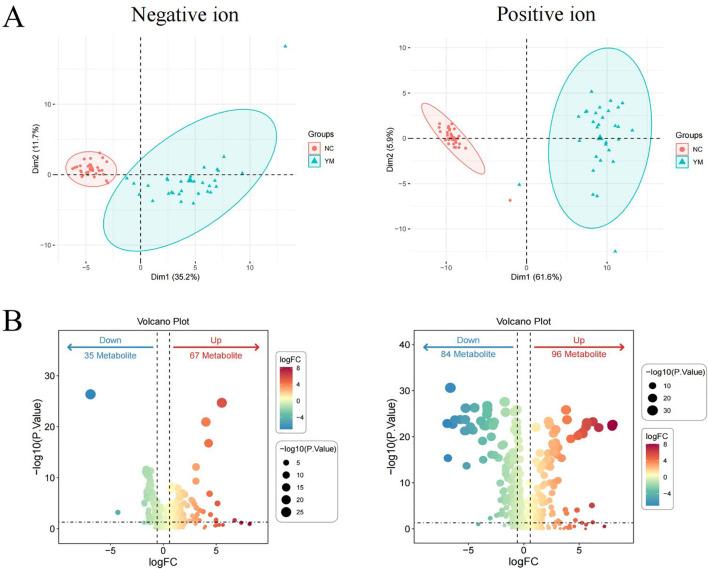
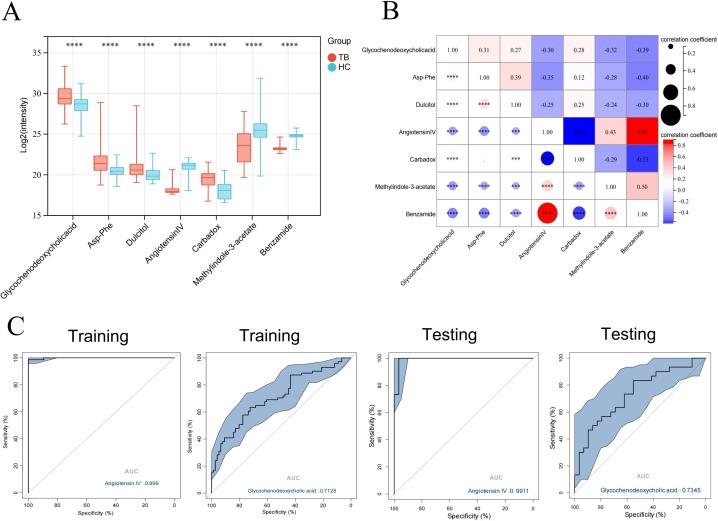
The metabolic profiling of TB patients showed significant separation from that of the HCs. In the training set, 282 metabolites were identified as differentially expressed in TB patients, with 214 metabolites validated in the independent validation cohort. KEGG pathway enrichment analysis showed that the differential metabolites were mainly enriched in lipid metabolism. Seven core differential metabolites were identified by the three machine learning algorithms. Receiver operating characteristic analysis revealed that Angiotensin IV had high accuracy in diagnosing TB.
CONCLUSION
These newly identified plasma metabolites are expected to serve as potentially valuable biomarkers for TB, potentially facilitating the diagnosis of the disease and enhancing the understanding of its underlying mechanisms.
引言
确定宿主与病原体相互作用期间的代谢谱对于开发新型诊断测试和探索传染病的潜在机制至关重要。然而,感染后循环代谢物的特征及其功能尚未完全阐明。因此,本研究旨在识别结核病(TB)患者中的差异代谢物,并探索这些代谢物作为潜在生物标志物的诊断价值。
方法
招募72例TB患者和78例健康对照(HC)作为训练集,同时招募30例TB患者和30例HC作为独立验证集。采用高分辨率质谱分析血浆样本中的代谢物。使用主成分分析和包括LASSO、随机森林和XGBoost在内的机器学习算法筛选差异代谢物。评估核心差异代谢物的诊断准确性。进行Pearson相关性分析。
结果
TB患者的代谢谱与HC有显著差异。在训练集中,282种代谢物被鉴定为在TB患者中差异表达,其中214种代谢物在独立验证队列中得到验证。KEGG通路富集分析表明,差异代谢物主要富集在脂质代谢中。通过三种机器学习算法鉴定出7种核心差异代谢物。受试者工作特征分析显示,血管紧张素IV在诊断TB方面具有较高的准确性。
结论
这些新鉴定的血浆代谢物有望作为TB潜在有价值的生物标志物,可能有助于疾病的诊断并增进对其潜在机制的理解。



 Zotero 插件