
孕期暴露于颗粒物与子痫前期风险:一项荟萃分析和孟德尔随机化研究的证据
Gestational Exposure to Particulate Matter and Preeclampsia Risk: Evidence from a Meta-Analysis and Mendelian Randomization Study.
作者信息
Ma Ruilin, Li Yanan, Cui Jianjian, Tao Hui, He Wencong, Sun Lei, Yang Zejun, Liu Ziyang, Zhao Yin
机构信息
Department of Obstetrics and Gynecology, Union Hospital, Tongji Medical College, Huazhong University of Science and Technology, Wuhan, China.
Shenzhen Huazhong University of Science and Technology Research Institute, Shenzhen, China.
出版信息
J Clin Hypertens (Greenwich). 2025 Jul;27(7):e70096. doi: 10.1111/jch.70096.
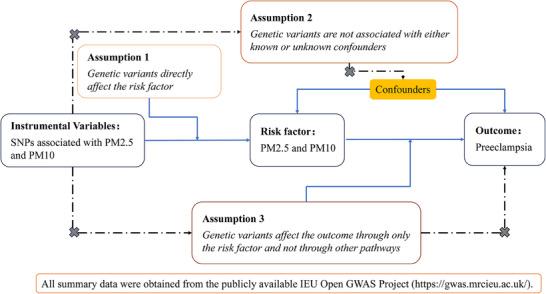
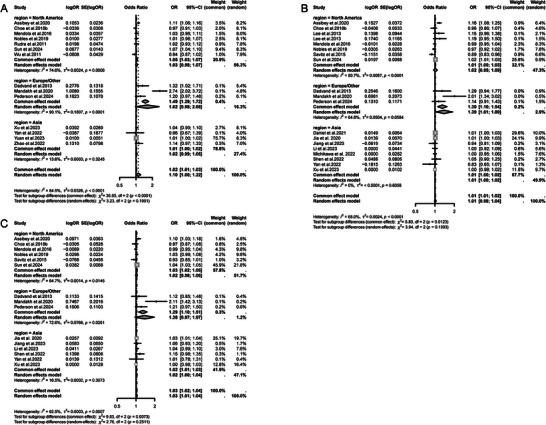
Preeclampsia (PE) is a severe hypertensive disorder that occurs during pregnancy. Exposure to particulate matter (PM), particularly fine particles such as PM2.5/PM10, has been investigated as a potential environmental risk factor for its development. In this study, we employed both meta-analysis and Mendelian randomization (MR) to investigate the relationship between PM exposure and PE risk. The meta-analysis of 26 studies (>2 million pregnancies) found modest associations between PM exposure and PE risk. In particular, PM2.5 exposure during the second trimester (OR = 1.03, 95% CI: 1.01-1.04) and PM10 exposure (OR = 1.06, 95% CI: 1.00-1.12) showed significant associations. Subgroup and meta-regression analyses revealed that regional differences, particularly between Europe and Asia, were major contributors to heterogeneity, while publication year showed minimal impact. In contrast, no significant associations were found for PM exposure during the first and third trimesters, with greater statistical uncertainty likely due to heterogeneity in study design and exposure assessment methods. The MR analysis, using genetic instruments from European genome-wide association studies data, did not support a causal relationship between PM exposure and PE risk (PM2.5: OR = 1.128, 95% CI: -0.593- 0.834; PM10: OR = 0.668, 95% CI: -1.482-0.675). These findings suggest that while PM exposure, particularly during mid-pregnancy, may be associated with increased PE risk in observational studies, the lack of a confirmed causal link in MR analysis indicates potential influence from residual confounding, exposure misclassification, and study heterogeneity. Therefore, the observed associations should be interpreted with caution.
子痫前期(PE)是一种在孕期发生的严重高血压疾病。接触颗粒物(PM),尤其是细颗粒物如PM2.5/PM10,已被作为其发病的潜在环境风险因素进行研究。在本研究中,我们采用荟萃分析和孟德尔随机化(MR)方法来探究PM暴露与PE风险之间的关系。对26项研究(超过200万例妊娠)的荟萃分析发现,PM暴露与PE风险之间存在适度关联。特别是,孕中期暴露于PM2.5(比值比[OR]=1.03,95%置信区间[CI]:1.01 - 1.04)和PM10暴露(OR = 1.06,95% CI:1.00 - 1.12)显示出显著关联。亚组分析和荟萃回归分析表明,区域差异,尤其是欧洲和亚洲之间的差异,是异质性的主要来源,而发表年份的影响最小。相比之下,孕早期和孕晚期的PM暴露未发现显著关联,可能由于研究设计和暴露评估方法的异质性导致更大的统计不确定性。使用来自欧洲全基因组关联研究数据的基因工具进行的MR分析不支持PM暴露与PE风险之间存在因果关系(PM2.5:OR = 1.128,95% CI: - 0.593 - 0.834;PM10:OR = 0.668,95% CI: - 1.482 - 0.675)。这些发现表明,虽然在观察性研究中,PM暴露,尤其是在孕中期,可能与PE风险增加有关,但MR分析中缺乏已证实的因果联系表明存在残余混杂、暴露错误分类和研究异质性的潜在影响。因此,对观察到的关联应谨慎解释。





 Zotero 插件