
减瘤性肾切除术对转移性肾细胞癌患者的生存益处:基于监测、流行病学和最终结果(SEER)数据库的回顾性队列研究证据
Survival benefits of Cytoreductive Nephrectomy in patients with metastatic renal cell carcinoma: evidence from a SEER-based retrospective cohort study.
作者信息
Peng Xiongwu, Duan Lingxing, Wu Qi, Wu Shiping, Wang Wenfeng, Shi Runlin
机构信息
Department of Urology, Nanchang University Second Affiliated Hospital, Nanchang, Jiangxi Province, China.
Department of Urology, Pingxiang Third People's Hospital, Pingxiang, Jiangxi Province, China.
出版信息
PLoS One. 2025 Jul 15;20(7):e0318896. doi: 10.1371/journal.pone.0318896. eCollection 2025.
BACKGROUND
Metastatic renal cell carcinoma (mRCC) is associated with poor prognosis, with a 5-year survival rate of less than 15%. Cytoreductive nephrectomy (CN) has historically played a critical role in mRCC management, potentially enhancing systemic therapy efficacy by reducing tumor burden. However, its relevance in the era of targeted therapies and immune checkpoint inhibitors (ICIs) has been questioned.
OBJECTIVE
This study evaluates the survival benefits of CN in mRCC patients using real-world, population-based data from the SEER database.
METHODS
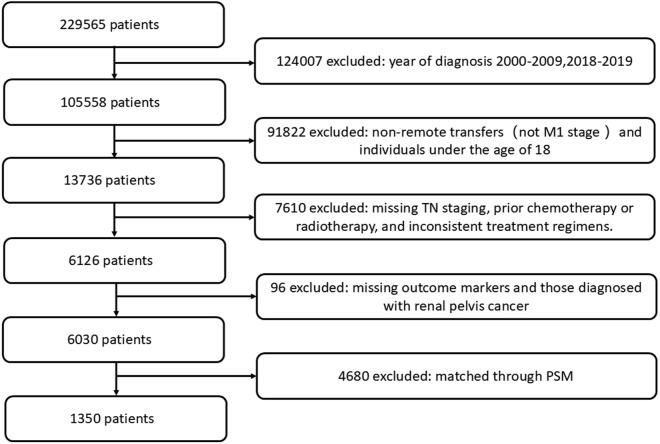
A retrospective cohort analysis of 6,030 mRCC patients was performed using data from 2010 to 2017. Propensity score matching (PSM) minimized selection bias, yielding 1,350 matched patients. Kaplan-Meier survival curves and multivariate Cox proportional hazards models assessed the impact of CN on overall survival (OS) and RCC-specific survival (CSS), stratified by demographic and clinical characteristics.
RESULTS
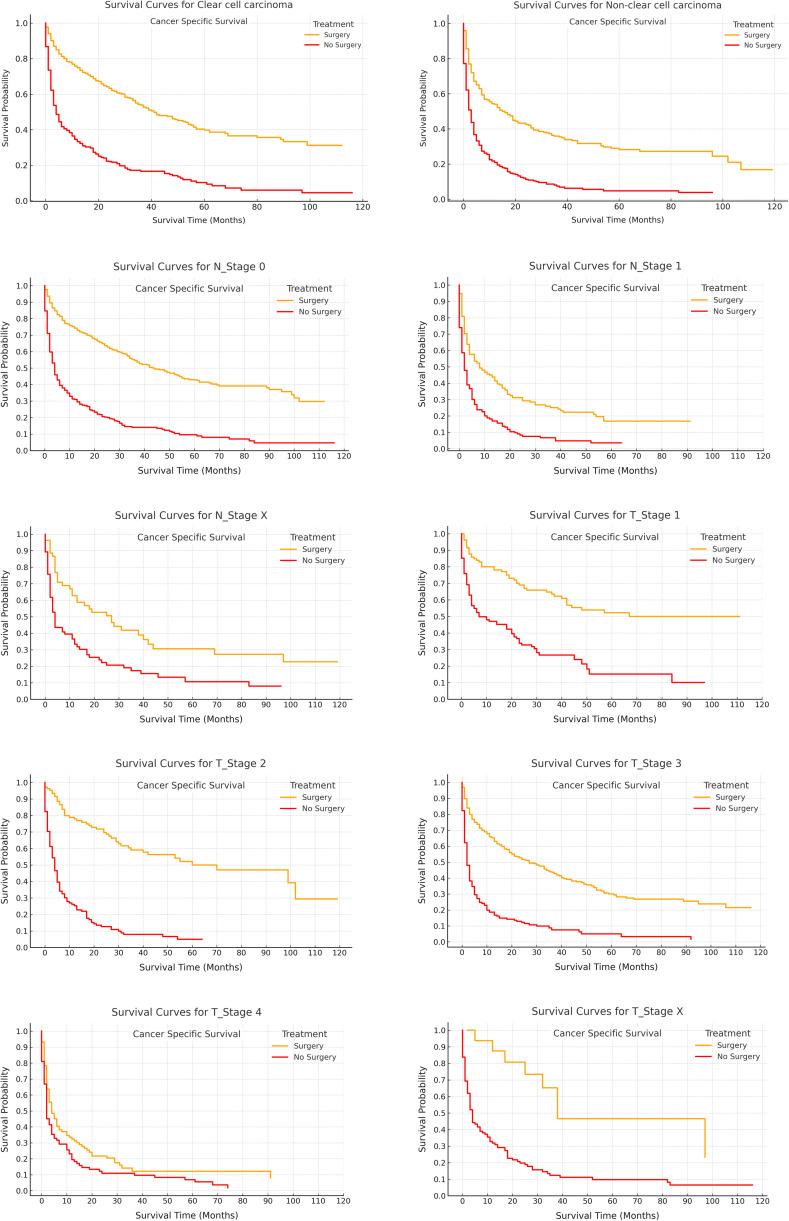
CN was associated with a 71% reduction in all-cause mortality (HR = 0.29, 95% CI = 0.25-0.33) and RCC-specific mortality (HR = 0.29, 95% CI = 0.25-0.34). Five-year OS rates were 31.5% in the CN group versus 3.6% in the non-CN group. Survival benefits were consistent across subgroups, including patients with high-grade or advanced-stage tumors, underscoring the role of CN within multimodal treatment strategies.
CONCLUSION
CN confers significant survival advantages in mRCC, even in challenging clinical scenarios. These findings reinforce the importance of integrating CN into multimodal therapeutic frameworks, particularly alongside modern systemic therapies. Further prospective studies are warranted to optimize patient selection and treatment sequencing.
背景
转移性肾细胞癌(mRCC)预后较差,5年生存率低于15%。既往减瘤性肾切除术(CN)在mRCC治疗中发挥了关键作用,可能通过减轻肿瘤负荷提高全身治疗疗效。然而,其在靶向治疗和免疫检查点抑制剂(ICI)时代的相关性受到了质疑。
目的
本研究使用来自监测、流行病学和最终结果(SEER)数据库的真实世界、基于人群的数据,评估CN对mRCC患者的生存获益。
方法
利用2010年至2017年的数据对6030例mRCC患者进行回顾性队列分析。倾向评分匹配(PSM)最小化了选择偏倚,产生了1350例匹配患者。采用Kaplan-Meier生存曲线和多变量Cox比例风险模型,根据人口统计学和临床特征分层,评估CN对总生存期(OS)和RCC特异性生存期(CSS)的影响。
结果
CN与全因死亡率降低71%(HR = 0.29,95%CI = 0.25 - 0.33)和RCC特异性死亡率降低71%(HR = 0.29,95%CI = 0.25 - 0.34)相关。CN组的5年OS率为31.5%,非CN组为3.6%。各亚组的生存获益一致,包括高级别或晚期肿瘤患者,突出了CN在多模式治疗策略中的作用。
结论
即使在具有挑战性的临床情况下,CN在mRCC中也具有显著的生存优势。这些发现强化了将CN纳入多模式治疗框架的重要性,特别是与现代全身治疗联合使用时。有必要进行进一步的前瞻性研究,以优化患者选择和治疗顺序。




 Zotero 插件