
介入治疗联合免疫靶向治疗不可切除的肝内胆管细胞癌:一项真实世界回顾性队列研究。
Interventional treatment combined with immunotargeted therapy in unresectable combined hepatocellular-cholangiocarcinoma: a real-world retrospective cohort study.
作者信息
Lin Yan-Song, Wu Li-Yan, Lin Li-Hui, Yang Xia, Liu Fang-Yi, Wu Yan-Qin, Ding Zhen, Liang Yu-Jing, Yun Jing-Ping
机构信息
State Key Laboratory of Oncology in South China, Guangdong Provincial Clinical Research Center for Cancer, Sun Yat-sen University Cancer Center, Guangzhou, China.
Department of Pathology, Sun Yat-sen University Cancer Center, Guangzhou, China.
出版信息
Front Immunol. 2025 Jul 1;16:1591127. doi: 10.3389/fimmu.2025.1591127. eCollection 2025.
BACKGROUND
Evidence-based treatment for unresectable combined hepatocellular-cholangiocarcinoma (cHCC-CCA) has not been established. This study aimed to assess the effectiveness and safety of interventional treatment combined with immunotargeted therapy (IIT) in unresectable cHCC-CCA patients.
METHODS
Patients with a histological diagnosis of unresectable cHCC-CCA who received IIT therapy from January 2019 to March 2024 were retrospectively enrolled. The study evaluated overall survival (OS), progression-free survival (PFS), tumor responses and safety.
RESULTS
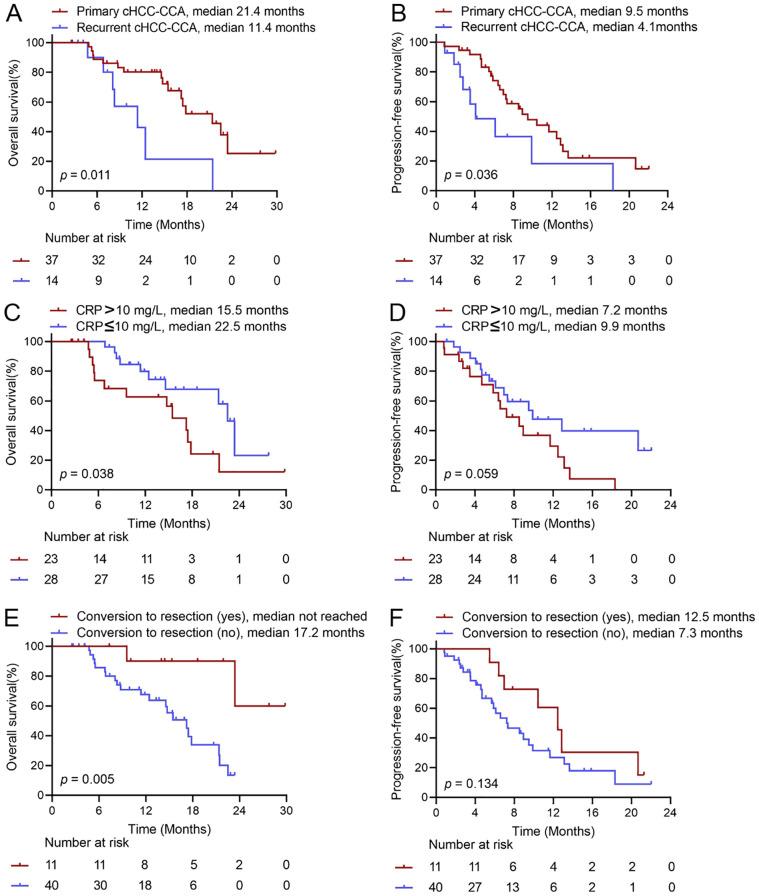
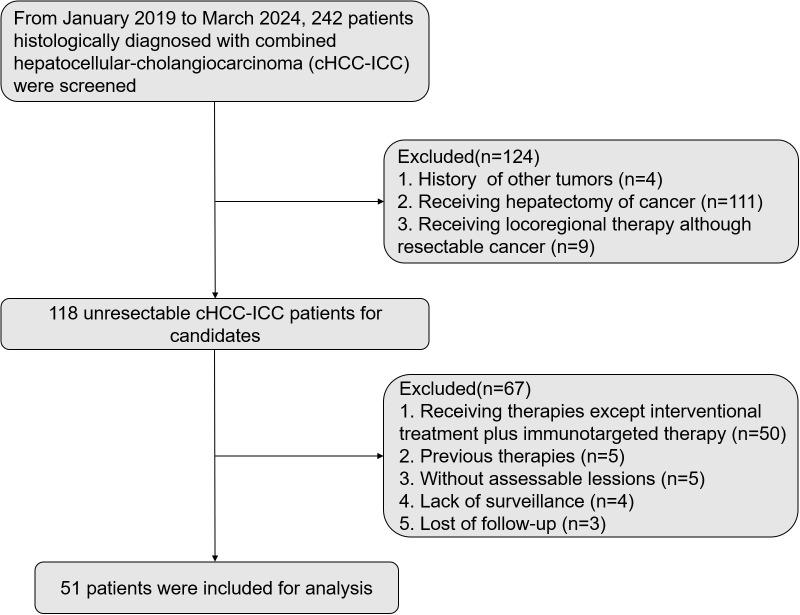
A total of 242 cHCC-CCA patients were screened and 51 patients were enrolled for analysis. The median follow-up duration was 15.8 months (95% CI: 12.0-19.7 months). The median OS was 17.8 months (95% CI: 12.4-23.2 months) and the median PFS was 8.9 months (95% CI: 5.8-12.0 months). For overall response, the objective response rate was 41.2% and 56.9% based on RECIST 1.1 and mRECIST, respectively. Patients with primary cHCC-CCA showed significantly prolonged OS (median OS: 21.4 months vs. 11.4 months, = 0.011) and PFS (median PFS: 9.5 months vs. 4.1 months, = 0.036) compared to those with recurrent cHCC-CCA. Patients with dominant HCC did not show significant differences for OS ( = 0.835) and PFS ( = 0.553) compared to those with dominant iCCA. Six patients (11.8%) experienced grade ≥3 adverse events, including leukopenia (n=1, 2.0%), neutropenia (n=1, 2.0%), thrombocytopenia (n=2, 3.9%), elevated alanine transaminase (ALT) (n=2, 3.9%), elevated aspartate aminotransferase (AST) (n=2, 3.9%), hypoalbuminemia (n=2, 3.9%), and hyperbilirubinemia (n=1, 2.0%). Immunotherapy was discontinued for two patients due to grade ≥3 elevations in ALT and AST.
CONCLUSION
The triple combination of interventional treatment, PD-(L)1 inhibitor, and targeted therapy is an effective and safe approach for unresectable cHCC-CCA patients.
背景
不可切除的肝细胞-胆管细胞癌(cHCC-CCA)的循证治疗方案尚未确立。本研究旨在评估介入治疗联合免疫靶向治疗(IIT)在不可切除的cHCC-CCA患者中的有效性和安全性。
方法
回顾性纳入2019年1月至2024年3月期间接受IIT治疗且组织学诊断为不可切除cHCC-CCA的患者。本研究评估了总生存期(OS)、无进展生存期(PFS)、肿瘤反应和安全性。
结果
共筛选出242例cHCC-CCA患者,51例患者纳入分析。中位随访时间为15.8个月(95%CI:12.0-19.7个月)。中位OS为17.8个月(95%CI:12.4-23.2个月),中位PFS为8.9个月(95%CI:5.8-12.0个月)。对于总体反应,基于RECIST 1.1和mRECIST的客观缓解率分别为41.2%和56.9%。与复发性cHCC-CCA患者相比,原发性cHCC-CCA患者的OS(中位OS:21.4个月对11.4个月,P=0.011)和PFS(中位PFS:9.5个月对4.1个月,P=0.036)显著延长。与以iCCA为主的患者相比,以HCC为主的患者在OS(P=0.835)和PFS(P=0.553)方面无显著差异。6例患者(11.8%)发生≥3级不良事件,包括白细胞减少(n=1,2.0%)、中性粒细胞减少(n=1,2.0%)、血小板减少(n=2,3.9%)、谷丙转氨酶(ALT)升高(n=2,3.9%)、谷草转氨酶(AST)升高(n=2,3.9%)、低白蛋白血症(n=2,3.9%)和高胆红素血症(n=1,2.0%)。2例患者因ALT和AST≥3级升高而停用免疫治疗。
结论
介入治疗、PD-(L)1抑制剂和靶向治疗的三联组合是不可切除cHCC-CCA患者的一种有效且安全的治疗方法。

 Zotero 插件