
原住民及托雷斯海峡岛民复杂创伤与优势问卷:心理测量学评估
Aboriginal and Torres Strait Islander Complex Trauma and Strengths Questionnaire: psychometric evaluation.
作者信息
Gee Graham, Bright Tess, Morgan Amy, Atkinson Carlie, Andrews Shawana, Clark Yvonne, Glover Karen, Hirvonen Tanja, Davis Elise, Jones Kimberley A, Reilly Rachel, Mensah Fiona, Hudson-Buhagiar Madelyne, Bennetts Shannon K, Herrman Helen, Milroy Helen, Mackinnon Andrew, Chamberlain Catherine
机构信息
Intergenerational Health Group, Murdoch Children's Research Institute, Parkville, Victoria, Australia.
School of Psychological Sciences, University of Melbourne, Parkville, Victoria, Australia.
出版信息
Aust J Psychol. 2024 May 23;76(1):2335917. doi: 10.1080/00049530.2024.2335917. eCollection 2024.
OBJECTIVE
Complex post-traumatic stress disorder (complex trauma) describes a cluster of symptoms frequently associated with prolonged exposure to inescapable threats or abuse. For Aboriginal and Torres Strait Islander peoples in Australia impacted by complex trauma, there may be compounding factors, such as experiences of historical trauma, loss and socio-economic deprivation stemming from colonisation. However, there is no culturally appropriate tool to assess complex trauma. This paper presents the psychometric evaluation of a preliminary version Aboriginal and Torres Strait Islander Complex Trauma and Strengths Questionnaire (ACTSQ).
METHODS
Following 2 years of rigorous Aboriginal-led co-design, participants were recruited through community networks and partner health services in South Australia, Victoria, and Northern Territory (October 2020-May 2022). A trained interviewer contacted Aboriginal ( = 109) and Torres Strait Islander ( = 1) parents aged >16 years by phone to complete the ACTSQ. Underlying domain structures were investigated with exploratory factor analysis and reviewed by experts to refine. Reliability and inter-rater reliability were assessed using McDonald's Omega and Intraclass Correlation Coefficient (ICC).
RESULTS
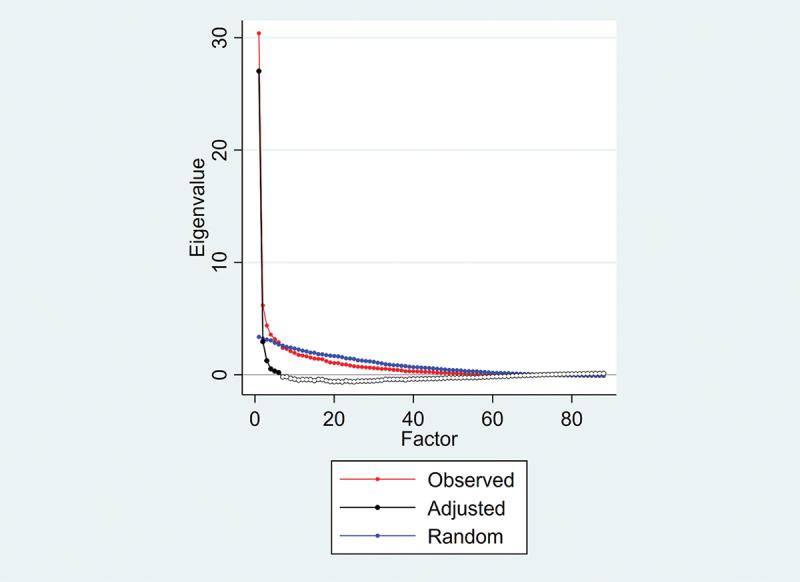
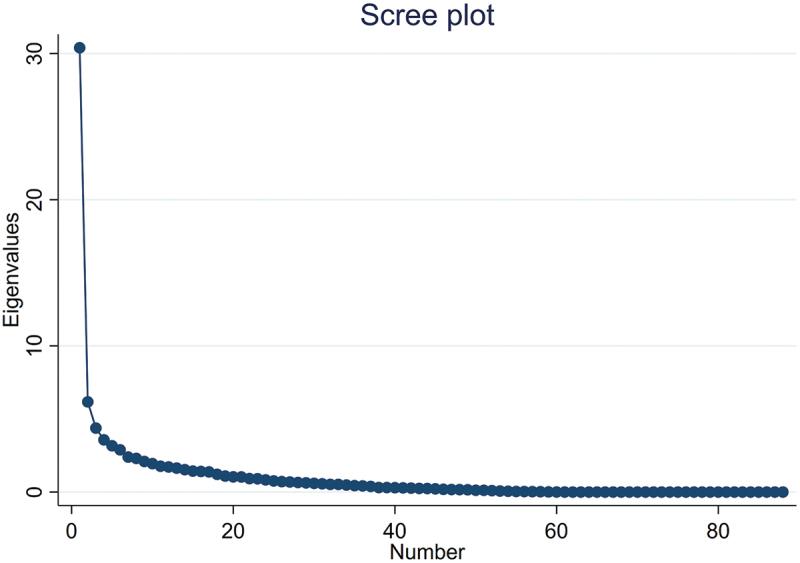
Forty-four items on five factors were retained. Factors were labelled complex trauma symptoms (16 items), grief, loss and disconnection (6 items), support and relationships (9 items), sense of self and strengths (7 items), and Cultural connections and resources (6 items). There were moderate correlations between factors, with the exception of factor 5. Omega was >0.75 for all factors. The inter-rater reliability for each factor was fair to good (ICC 0.5-0.7).
CONCLUSIONS
This study conducted a comprehensive psychometric validation that provides initial evidence towards the cultural validity of the ACTSQ to support assessment of complex trauma and strengths among Aboriginal and Torres Strait Islander peoples. Future studies are required to replicate and further evaluate the psychometric properties of the ACTSQ using larger samples.
目的
复杂性创伤后应激障碍(复杂创伤)描述了一组常与长期暴露于无法逃避的威胁或虐待相关的症状。对于澳大利亚受复杂创伤影响的原住民和托雷斯海峡岛民来说,可能存在一些复合因素,比如历史创伤经历、因殖民化导致的损失和社会经济剥夺。然而,目前尚无适合其文化背景的工具来评估复杂创伤。本文介绍了原住民和托雷斯海峡岛民复杂创伤与优势问卷(ACTSQ)初步版本的心理测量学评估。
方法
经过两年由原住民主导的严格协同设计后,通过南澳大利亚州、维多利亚州和北领地的社区网络及合作医疗服务机构招募参与者(2020年10月至2022年5月)。一名经过培训的访谈员通过电话联系年龄大于16岁的原住民(n = 109)和托雷斯海峡岛民(n = 1)父母,以完成ACTSQ。使用探索性因素分析研究潜在的领域结构,并由专家进行审查以完善。使用麦克唐纳欧米伽系数和组内相关系数(ICC)评估信度和评分者间信度。
结果
保留了五个因素的44个条目。各因素分别被标记为复杂创伤症状(16个条目)、悲伤、损失与脱节(6个条目)、支持与关系(9个条目)、自我意识与优势(7个条目)以及文化联系与资源(6个条目)。除因素5外,各因素之间存在中等程度的相关性。所有因素的欧米伽系数均大于0.75。各因素的评分者间信度为中等至良好(ICC 0.5 - 0.7)。
结论
本研究进行了全面的心理测量学验证,为ACTSQ在文化上的有效性提供了初步证据,以支持对原住民和托雷斯海峡岛民复杂创伤及优势的评估。未来研究需要使用更大样本重复并进一步评估ACTSQ的心理测量特性。



 Zotero 插件