
海洋快速变暖促使一种受威胁的海洋捕食性变温动物出现性别差异的栖息地利用模式。
Rapid Ocean Warming Drives Sexually Divergent Habitat Use in a Threatened Predatory Marine Ectotherm.
作者信息
Mead Lucy R, Piper Adam, Alvarado David Jiménez, Meyers Eva, Barker Joanna, Toledo-Padilla Hector, Herraiz Edy, Campoamor Alberto F, Sealey Michael, Caro Maria Belén, Bañeras Tomàs, Pike Charlotte, Gollock Matthew, Ravina-Olivares Felipe, Jacoby David M P
机构信息
Institute of Zoology, Zoological Society of London, London, UK.
School of Biological and Behavioural Sciences, Queen Mary University of London, London, UK.
出版信息
Glob Chang Biol. 2025 Jul;31(7):e70331. doi: 10.1111/gcb.70331.
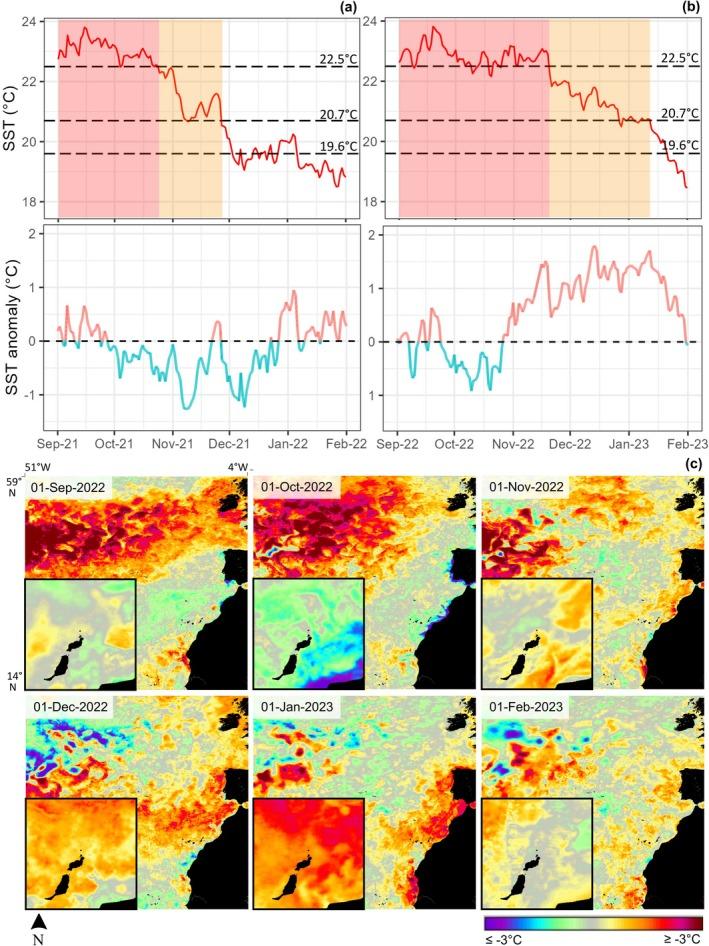
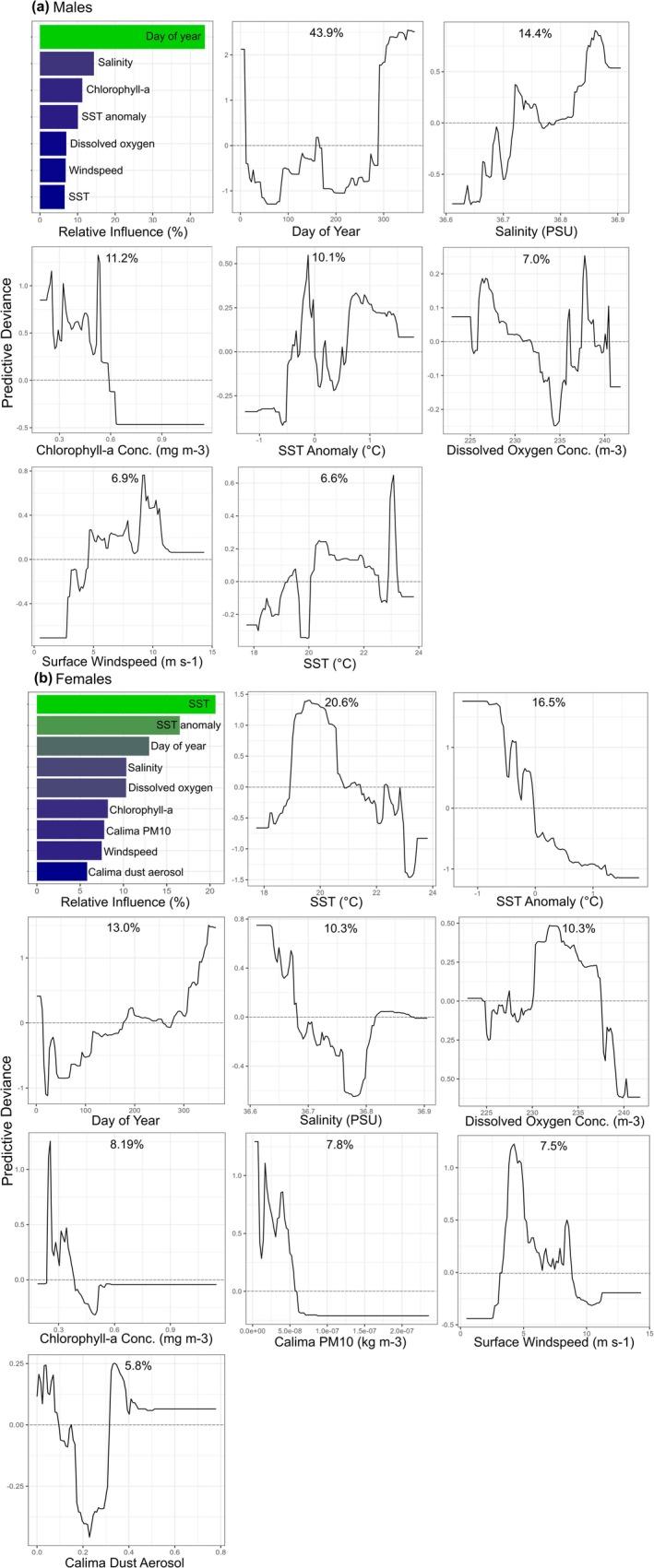
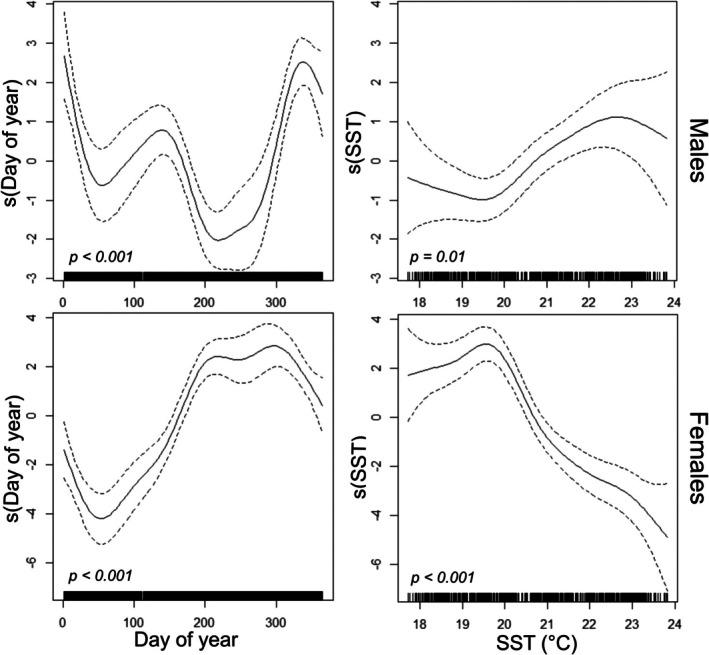
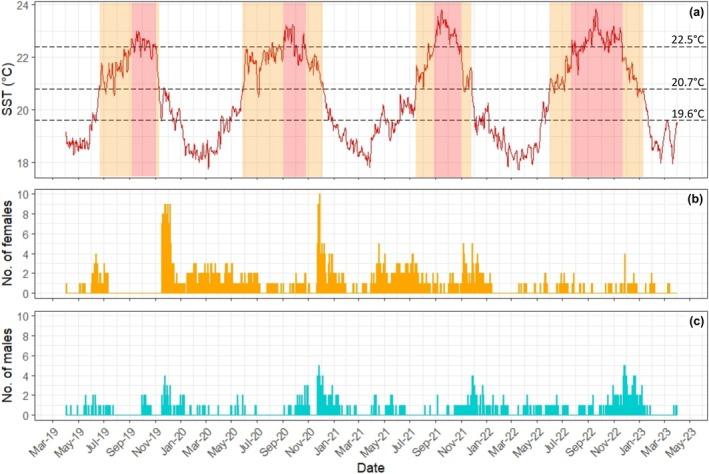
Climate change poses one of the greatest threats to marine ecosystems worldwide, altering physical, chemical, and biological processes at unprecedented rates. Severe impacts on marine species and habitats have been extensively documented, with shifts in phenology, spatial distribution, and migratory behaviour increasingly pervasive. However, there is a lack of species-specific data examining responses and adaptation to rapid warming and environmental extremes, especially for marine ectotherms. In this study, we investigate the broad-scale environmental drivers of distribution in a Critically Endangered ectothermic marine predator, the angelshark Squatina squatina, and report on a behavioural anomaly observed in 2022. Between 2018 and 2023, 112 adult S. squatina were tracked using acoustic telemetry in La Graciosa Marine Reserve in the Canary Islands. Relationships between seasonal presence of S. squatina and remotely sensed environmental parameters were examined with Boosted Regression Tree and Generalised Additive Modelling. Major sex differences were found, with female sharks strongly influenced by environmental conditions and particularly sensitive to temperature, with a possible upper thermal threshold close to 22.5°C. Peak sea surface temperature in the study area increased from 22.99°C to 23.81°C, and the number of days above 22.5°C nearly tripled. Absence of females during the 2022 breeding season coincided with widespread thermal anomalies across the Northeast Atlantic Ocean, with unusually high temperatures persisting later into the year. We conclude that this potentially disrupted seasonal thermal cues for S. squatina movement, leading to sexually divergent habitat use. Given the warming projected for this region, thermal thresholds may increasingly be exceeded, and key areas may become inhospitable for female S. squatina, which is of huge concern for this already highly threatened species. These findings highlight the urgency of identifying species-specific environmental tolerances and incorporating these into conservation so that management remains ecologically relevant in a rapidly warming ocean.
气候变化是全球海洋生态系统面临的最大威胁之一,正以前所未有的速度改变着物理、化学和生物过程。对海洋物种和栖息地的严重影响已有大量记录,物候、空间分布和迁徙行为的变化越来越普遍。然而,缺乏针对物种的特定数据来研究对快速变暖和极端环境的反应及适应情况,尤其是对于海洋变温动物。在本研究中,我们调查了极度濒危的变温海洋捕食者扁鲨(Squatina squatina)分布的广泛环境驱动因素,并报告了2022年观察到的一种行为异常现象。2018年至2023年期间,在加那利群岛的拉格拉西奥萨海洋保护区使用声学遥测技术追踪了112条成年扁鲨。利用增强回归树和广义相加模型研究了扁鲨季节性出现与遥感环境参数之间的关系。发现了主要的性别差异,雌鲨受环境条件强烈影响,对温度特别敏感,可能的热上限接近22.5°C。研究区域的海表面温度峰值从22.99°C升至23.81°C,高于22.5°C的天数几乎增加了两倍。2022年繁殖季节雌鲨的缺失与东北大西洋广泛的热异常现象同时出现,异常高温持续到当年更晚的时候。我们得出结论,这可能扰乱了扁鲨活动的季节性热信号,导致栖息地使用出现性别差异。鉴于该地区预计的变暖趋势,热阈值可能会越来越多地被突破,关键区域可能会变得不适宜雌扁鲨生存,这对这个已经受到高度威胁的物种来说是巨大的担忧。这些发现凸显了确定物种特定环境耐受性并将其纳入保护工作的紧迫性,以便在海洋快速变暖的情况下管理工作仍保持生态相关性。


 Zotero 插件