
低剂量美沙酮与持续阿片类药物治疗联合用于控制不佳的癌痛的疗效和安全性:一项开放标签单臂研究。
Efficacy and safety of combining low-dose methadone with ongoing opioid treatment for uncontrolled cancer pain: an open-label single-arm study.
作者信息
Hasegawa Takaaki, Okuyama Toru, Suzuki Nana, Furukawa Yosuke, Tasaki Yoshihiko, Iida Moeko, Ito Asako, Uchida Megumi, Kubota Yosuke, Kikuchi Shino, Yamakawa Hideo, Harada Yoshihiko, Akechi Tatsuo
机构信息
Center for Psycho-oncology and Palliative Care, Nagoya City University Hospital, Nagoya 467-8601, Japan.
Department of Psychiatry and Cognitive-Behavioral Medicine, Nagoya City University Graduate School of Medical Sciences, Nagoya 467-8601, Japan.
出版信息
Oncologist. 2025 Sep 1;30(9). doi: 10.1093/oncolo/oyaf215.
BACKGROUND
Pharmacological options for refractory cancer pain are limited. This study aimed to investigate the efficacy and safety of the combined use of low-dose methadone and ongoing opioid treatment for uncontrolled cancer pain.
METHODS
This was a prospective, open-label study. Participants were patients with uncontrolled cancer pain despite dose titration of opioids. Patients received low-dose methadone (starting dose of 5 or 10 mg/day) combined with another ongoing opioid therapy. The primary outcome was the proportion of responders (defined as ≥33% reduction in average pain intensity on the numerical rating scale [NRS]) on day 15. Pain intensity and adverse events according to the Patient-Reported Outcome Common Terminology Criteria for Adverse Events were evaluated at baseline, on days 8 and 15.
RESULTS
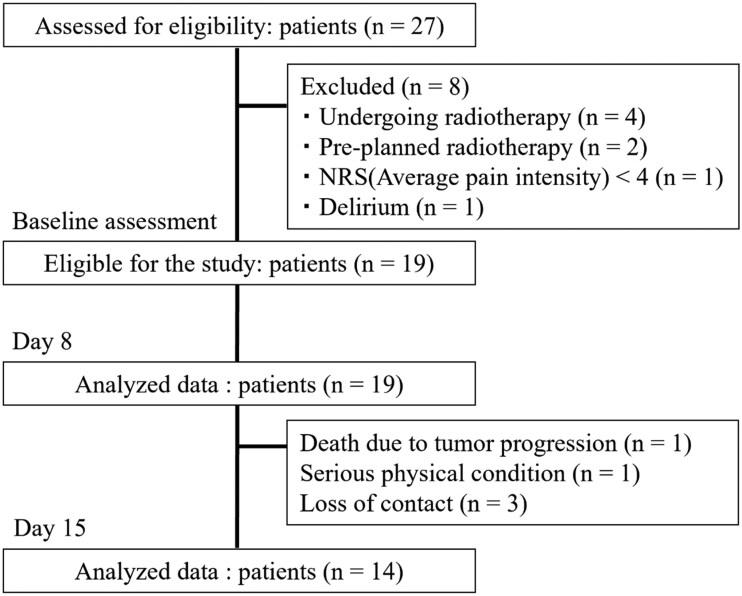
Nineteen patients participated in this study, 11 (57.9%) of whom had neuropathic pain. The mean daily oral morphine equivalent dose before combination was 112.6 mg. The primary outcome occurred in 13 (68.4%) of patients (95% CI, 43.4 to 87.4). The mean average NRS was 5.9 at baseline, which decreased significantly to 4.2 and 3.3 on days 8 and 15 (P < .001), respectively. The worst pain intensity on NRS decreased significantly over time. Adverse effects, including nausea, vomiting, constipation, and somnolence, which were new or had worsened from baseline, were reported in 26.3%, 26.3%, 5.3%, and 26.3%, respectively. Delirium was observed in one patient.
CONCLUSION
Low-dose methadone with ongoing opioid treatment shows potential efficacy in the management of uncontrolled pain with acceptable adverse events.
CLINICALTRIALS.GOV IDENTIFIER: UMIN000038924.
背景
难治性癌痛的药物治疗选择有限。本研究旨在探讨低剂量美沙酮与持续阿片类药物治疗联合用于控制不佳的癌痛的疗效和安全性。
方法
这是一项前瞻性、开放标签研究。参与者为尽管阿片类药物进行了剂量滴定但癌痛仍控制不佳的患者。患者接受低剂量美沙酮(起始剂量为5或10毫克/天)联合另一种持续的阿片类药物治疗。主要结局是第15天时反应者的比例(定义为数字评分量表[NRS]上平均疼痛强度降低≥33%)。根据患者报告结局不良事件通用术语标准评估基线、第8天和第15天的疼痛强度和不良事件。
结果
19名患者参与了本研究,其中11名(57.9%)患有神经性疼痛。联合治疗前每日口服吗啡当量平均剂量为112.6毫克。13名(68.4%)患者出现主要结局(95%CI,43.4至87.4)。基线时平均NRS为5.9,在第8天和第15天分别显著降至4.2和3.3(P<0.001)。NRS上最严重的疼痛强度随时间显著降低。分别有26.3%、26.3%、5.3%和26.3%的患者报告了新出现的或从基线恶化的不良反应,包括恶心、呕吐、便秘和嗜睡。一名患者出现谵妄。
结论
低剂量美沙酮与持续阿片类药物治疗在控制不佳的疼痛管理中显示出潜在疗效,且不良事件可接受。
临床试验注册编号
UMIN000038924。


 Zotero 插件