
基于自动短信文本消息程序的患者互动表型与出院后急性医疗资源的使用:观察性研究
Patient Interaction Phenotypes With an Automated SMS Text Message-Based Program and Use of Acute Health Care Resources After Hospital Discharge: Observational Study.
作者信息
Profka Klea, Wang Agnes, Schriver Emily, Batugo Ashley, Morgan Anna U, Mowery Danielle, Bressman Eric
机构信息
Department of Medicine, Perelman School of Medicine, University of Pennsylvania, 423 Guardian Dr, Philadelphia, PA, 19104, United States, 1 2155732740.
Leonard Davis Institute of Health Economics, University of Pennsylvania, Philadelphia, PA, United States.
出版信息
J Med Internet Res. 2025 Jul 18;27:e72875. doi: 10.2196/72875.
BACKGROUND
Automated bidirectional SMS text messaging has emerged as a compelling strategy to facilitate communication between patients and the health system after hospital discharge. Understanding the unique ways in which patients interact with these messaging programs can inform future efforts to tailor their design to individual patient styles and needs.
OBJECTIVE
Our primary aim was to identify and characterize distinct patient interaction phenotypes with a postdischarge automated SMS text messaging program.
METHODS
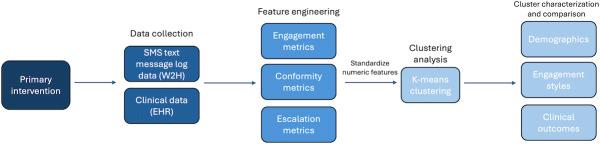
This was a secondary analysis of data from a randomized controlled trial that tested a 30-day postdischarge automated SMS text messaging intervention. We analyzed SMS text messages and patterns of engagement among patients who received the intervention and responded to messages. We engineered features to describe patients' engagement with and conformity to the program and used a k-means clustering approach to learn distinct interaction phenotypes among program participant subgroups. We also looked at the association between these interaction phenotypes and (1) patient demographics and clinical characteristics and (2) hospital revisit outcomes.
RESULTS
A total of 1731 patients engaged with the intervention, among which 1060 (61.2%) were female; the mean age was 65 (SD 16.1) years; 782 (45.2%) and 828 (47.8%) patients identified as Black and White, respectively; and 970 (56%) and 317 (18.3%) patients were insured by Medicare and Medicaid, respectively. Using k-means clustering, we observed four distinct subgroups representing patient interaction phenotypes: (1) a high engagement, high conformity group (enthusiasts, n=1029); (2) a low engagement, high conformity group (minimalists, n=515); (3) a low engagement, low conformity group (nonadapters, n=170); and (4) a high engagement with an intense level of need group (high needs responders, n=17). Differences were observed in demographic characteristics-including gender, race, and insurance type-and clinical outcomes across groups.
CONCLUSIONS
For health systems looking to leverage an SMS text messaging approach to engage patients after discharge, this work offers two main takeaways: (1) not all patients interact with SMS text messaging equally, and some may require either additional guidance or a different medium altogether; and (2) the way in which patients interact with this type of program (in addition to the information they communicate through the program) may have added predictive signal toward adverse outcomes.
背景
出院后,自动双向短信文本消息已成为促进患者与医疗系统之间沟通的一项引人注目的策略。了解患者与这些消息程序互动的独特方式,可以为未来根据患者个体风格和需求调整其设计的努力提供参考。
目的
我们的主要目的是识别并描述出院后自动短信文本消息程序中不同的患者互动表型。
方法
这是对一项随机对照试验数据的二次分析,该试验测试了一项为期30天的出院后自动短信文本消息干预措施。我们分析了接受干预并回复消息的患者的短信文本消息和参与模式。我们设计了一些特征来描述患者对该程序的参与度和依从性,并使用k均值聚类方法来了解程序参与者亚组中不同的互动表型。我们还研究了这些互动表型与(1)患者人口统计学和临床特征以及(2)医院复诊结果之间的关联。
结果
共有1731名患者参与了该干预措施,其中1060名(61.2%)为女性;平均年龄为65岁(标准差16.1);分别有782名(45.2%)和828名(47.8%)患者被认定为黑人及白人;分别有970名(56%)和317名(18.3%)患者由医疗保险和医疗补助承保。通过k均值聚类,我们观察到代表患者互动表型的四个不同亚组:(1)高参与度、高依从性组(热心者,n = 1029);(2)低参与度、高依从性组(极简主义者);(3)低参与度、低依从性组(不适应者,n = 170);(4)高参与度且需求强烈组(高需求响应者,n = 17)。各亚组在人口统计学特征(包括性别、种族和保险类型)和临床结果方面存在差异。
结论
对于希望利用短信文本消息方法在出院后吸引患者的医疗系统而言,这项研究有两个主要收获:(1)并非所有患者与短信文本消息的互动程度相同,有些患者可能需要额外的指导或完全不同的媒介;(2)患者与这类程序互动的方式(除了他们通过该程序传达的信息之外)可能对不良结果有额外的预测信号。
 Zotero 插件