
促进大学生心理健康和健康行为的数字公共卫生干预措施:一项快速综述
Digital public health interventions for the promotion of mental well-being and health behaviors among university students: a rapid review.
作者信息
Matos Fialho Paula M, Wenig Vanessa, Heumann Eileen, Müller Maria, Stock Christiane, Pischke Claudia R
机构信息
Medical Faculty and University Hospital Duesseldorf, Centre for Health and Society, Institute of Medical Sociology, Heinrich Heine University Duesseldorf, Moorenstr. 5, Duesseldorf, Germany.
Institute of Health and Nursing Science, Charité- Universitätsmedizin Berlin, corporate member of Freie Universität Berlin and Humboldt-Universität zu Berlin, Berlin, Germany.
出版信息
BMC Public Health. 2025 Jul 18;25(1):2500. doi: 10.1186/s12889-025-23669-1.
BACKGROUND
Student life offers many opportunities for personal development; however, this transitional phase often also poses challenges to mental health. Various factors associated with university life, such as academic stress and financial burdens, have been found to exacerbate psychological distress and contribute to increased alcohol and substance use among students. Our aim is to closely examine (i) components of available digital public health interventions (DPHIs), (ii) to evaluate their effectiveness for promoting well-being, health behaviors, and reducing symptoms of mental disorders among university students and (iii) to rate the quality of the evidence identified in this rapid review.
METHODS
We conducted a rapid review to capture the evidence on DPHIs for university students. We adhered to the methodological criteria recommended by the Cochrane Rapid Reviews Methods Group and PRISMA. The literature search was performed in Ovid MEDLINE to look for articles related to university students, mental well-being, mental health, and DPHIs published between June 2018 - June 2023. The selection was carried out in two steps: Screening of titles and abstracts and screening of full texts.
RESULTS
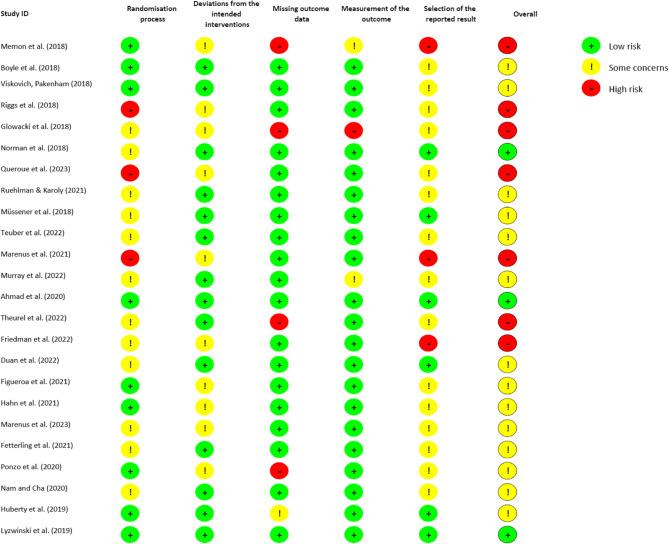
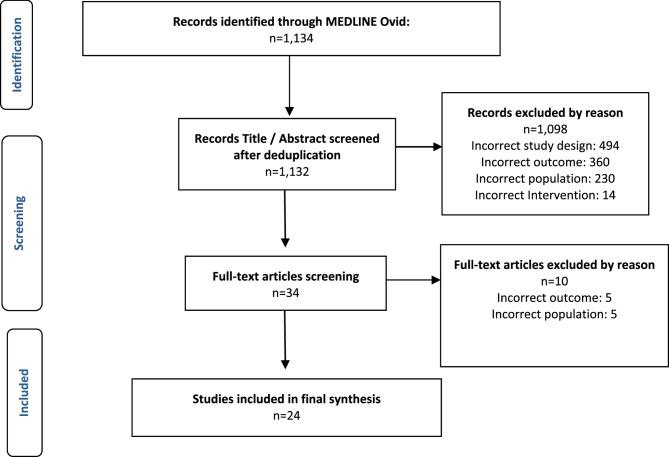
One thousand one hundred thirty-two articles were screened, of which 24 met the inclusion criteria for data extraction. (i) Of the intervention components in the included studies, 18 used web-based platforms, while six used smartphone applications. The interventions were aimed at improving mental health (68%), reducing substance use (28%), promoting physical activity (PA) (36%) and changing eating habits (16%). (ii) 42% of the included studies were able to demonstrate significant effects in the intended direction for mental health, 4% for substance use, 25% for PA and 8% for eating behavior. (iii) The quality assessment revealed that 58% of the studies were classified with 'some concerns', indicating moderate bias, while 29% were classified as 'high risk', suggesting considerable bias affecting the validity of the results.
CONCLUSION
This rapid review comprehensively summarized intervention components of DPHIs. Further, the findings of this review provide significant insights into the effectiveness of DPHIs targeting mental well-being and health behaviors among university students. The studies included in the analysis demonstrate varying degrees of success across different domains, highlighting both the potential and limitations of DPHIs.
背景
学生生活为个人发展提供了许多机会;然而,这个过渡阶段往往也给心理健康带来挑战。已发现与大学生活相关的各种因素,如学业压力和经济负担,会加剧心理困扰,并导致学生中酒精和药物使用增加。我们的目的是仔细研究(i)现有数字公共卫生干预措施(DPHIs)的组成部分,(ii)评估它们对促进大学生幸福感、健康行为以及减轻精神障碍症状的有效性,以及(iii)对本次快速综述中确定的证据质量进行评级。
方法
我们进行了一项快速综述,以获取有关针对大学生的DPHIs的证据。我们遵循了Cochrane快速综述方法小组和PRISMA推荐的方法学标准。在Ovid MEDLINE中进行文献检索,以查找2018年6月至2023年6月期间发表的与大学生、心理健康、精神健康和DPHIs相关的文章。选择过程分两步进行:标题和摘要筛选以及全文筛选。
结果
共筛选了1132篇文章,其中24篇符合数据提取的纳入标准。(i)在纳入研究的干预组成部分中,18项使用基于网络的平台,6项使用智能手机应用程序。这些干预措施旨在改善心理健康(68%)、减少药物使用(28%)、促进身体活动(PA)(36%)和改变饮食习惯(16%)。(ii)42%的纳入研究能够在心理健康的预期方向上显示出显著效果,药物使用方面为4%,PA方面为25%,饮食行为方面为8%。(iii)质量评估显示,58%的研究被归类为“有些担忧”,表明存在中度偏倚,而29%被归类为“高风险”,表明存在相当大的偏倚影响结果的有效性。
结论
本次快速综述全面总结了DPHIs的干预组成部分。此外,本综述的结果为针对大学生心理健康和健康行为的DPHIs的有效性提供了重要见解。分析中纳入的研究在不同领域显示出不同程度的成功,突出了DPHIs的潜力和局限性。
 Zotero 插件