
SENP1:从免疫细胞到疾病的视角(综述)。
SENP1: A perspective from immune cells to disease (Review).
作者信息
Feng Xiaofang, Wu Guoyu, Zeng Qiyan
机构信息
Department of Nuclear Medicine, Minzu Hospital of Guangxi Zhuang Autonomous Region, Nanning, Guangxi Zhuang Autonomous Region 530001, P.R. China.
Department of Cardiothoracic Surgery, Minzu Hospital of Guangxi Zhuang Autonomous Region, Nanning, Guangxi Zhuang Autonomous Region 530001, P.R. China.
出版信息
Oncol Rep. 2025 Sep;54(3). doi: 10.3892/or.2025.8947. Epub 2025 Jul 19.
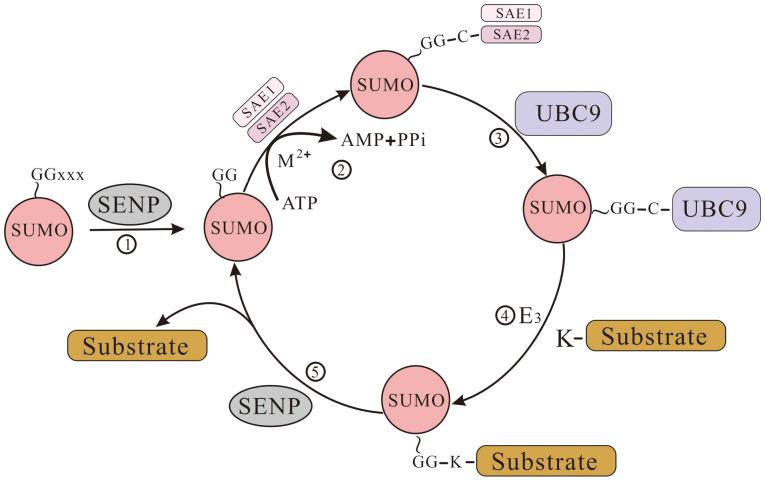
Small ubiquitin‑like modifier (SUMO) is a ubiquitin‑like protein that modifies target proteins across various eukaryotic subcellular structures. This process, known as SUMOylation, has been established as an essential regulatory mechanism that affects both the activity and positioning of proteins, maintaining cellular homeostasis. SUMOylation and deSUMOylation are reversible post‑translational modification processes mediated by SUMO proteins and SUMO/sentrin‑specific proteases (SENPs). The human SENP family comprises six members, each characterized by unique cellular localization and substrate specificity. The present review primarily summarizes the role and mechanisms of SENP1 in the development and maturation of immune cells, including lymphocytes, macrophages and erythrocytes, as well as its involvement in tumor cell invasion, metastasis, angiogenesis and resistance to pharmacological therapies. In addition, the introduction of SENP1 inhibitors as a therapeutic approach for cancer treatment is explored. Overall, the present study aimed to offer theoretical insights into cancer therapy strategies that target SENP1.
小泛素样修饰物(SUMO)是一种类泛素蛋白,可修饰跨越各种真核亚细胞结构的靶蛋白。这一过程称为SUMO化,已被确立为一种重要的调节机制,可影响蛋白质的活性和定位,维持细胞内稳态。SUMO化和去SUMO化是由SUMO蛋白和SUMO/ sentrin特异性蛋白酶(SENPs)介导的可逆翻译后修饰过程。人类SENP家族由六个成员组成,每个成员都具有独特的细胞定位和底物特异性。本综述主要总结了SENP1在免疫细胞(包括淋巴细胞、巨噬细胞和红细胞)发育和成熟中的作用及机制,以及其在肿瘤细胞侵袭、转移、血管生成和对药物治疗的抗性中的作用。此外,还探讨了引入SENP1抑制剂作为癌症治疗方法的可能性。总体而言,本研究旨在为以SENP1为靶点的癌症治疗策略提供理论见解。

 Zotero 插件