
德国2020 - 2023年新冠疫苗接种后口腔不良事件的国家药物警戒评估
National Pharmacovigilance Assessment of Oral Adverse Events Following COVID-19 Vaccination in Germany (2020-2023).
作者信息
Riad Abanoub
机构信息
Masaryk Centre for Global Health (MCGH), Department of Public Health, Faculty of Medicine, Masaryk University, Brno, Czech Republic; Department of Public Health, Faculty of Medicine, Masaryk University, Brno, Czech Republic.
出版信息
Int Dent J. 2025 Jul 19;75(5):100906. doi: 10.1016/j.identj.2025.100906.
OBJECTIVES
Pharmacovigilance efforts for COVID-19 vaccines have largely focused on severe adverse events (AEs), while nonserious, yet distressing, AEs, such as oral AEs, remain underexamined. This study aimed to analyse oral AE reporting patterns in the German national pharmacovigilance database.
METHODS
A retrospective analysis of individual case safety reports (ICSRs) from the Paul-Ehrlich-Institut (PEI) database was conducted for December 2020 to December 2023. The absolute reporting ratio was calculated as cases per 1000 ICSRs for each oral AE. Secondary analyses included: (1) cross-database comparisons with the U.S. Vaccine Adverse Event Reporting System (VAERS); (2) disproportionality analysis using a hybrid approach combining frequentist and Bayesian conditions to establish signals of disproportionate reporting (SDRs); (3) subgroup analyses based on demographic and vaccine-related factors; and (4) multivariable regression to adjust for potential confounders.
RESULTS
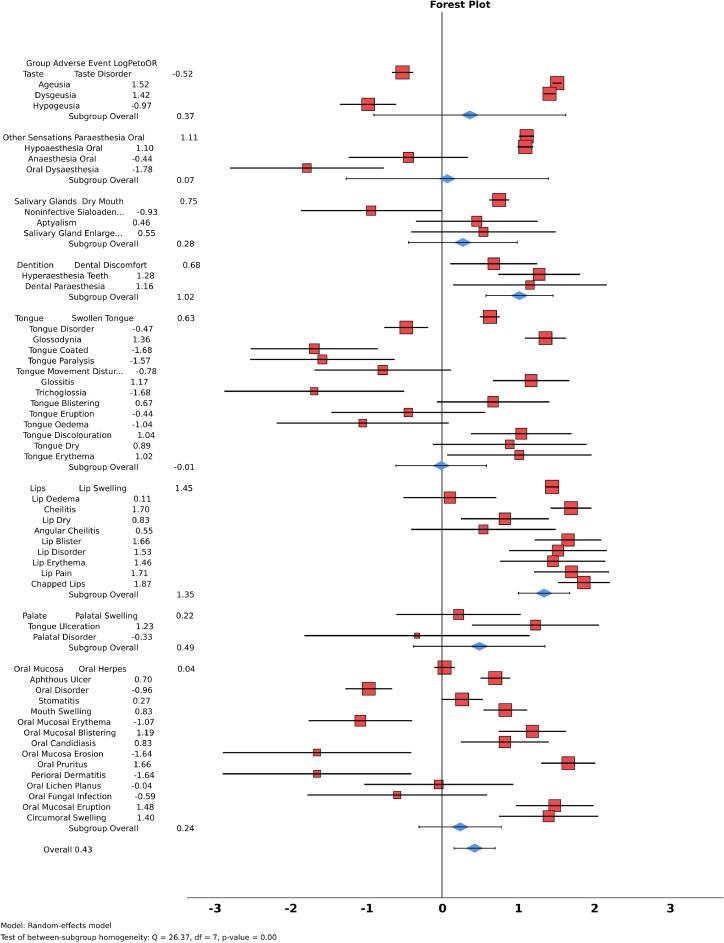
Gustatory AEs, such as ageusia and dysgeusia; other oral sensory AEs, including oral paraesthesia and oral hypoaesthesia; and specific mucosal AEs, such as oral herpes and aphthous stomatitis, were the most frequently reported oral AEs in the PEI dataset. Cross-database analysis not only confirmed the prominence of gustatory and other sensory AEs but also highlighted differences, with VAERS reporting higher rates of swollen tongue and lip swelling. Disproportionality analysis identified 21 oral AEs as true SDRs. Female susceptibility was evident in several oral AEs, and age-stratified analysis revealed higher reporting among minors and seniors compared to middle-aged adults. Differences in oral AE reporting between mRNA and viral vector vaccines lacked a consistent pattern, and booster doses were associated with increased reporting of select oral AEs.
CONCLUSIONS
Within the limitations of passive surveillance data, this study highlights the need for further research on oral AEs using self-controlled case-series designs for clinically significant events. Integrating oral AEs into vaccine safety monitoring could improve postmarketing surveillance, while validated AEs may warrant inclusion in product information for transparency.
目的
针对新冠病毒疫苗的药物警戒工作主要集中在严重不良事件(AE)上,而诸如口腔不良事件等不严重但令人苦恼的不良事件仍未得到充分研究。本研究旨在分析德国国家药物警戒数据库中的口腔不良事件报告模式。
方法
对保罗·埃利希研究所(PEI)数据库2020年12月至2023年12月的个体病例安全报告(ICSR)进行回顾性分析。计算每种口腔不良事件的绝对报告率,即每1000份ICSR中的病例数。二次分析包括:(1)与美国疫苗不良事件报告系统(VAERS)进行跨数据库比较;(2)使用结合频率论和贝叶斯条件的混合方法进行不成比例分析,以建立不成比例报告信号(SDR);(3)基于人口统计学和疫苗相关因素的亚组分析;(4)多变量回归以调整潜在混杂因素。
结果
味觉不良事件,如味觉丧失和味觉障碍;其他口腔感觉不良事件,包括口腔感觉异常和口腔感觉减退;以及特定的黏膜不良事件,如口腔疱疹和复发性阿弗他口炎,是PEI数据集中报告最频繁的口腔不良事件。跨数据库分析不仅证实了味觉和其他感觉不良事件的突出性,还突出了差异,VAERS报告的舌肿胀和唇肿胀发生率更高。不成比例分析确定了21种口腔不良事件为真正的SDR。女性易感性在几种口腔不良事件中很明显,年龄分层分析显示,与中年成年人相比,未成年人和老年人的报告率更高。mRNA疫苗和病毒载体疫苗之间口腔不良事件报告的差异缺乏一致模式,加强剂量与某些口腔不良事件的报告增加有关。
结论
在被动监测数据的局限性内,本研究强调需要使用自我对照病例系列设计对具有临床意义的事件进行口腔不良事件的进一步研究。将口腔不良事件纳入疫苗安全性监测可以改善上市后监测,而经过验证的不良事件可能需要纳入产品信息以提高透明度。

 Zotero 插件