
早期小肝细胞癌手术切除与射频消融的竞争风险分析:一项基于监测、流行病学和最终结果(SEER)数据库的研究
Competing risk analysis of surgical resection radiofrequency ablation in early-stage small hepatocellular carcinoma: a SEER-based study.
作者信息
Zeng Zhenpeng, Wu Ying, Tan Xiaosong, Wu Yumin, Liu Chunlin, Du Duanming
机构信息
Department of Interventional Therapy, Shenzhen Second People's Hospital, The First Affiliated Hospital of Shenzhen University, Shenzhen, China.
出版信息
Transl Cancer Res. 2025 Jun 30;14(6):3565-3576. doi: 10.21037/tcr-2024-2550. Epub 2025 Jun 27.
BACKGROUND
Hepatocellular carcinoma (HCC) is a leading cause of cancer-related mortality globally. While surgical resection (SR) is the gold standard for early-stage HCC, radiofrequency ablation (RFA) serves as an alternative for patients unfit for surgery. The relative efficacy of SR versus RFA for solitary tumors ≤5 cm remains a topic of debate. Traditional survival analysis methods, often used in comparative studies, fail to account for competing risk events, potentially biasing survival outcome estimates. This study utilizes data from the Surveillance, Epidemiology, and End Results (SEER) database, integrated with competing risk analysis, with the aim of more accurately assessing the efficacy differences between SR and RFA in patients with early-stage HCC, thereby offering clinicians more scientific and reliable evidence.
METHODS
Patients with early-stage HCC [American Joint Committee on Cancer (AJCC) stage I/II] and solitary tumors ≤5 cm who underwent SR or RFA were identified from the SEER database [2004-2021]. Kaplan-Meier survival curves and Cox proportional hazards models were used to evaluate overall survival (OS) and cancer-specific survival (CSS). Competing risk models were applied to assess liver cancer-specific death (LCSD) and other cause-specific death (OCSD). Propensity score matching (PSM) was performed to minimize baseline differences between SR and RFA groups.
RESULTS
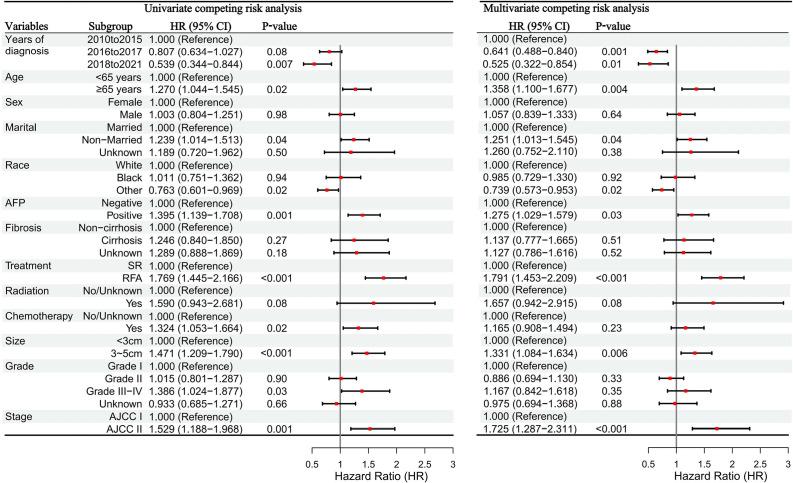
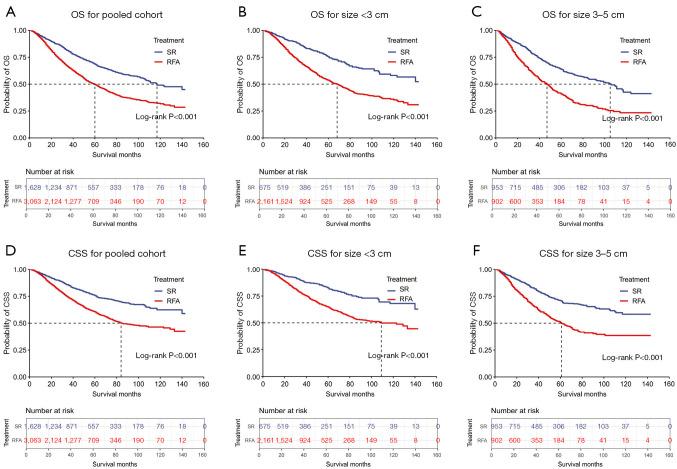
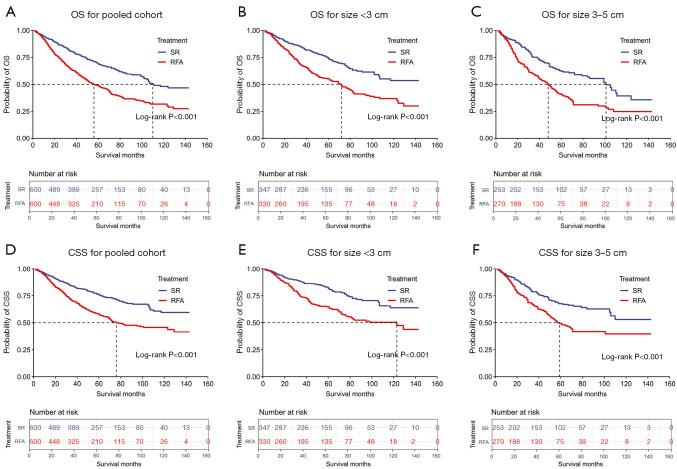
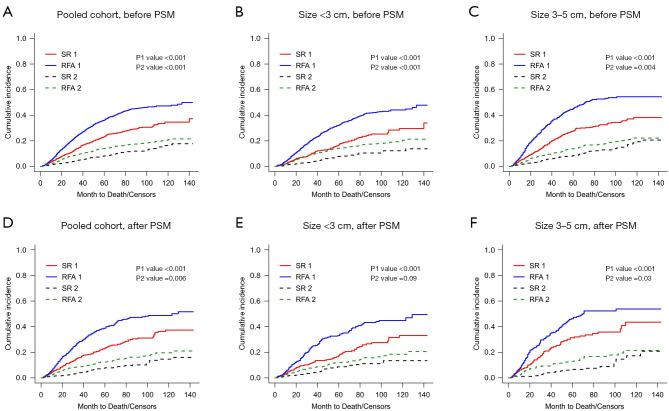
A total of 4,691 patients were included (1,628 in the SR group, 3,063 in the RFA group). After PSM, 1,200 patients (600 per group) were analyzed. Kaplan-Meier analysis demonstrated superior OS and CSS in the SR group before and after PSM. Competing risk analysis showed a lower cumulative incidence of LCSD in the SR group compared to the RFA group, consistent across tumor size subgroups (<3 and 3-5 cm). Multivariate analysis revealed that RFA was associated with a higher risk of LCSD [hazard ratio (HR): 1.955 in Cox model; HR: 1.791 in competing risk model].
CONCLUSIONS
SR is associated with better OS, CSS, and lower LCSD compared to RFA in early-stage HCC patients with solitary tumors ≤5 cm. Competing risk analysis provides more accurate and clinically relevant insights into treatment efficacy. These findings support SR as the preferred treatment for eligible patients and highlight the importance of considering competing risks in survival studies.
背景
肝细胞癌(HCC)是全球癌症相关死亡的主要原因。虽然手术切除(SR)是早期HCC的金标准,但射频消融(RFA)是不适于手术患者的替代方案。对于直径≤5cm的孤立肿瘤,SR与RFA的相对疗效仍是一个有争议的话题。比较研究中常用的传统生存分析方法未考虑竞争风险事件,可能会使生存结果估计产生偏差。本研究利用监测、流行病学和最终结果(SEER)数据库的数据,并结合竞争风险分析,旨在更准确地评估SR与RFA在早期HCC患者中的疗效差异,从而为临床医生提供更科学可靠的证据。
方法
从SEER数据库(2004 - 2021年)中识别出接受SR或RFA治疗的早期HCC患者[美国癌症联合委员会(AJCC)I/II期]且孤立肿瘤≤5cm。采用Kaplan-Meier生存曲线和Cox比例风险模型评估总生存(OS)和癌症特异性生存(CSS)。应用竞争风险模型评估肝癌特异性死亡(LCSD)和其他特定原因死亡(OCSD)。进行倾向评分匹配(PSM)以最小化SR组和RFA组之间的基线差异。
结果
共纳入4691例患者(SR组1628例,RFA组3063例)。PSM后,分析了1200例患者(每组600例)。Kaplan-Meier分析显示PSM前后SR组的OS和CSS均更优。竞争风险分析表明,与RFA组相比,SR组的LCSD累积发生率更低,在不同肿瘤大小亚组(<3cm和3 - 5cm)中均一致。多因素分析显示,RFA与更高的LCSD风险相关[Cox模型中的风险比(HR):1.955;竞争风险模型中的HR:1.791]。
结论
对于孤立肿瘤≤5cm的早期HCC患者,与RFA相比,SR与更好的OS、CSS以及更低的LCSD相关。竞争风险分析为治疗疗效提供了更准确且与临床相关的见解。这些发现支持SR作为符合条件患者的首选治疗方法,并强调在生存研究中考虑竞争风险的重要性。

 Zotero 插件