
辣椒素对小鼠肠道形态和微生物群组成的剂量依赖性影响:结构、免疫组织化学和微生物学见解
Dose-dependent effects of capsaicin on intestinal morphology and microbiota composition in mice: Structural, immunohistochemical, and microbial insights.
作者信息
Li Kai, Xu Jianghai, Chen Siying, Du Aifei, Feng Shaohua, Yuan Shibin, Wu Bangyuan
机构信息
College of Life Sciences, China West Normal University, Nanchong, 637000, Sichuan, China.
Yucai School Attached to Sichuan Chengdu No. 7 High School, Chengdu, 610021, Sichuan, China.
出版信息
Vet World. 2025 Jun;18(6):1703-1714. doi: 10.14202/vetworld.2025.1703-1714. Epub 2025 Jun 26.
BACKGROUND AND AIM
Capsaicin (CAP), the pungent component of chili peppers, possesses diverse bioactive properties, including antioxidant, anti-inflammatory, and antimicrobial effects. However, its impact on gastrointestinal integrity and microbial ecology remains dose-dependent and incompletely understood. This study aimed to investigate the effects of varying CAP doses on intestinal morphology, tight junction protein expression, goblet cell density, mucosal injury markers, and gut microbiota composition in mice.
MATERIALS AND METHODS
Seventy-five male Kunming mice were randomly assigned to five groups (n = 15/group): Normal control, vehicle control (dimethyl sulfoxide), low-dose CAP (5 mg/kg), medium-dose (15 mg/kg), and high-dose (20 mg/kg). Mice received oral gavage every other day for 14 days. Histological assessments (H&E and Alcian Blue-Periodic Acid-Schiff staining), enzyme-linked immunosorbent assays for diamine oxidase, fatty acid-binding protein 2, and plasma endotoxin as well as immunohistochemistry for ZO-1, Claudin-1, and Occludin, and 16S rRNA sequencing were employed to evaluate structural and microbial changes.
RESULTS
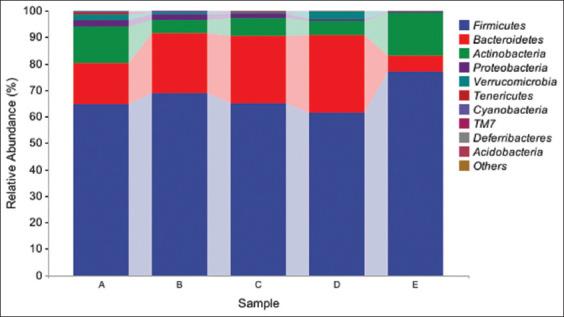
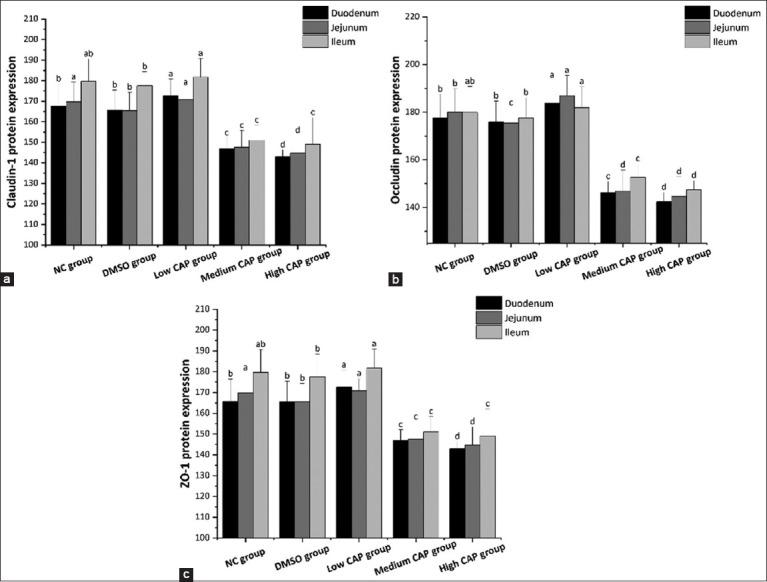
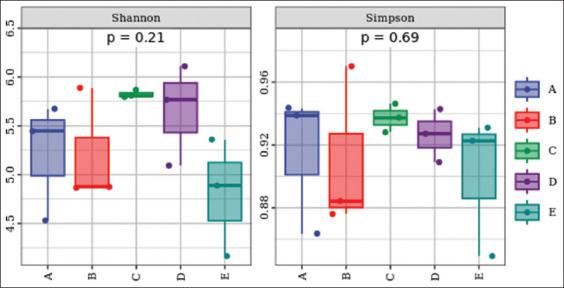
Low-dose CAP significantly enhanced villus height, reduced crypt depth, and elevated the villus-to-crypt ratio across all intestinal segments (p < 0.05). Tight junction protein expression and goblet cell counts were highest in the low-dose group, suggesting mucosal protection. In contrast, medium and high-dose CAP induced epithelial damage, villus atrophy, and downregulation of junctional proteins. Microbiota analysis revealed the suppression of Proteobacteria and the expansion of Firmicutes in the medium- and high-dose groups. All CAP doses stimulated microbial biosynthesis of cofactors, vitamins, and electron carriers, with enhanced alpha diversity at higher doses.
CONCLUSION
CAP exhibits a biphasic effect on intestinal physiology. While low-dose administration supports mucosal integrity and promotes beneficial microbial functions, higher doses disrupt epithelial architecture and induce dysbiosis. These findings underscore the importance of dose consideration in CAP's dietary and therapeutic applications, providing mechanistic insights into its gut-mediated effects.
背景与目的
辣椒素(CAP)是辣椒中的辛辣成分,具有多种生物活性特性,包括抗氧化、抗炎和抗菌作用。然而,其对胃肠道完整性和微生物生态的影响仍呈剂量依赖性且尚未完全明确。本研究旨在探讨不同剂量的CAP对小鼠肠道形态、紧密连接蛋白表达、杯状细胞密度、黏膜损伤标志物和肠道微生物群组成的影响。
材料与方法
75只雄性昆明小鼠随机分为五组(每组n = 15):正常对照组、溶剂对照组(二甲基亚砜)、低剂量CAP组(5 mg/kg)、中剂量组(15 mg/kg)和高剂量组(20 mg/kg)。小鼠每隔一天接受一次口服灌胃,持续14天。采用组织学评估(苏木精-伊红染色和阿尔辛蓝-过碘酸-希夫染色)、二胺氧化酶、脂肪酸结合蛋白2和血浆内毒素的酶联免疫吸附测定以及紧密连接蛋白1、闭合蛋白和闭锁蛋白的免疫组织化学染色,以及16S rRNA测序来评估结构和微生物变化。
结果
低剂量CAP显著增加了所有肠段的绒毛高度,降低了隐窝深度,并提高了绒毛与隐窝的比值(p < 0.05)。紧密连接蛋白表达和杯状细胞计数在低剂量组中最高,表明对黏膜有保护作用。相反,中剂量和高剂量CAP诱导上皮损伤、绒毛萎缩和连接蛋白下调。微生物群分析显示,中剂量和高剂量组中变形菌门受到抑制,厚壁菌门扩张。所有剂量的CAP均刺激了辅因子、维生素和电子载体的微生物生物合成,并在较高剂量下增强了α多样性。
结论
CAP对肠道生理表现出双相效应。低剂量给药可维持黏膜完整性并促进有益的微生物功能,而高剂量则破坏上皮结构并导致菌群失调。这些发现强调了在CAP的饮食和治疗应用中考虑剂量的重要性,为其肠道介导的效应提供了机制性见解。



 Zotero 插件