
感染中的血小板:内在作用与功能结果
Platelets in infection: intrinsic roles and functional outcomes.
作者信息
Hu Yuwei, Dai Shuchang, Qiao Congchao, Ye Yifan, Ren Junyi, Wang Kai, Li Ling, Liu Zhong
机构信息
Clinical Transfusion Research Center, Institute of Blood Transfusion, Chinese Academy of Medical Sciences & Peking Union Medical College, Chengdu, China.
Key Laboratory of Transfusion Adverse Reactions, Chinese Academy of Medical Sciences, Chengdu, China.
出版信息
Front Immunol. 2025 Jul 7;16:1616783. doi: 10.3389/fimmu.2025.1616783. eCollection 2025.
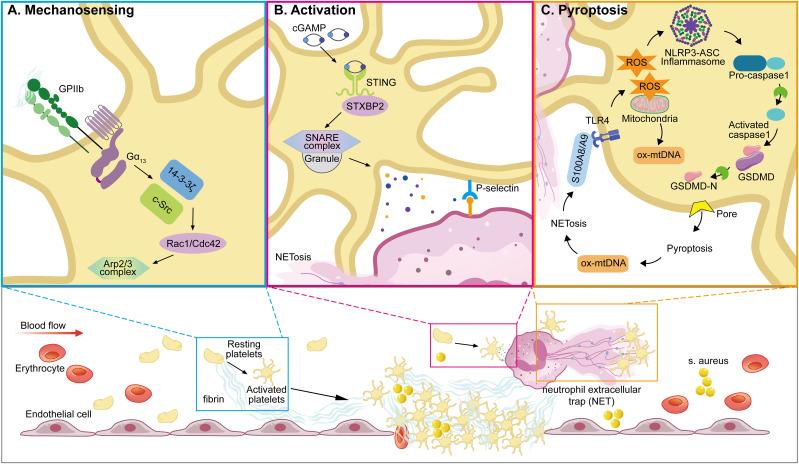
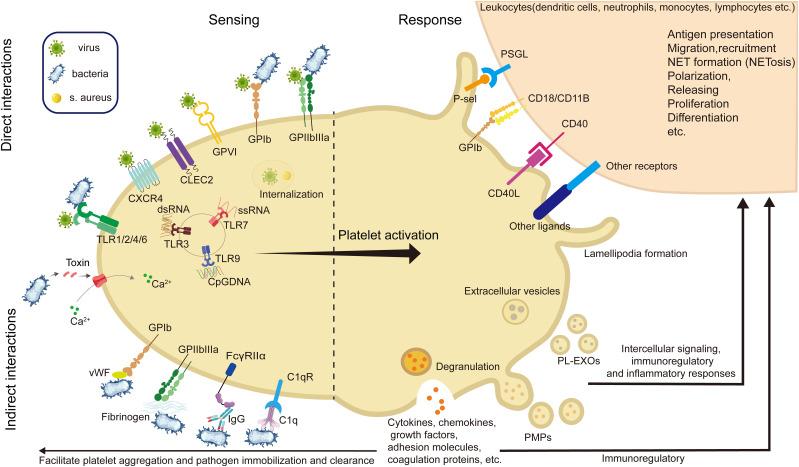
Platelets have long been acknowledged for their essential roles in hemostasis and thrombosis; however, recent insights highlight their broader involvement as key participants in host responses during infection. Beyond their classical functions, platelets exhibit diverse anti-infective capabilities, such as direct pathogen internalization, receptor-mediated pathogen recognition, the release of antimicrobial peptides, cytokines, and chemokines, and the generation of immunomodulatory extracellular vesicles. These intrinsic platelet attributes enable dynamic interactions with pathogens and immune cells, significantly contributing to pathogen capture, neutralization, and the orchestration of innate and adaptive immune responses. This review examines the multifaceted intrinsic roles of platelets and delineates the beneficial outcomes of their activation, providing an integrated perspective on platelet-driven immunity and defense mechanisms during infection.
长期以来,血小板在止血和血栓形成中的重要作用已得到公认;然而,最近的研究见解突出了它们作为感染期间宿主反应关键参与者的更广泛参与。除了其经典功能外,血小板还具有多种抗感染能力,如直接内化病原体、受体介导的病原体识别、释放抗菌肽、细胞因子和趋化因子,以及产生免疫调节细胞外囊泡。血小板的这些内在特性使其能够与病原体和免疫细胞进行动态相互作用,对病原体的捕获、中和以及先天和适应性免疫反应的协调做出重大贡献。本综述探讨了血小板多方面的内在作用,并阐述了其激活的有益结果,为感染期间血小板驱动的免疫和防御机制提供了一个综合观点。
 Zotero 插件