
没有证据表明亲缘选择是小丑鱼社会群体形成的一种解释。
No evidence for kin selection as an explanation for social group formation in clown anemonefish.
作者信息
Rueger Theresa, Barbasch Tina Adria, Patel Matishalin, Bogdanowicz Steven Michael, Buston Peter Michael
机构信息
Dove Marine Laboratory, School of Natural and Environmental Sciences, Newcastle University, King's Gate, Newcastle upon Tyne, NE1 7RU, United Kingdom.
Carl R. Woese Institute for Genomic Biology, University of Illinois Urbana Champaign, 1206 W Gregory Dr, Urbana, IL 61801, United States.
出版信息
Behav Ecol. 2025 Jun 29;36(4):araf075. doi: 10.1093/beheco/araf075. eCollection 2025 Jul-Aug.
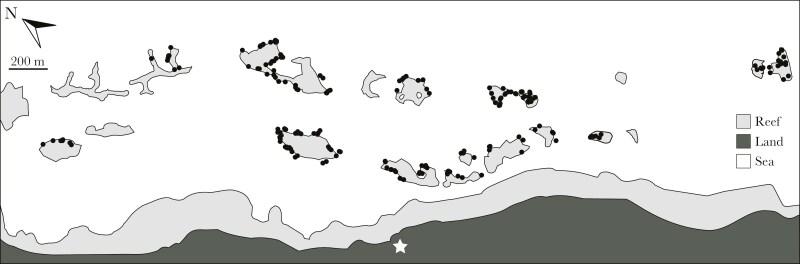
Social groups in which some individuals forgo reproduction and others reproduce, are one of the most remarkable products of evolution. To fully understand these social groups, we must understand both why non-breeders tolerate their situation and why breeders tolerate non-breeders. In general, breeders tolerate non-breeders because they help provision the breeders' offspring or the breeders themselves, but in some vertebrate societies the benefits that breeders accrue from non-breeders are surprisingly hard to detect. This raises the question: why do breeders tolerate non-breeders in such societies? Here, we test the hypothesis that breeders of the clown anemonefish () will tolerate non-breeders because they are distant relatives who go on to inherit the territory. We use 40 polymorphic microsatellite loci to assess the pairwise relatedness of 683 individuals from 203 groups. We show that the mean pairwise relatedness among individuals from the same group is effectively zero, and no different from that found among individuals from the same reef or that found among individuals from the population at large. Further, we show that the mean pairwise relatedness found among breeder/breeder dyads is no different from that found among breeder/non-breeder dyads or that found among non-breeder/non-breeder dyads. We conclude that kin selection does not explain why breeders tolerate non-breeders in the clown anemonefish, and suggest that the explanation must lie with other, as yet untested, hypotheses: within-generation bet-hedging or mutualist-mediated benefits.
一些个体放弃繁殖而其他个体进行繁殖的社会群体,是进化过程中最显著的产物之一。要全面理解这些社会群体,我们必须既要明白非繁殖者为何容忍自己的处境,也要明白繁殖者为何容忍非繁殖者。一般来说,繁殖者容忍非繁殖者是因为他们有助于为繁殖者的后代或繁殖者自身提供给养,但在一些脊椎动物社会中,繁殖者从非繁殖者那里获得的益处却出奇地难以察觉。这就引发了一个问题:在这样的社会中,繁殖者为何容忍非繁殖者呢?在此,我们检验了一个假说,即小丑鱼()的繁殖者会容忍非繁殖者,是因为它们是远亲,最终会继承领地。我们使用40个多态微卫星位点来评估来自203个群体的683个个体之间的成对亲缘关系。我们发现,同一群体中个体之间的平均成对亲缘关系实际上为零,与同一珊瑚礁中个体之间或整个种群中个体之间的成对亲缘关系没有差异。此外,我们还发现,繁殖者/繁殖者二元组之间的平均成对亲缘关系与繁殖者/非繁殖者二元组之间或非繁殖者/非繁殖者二元组之间的平均成对亲缘关系没有差异。我们得出结论,亲缘选择并不能解释小丑鱼中繁殖者为何容忍非繁殖者,并认为解释必须在于其他尚未经过检验的假说:代内风险对冲或互利共生介导的益处。

 Zotero 插件