
通过机器学习得出的多维睡眠概况与痴呆症和心血管疾病风险
Multidimensional sleep profiles via machine learning and risk of dementia and cardiovascular disease.
作者信息
Cavaillès Clémence, Wallace Meredith, Leng Yue, Stone Katie L, Ancoli-Israel Sonia, Yaffe Kristine
机构信息
Department of Psychiatry and Behavioral Sciences, University of California San Francisco, San Francisco, CA, USA.
Department of Psychiatry, University of Pittsburgh, Pittsburgh, PA, USA.
出版信息
Commun Med (Lond). 2025 Jul 22;5(1):306. doi: 10.1038/s43856-025-01019-x.
BACKGROUND
Sleep health comprises several dimensions such as sleep duration and fragmentation, circadian activity, and daytime behavior. Yet, most research has focused on individual sleep characteristics. Studies are needed to identify sleep/circadian profiles incorporating multiple dimensions and to assess their associations with adverse health outcomes.
METHODS
This multicenter population-based cohort study identified 24 h actigraphy-based sleep/circadian profiles in 2667 men aged ≥65 years using an unsupervised machine learning approach and investigated their associations with dementia and cardiovascular disease (CVD) incidence over 12 years.
RESULTS
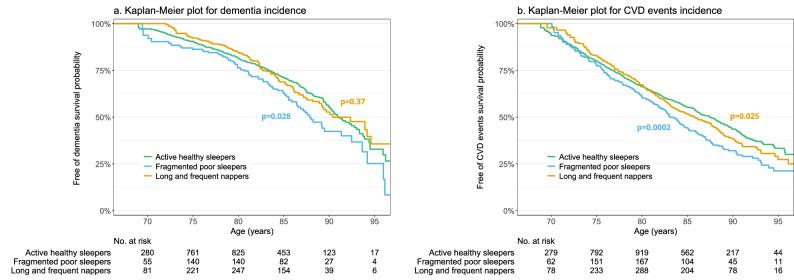
We identify three distinct profiles: active healthy sleepers (AHS; 64.0%), fragmented poor sleepers (FPS; 14.1%), and long and frequent nappers (LFN; 21.9%). Over the follow-up, compared to AHS, FPS exhibit increased risks of dementia and CVD events (HR = 1.35, 95% CI = 1.02-1.78 and HR = 1.32, 95% CI = 1.08-1.60, respectively) after multivariable adjustment, whereas LFN show a marginal association with increased CVD events risk (HR = 1.16, 95% CI = 0.98-1.37) but not with dementia (HR = 1.09, 95%CI = 0.86-1.38).
CONCLUSIONS
These results highlight potential targets for sleep interventions and the need for more comprehensive screening of poor sleepers for adverse outcomes.
背景
睡眠健康包括多个方面,如睡眠时间和睡眠碎片化、昼夜节律活动以及日间行为。然而,大多数研究都集中在个体睡眠特征上。需要开展研究来确定包含多个维度的睡眠/昼夜节律模式,并评估它们与不良健康结局之间的关联。
方法
这项基于多中心人群的队列研究,采用无监督机器学习方法,在2667名年龄≥65岁的男性中确定了基于24小时活动记录仪的睡眠/昼夜节律模式,并调查了这些模式与12年内痴呆症和心血管疾病(CVD)发病率之间的关联。
结果
我们确定了三种不同的模式:活跃健康睡眠者(AHS;64.0%)、睡眠碎片化差的睡眠者(FPS;14.1%)和长时间频繁小睡者(LFN;21.9%)。在随访期间,与AHS相比,多变量调整后,FPS患痴呆症和CVD事件的风险增加(HR = 1.35,95%CI = 1.02 - 1.78和HR = 1.32,95%CI = 1.08 - 1.60),而LFN与CVD事件风险增加存在微弱关联(HR = 1.16,95%CI = 0.98 - 1.37),但与痴呆症无关(HR = 1.09,95%CI = 0.86 - 1.38)。
结论
这些结果突出了睡眠干预的潜在目标,以及对睡眠不佳者进行更全面的不良结局筛查的必要性。

 Zotero 插件