
体内RNA干扰靶向改善对乙酰氨基酚诱导的肝脏氧化应激和炎症
Amelioration of Acetaminophen-Induced Hepatic Oxidative Stress and Inflammation by RNAi Targeting In Vivo.
作者信息
Liu Wenwen, Huan Liwen, Zhang Cai, Yin Runting, Ouyang Zhen, Wei Yuan
机构信息
School of Pharmacy, Jiangsu University, Zhenjiang 212013, China.
出版信息
Curr Issues Mol Biol. 2025 May 19;47(5):372. doi: 10.3390/cimb47050372.
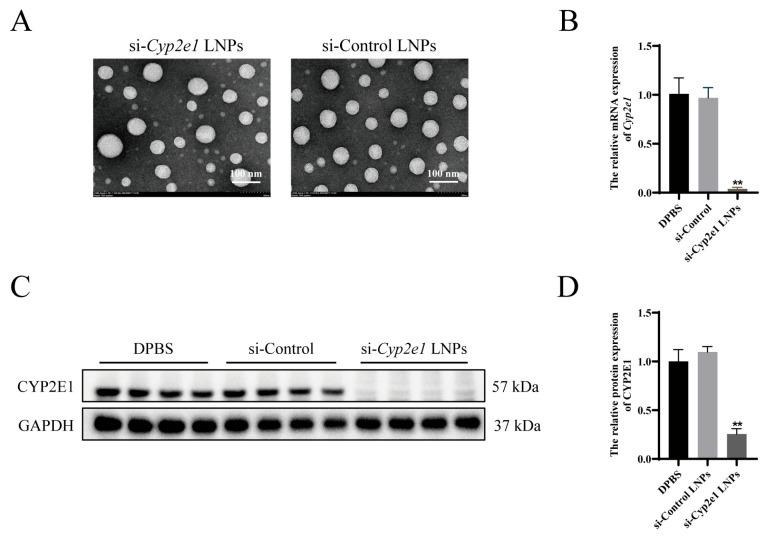
The overdose of acetaminophen (APAP) has become the leading cause of acute liver failure in the United States and some Western countries. As a principal member of the cytochrome P450 enzymes (CYPs), CYP2E1 is a vital enzyme in regard to the production of toxic APAP metabolites and in the development of APAP-induced liver injury (AILI). In this study, we investigated the therapeutic effects and mechanisms of lipid nanoparticle (LNP)-based delivery of small interfering RNA targeting (si- LNPs) on AILI in mice. C57BL/6J male mice were injected with 300 mg/kg APAP to establish an AILI model, and si- LNPs were administered via the tail vein. The results showed that the levels of serum alanine aminotransferase and aspartate aminotransferase were lower than those in APAP mice after treatment with si- LNPs immediately. Moreover, si- LNPs significantly inhibited liver necrosis and oxidative stress in APAP mice. RNA sequencing revealed that si- LNPs exerted regulatory effects on pathways and genes related to peroxisome proliferator-activated receptor (PPAR). Consistent with this finding, we also proved that si- LNPs markedly regulated the expressions of genes involved in the PPAR signaling pathway (CYP4A, PPARα, FABP 1, and CD36) in APAP mice, as well as inflammatory factors (, , and ). These findings suggested that si- LNPs may alleviate APAP-induced oxidative stress and inflammation by regulating lipid metabolism via PPAR-related pathways.
对乙酰氨基酚(APAP)过量服用已成为美国和一些西方国家急性肝衰竭的主要原因。作为细胞色素P450酶(CYPs)的主要成员,CYP2E1在有毒APAP代谢产物的产生以及APAP诱导的肝损伤(AILI)的发展中是一种重要的酶。在本研究中,我们研究了基于脂质纳米颗粒(LNP)递送靶向的小干扰RNA(si-LNPs)对小鼠AILI的治疗效果和机制。给C57BL/6J雄性小鼠注射300mg/kg APAP以建立AILI模型,并通过尾静脉给予si-LNPs。结果表明,立即用si-LNPs治疗后,血清丙氨酸氨基转移酶和天冬氨酸氨基转移酶水平低于APAP小鼠。此外,si-LNPs显著抑制APAP小鼠的肝坏死和氧化应激。RNA测序显示,si-LNPs对与过氧化物酶体增殖物激活受体(PPAR)相关的途径和基因发挥调节作用。与此发现一致,我们还证明si-LNPs显著调节APAP小鼠中参与PPAR信号通路的基因(CYP4A、PPARα、FABP 1和CD36)以及炎症因子(、和)的表达。这些发现表明,si-LNPs可能通过PPAR相关途径调节脂质代谢来减轻APAP诱导的氧化应激和炎症。



 Zotero 插件