
γδ T细胞免疫记忆反应的双重性质。
A dual nature of γδ T cell immune memory responses.
作者信息
Suen Tsz Kin, Al Burcu, Scarpa Alice, Dorhoi Anca, Netea Mihai G, Placek Katarzyna
机构信息
Immunology and Metabolism Unit, Life and Medical Sciences (LIMES) Institute, University of Bonn, Bonn, Germany.
Institut of Immunology, Friedrich-Loeffler-Institut, Federal Research Institute for Animal Health, Greifswald-Insel Riems, Germany.
出版信息
Elife. 2025 Jul 23;14:e104887. doi: 10.7554/eLife.104887.
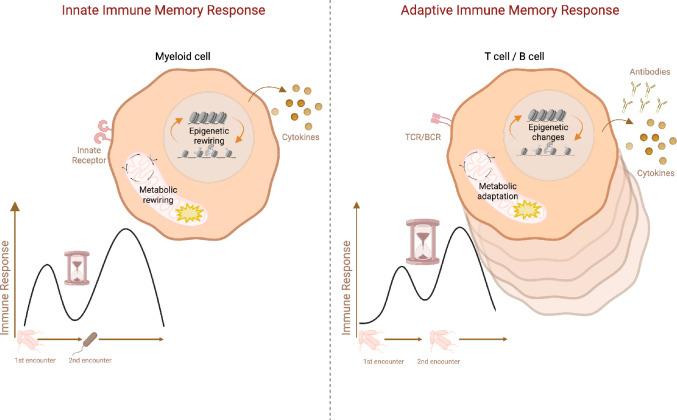
Immune memory was considered for decades an exclusive hallmark of the adaptive immune response. However, recent studies have revealed that innate immune cells can also 'recall' information of a primary insult during infection or vaccination and deploy robust antigen-agonistic immune reactivity upon secondary challenge. This innate immune memory response is designated as 'trained immunity'. γδ T cells are unconventional T cells that possess unique immunologic features of both adaptive and innate immunity. Their immune memory responses to various bacterial and viral agents were originally described to be of an adaptive immune nature. Nevertheless, growing evidence shows that γδ T cells can also mount antigen-independent memory responses resembling trained immunity. In this review, we discuss the dual nature of immune memory responses of γδ T cells and provide insights into their important role in protection against bacterial, viral, and parasitic infections in humans and animals.
几十年来,免疫记忆一直被认为是适应性免疫反应的独特标志。然而,最近的研究表明,天然免疫细胞在感染或接种疫苗期间也能“回忆”初次损伤的信息,并在再次受到攻击时产生强大的抗原激动性免疫反应。这种天然免疫记忆反应被称为“训练免疫”。γδ T细胞是非常规T细胞,具有适应性免疫和天然免疫的独特免疫特征。它们对各种细菌和病毒制剂的免疫记忆反应最初被描述为具有适应性免疫性质。然而,越来越多的证据表明,γδ T细胞也能产生类似于训练免疫的不依赖抗原的记忆反应。在这篇综述中,我们讨论了γδ T细胞免疫记忆反应的双重性质,并深入探讨了它们在保护人类和动物免受细菌、病毒和寄生虫感染方面的重要作用。
 Zotero 插件